
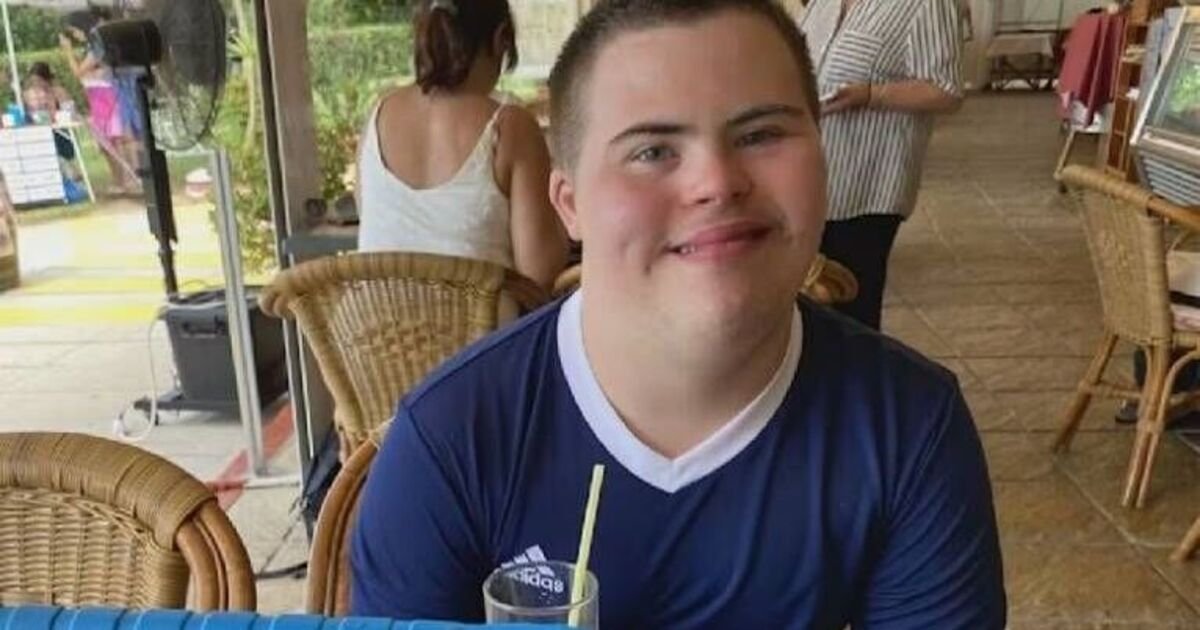

The family of a man with Down’s Syndrome who died after allegedly being left without food for nine days whilst in NHS care, have revealed details of their devastating ordeal.
Adrian Poulton, 56, was taken to Poole Hospital in Dorset in September 2021 after suffering a fall at his care facility that resulted in a fractured hip.
Throughout his hospital admission, medical staff allegedly mistakenly marked him as “nil by mouth”, which meant he received no nourishment for nine days.
Mr Poulton tragically passed away on September 28, 2021, merely two weeks following his admission.
“Not being medical, we just naturally thought he was having nutrition, a feed,” his father, Derek Poulton, told ITV News.
“But as it turns out, they were starving him.”
By the time Mr Poulton’s relatives discovered this error, he was already too ill to make a recovery, the Mirror reports.
Lesley Bungay, his sister, said: “We were just so worried. He was really poorly. He did look at me and dad… he said to me, ‘Lesley, I don’t want to die’. He knew he was going to die. It was just awful.”
An internal hospital inquiry verified that insufficient nutrition played a role in Mr Poulton’s death.
The report suggested enhanced training throughout the Trust regarding specialist care for patients with learning disabilities. Dr Peter Wilson, Chief Medical Officer at University Hospitals Dorset, expressed his regret to ITV News: “We offer our sincere condolences once again to [Mr Poulton’s] family and have apologised for the failings that resulted in his death. At the time, we undertook a serious incident investigation to identify any learning points. We have implemented a number of changes following this and have shared these with the family.”
A review funded by the NHS, titled Learning from Lives and Deaths and published in September 2025, disclosed that adults with learning disabilities are dying nearly 20 years earlier than the general population on average – with almost 40 per cent of those deaths considered “avoidable”. In 2023, common causes of these avoidable deaths included influenza, pneumonia, digestive tract cancers and heart disease.
Jon Sparkes, chief executive of the learning disability charity Mencap, spoke to the BBC about the alarming statistics: “These stark new figures show people with a learning disability are dying a shocking 19.5 years younger than the general population,” he said. “People with a learning disability and their families deserve better. In this day and age, no one should die early because they don’t get the right treatment.”
Mencap is currently part of a coalition of 16 charities and campaigners who have sent an urgent letter to Health Secretary Wes Streeting, demanding immediate action to prevent the collapse of the Learning Disability Nursing workforce.
According to ITV News, a letter they have seen warns: “The profession is in crisis, and urgent intervention is needed to avoid imminent collapse.
“The Learning Disability nursing workforce has declined by 43% since records began in 2009,” the letter states. “If nothing changes, it is predicted by 2028 there will only be a tiny number of Learning Disability Nurses qualifying in England, with a pattern of reducing numbers in the other UK countries too.”
Adrian Poulton’s death isn’t the only one that has caused public outrage. Oliver McGowan, an 18 year old with autism and epilepsy, died in 2016 in an NHS hospital after he was given an anti-psychotic drug – despite medical records stating he had a known intolerance to it.
A subsequent review found a “general lack of understanding and acknowledgement of Oliver’s autism” among staff and concluded that his death was potentially avoidable.
His death led to the creation of the Oliver McGowan Mandatory Training programme – the government’s gold standard training initiative for health and social care workers in England, launched in 2022. However, according to ITV News, NHS England has so far failed to meet its own targets – with all but one region in England falling short of the goal to train 30 per cent of staff by 2025.
Health Secretary Wes Streeting expressed his shock at the unequal outcomes for learning disabled people in the country during a broadcast interview. He said: “It really is shocking the unequal outcomes that we see for learning disabled people in the country. Not just unequal access to care but shockingly lower life expectancy. That’s why we have committed to publish every single year the data about those patients and their care, so that we can hold ourselves to account and the public can hold us to account to improve their care.”
An NHS England spokesperson said: “The rollout of Oliver McGowan Mandatory Training on Learning Disability and Autism is one of the largest health and social care training programmes in history with more than three million staff starting the course. We’ve been working with local health systems across the NHS to develop a sustainable model so that more staff have this essential training including investing in better data collection so we can identify areas that haven’t met this target and to provide more support.”
