

- Round 1, No. 2 overall: David Bailey (EDGE, Texas Tech)
- Round 1, No. 16 overall: Kenyon Sadiq (TE, Oregon)
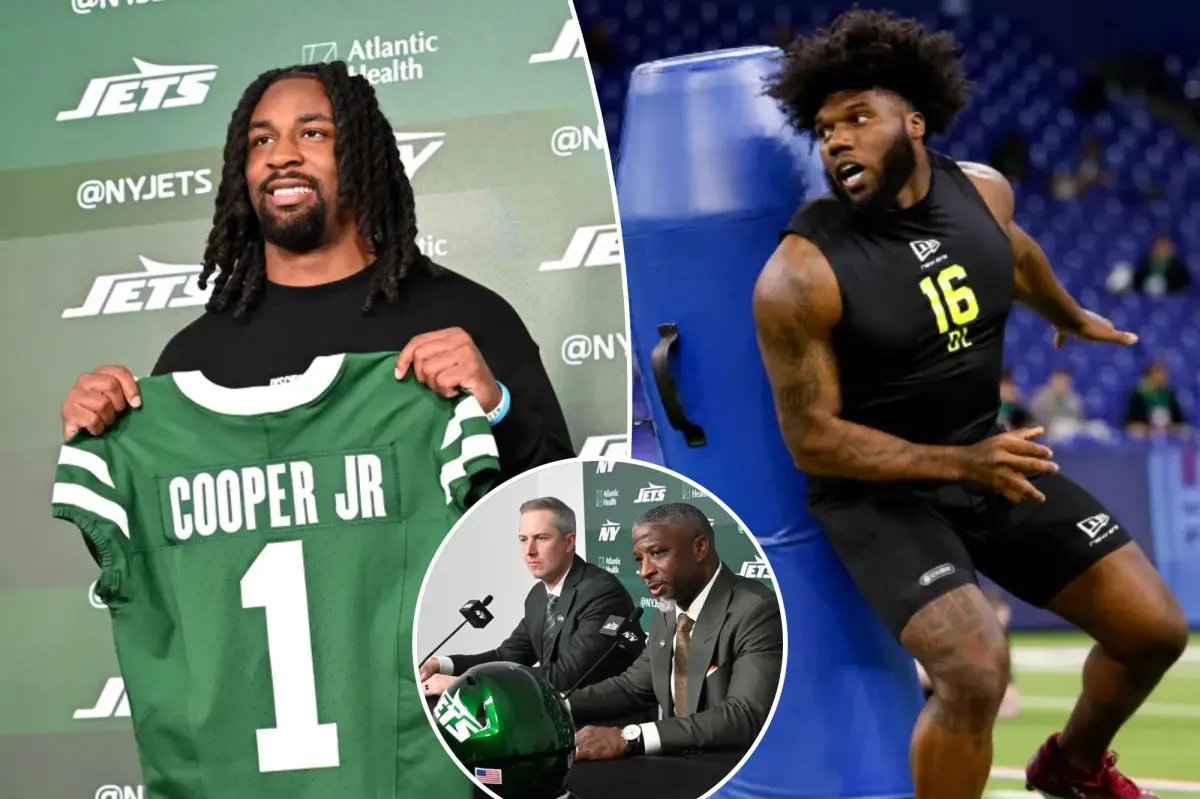
- Round 1, No. 30 overall: Omar Cooper Jr. (WR, Indiana)
- Round 2, No. 50 overall: D’Angelo Ponds (CB, Indiana)
- Round 4, 103 overall: Darrell Jackson Jr.(DT, Florida State)
- Round 4, 110 overall: Cade Klubnik (QB, Clemson)
- Round 6, 188 overall: Anez Cooper (OG, Miami)
- Round 7, 228 overall: VJ Payne (S, Kansas State)
The Jets finished the NFL Draft without acquiring a franchise quarterback.
No surprise there.
But the rest of the roster looks a lot better positioned for Geno Smith to find some success in the near future and to ease the transition for the quarterback that the Jets hope to find in 2027.
Here are The Post’s pick-by-pick grades for the Jets draft class:
Round 1, No. 2 overall: David Bailey (EDGE, Texas Tech)
If he can get double-digit sacks annually, it won’t matter that Bailey is suspect against the run. Especially because the effort is there, so maybe the technique can be coached.
Bailey is the best plug-and-play pure pass-rusher in the class, so the Jets ultimately played it safe and took him over high-upside Arvell Reese in a move from linebacker to edge.
Bailey’s first-step quickness is elite. He had 29 career sacks, including 14.5 with a FBS-best 20.4 pressure percentage last season.
Jets offensive coordinator Frank Reich is close to former NFL quarterback Andrew Luck, who is Stanford football’s general manager. Bailey spent three seasons at Stanford and earned a degree in science, technology and society.
The Jets opened themselves to criticism of the pick if it goes wrong by cancelling a pre-draft facility visit with Bailey. If he underachieves, is there something more that they could’ve learned from another point of contact?
Grade: A
Round 1, No. 16 overall: Kenyon Sadiq (TE, Oregon)
Good luck finding a single mock draft with this projection.
You won’t because the Jets used a second-round pick on tight end Mason Taylor in 2025. That doesn’t mean it’s not a good pick.
Sadiq is the ideal “move” tight end in a double-tight offense, offering speed, athleticism and a desire to knock a defender on his butt as a blocker. He can line up attached to the tackle or in the slot — and everything he does looks like a fastball.
The tape shows too many concentration drops, but even more holy-cow catches.
Sadiq is a historical outlier as the first receiver or tight end drafted in the first round since 2004 with fewer than 1,000 career receiving yards. But he ran the fastest 40-yard dash time by a tight end (4.39 seconds) since at least 2003 and should create mismatches.
Grade: A-
Round 1, No. 30 overall: Omar Cooper Jr. (WR, Indiana)
The Jets traded up three spots to make it a three-player first-round class just like in 2022.
The rugged and strong-handed Cooper has no problem working the middle of the field for a first-down catch or run blocking, and he is a nightmare to tackle after the catch.
But he also delivered the biggest play of the college football season when he elevated to make a game-winning third-down catch and tapped his toes in the end zone against Penn State for the eventual undefeated national champions.
Between Sadiq and Cooper, the Jets’ two-man passing attack of Garrett Wilson and Breece Hall should finally have help. The Jets have scored the second-fewest points in the league since Wilson and Hall entered the NFL in 2022.
Cooper is just the fourth first-round receiver taken by the Jets in the last 30 years. Pencil him in as a starter with Wilson (third on that list).
Grade: A+
Round 2, No. 50 overall: D’Angelo Ponds (CB, Indiana)
If Ponds was taller than 5-foot-9, he likely would have been a first-round pick.
But part of what makes Ponds special is the underdog chip that he carries on his shoulder.
Ponds brings seven career interceptions (and 32 pass break-ups) to a defense that set a futile NFL record with zero last season. He also blocked two punts, committed just one penalty and is known as a sure-tackler.
There is no denying, however, that Ponds will be at a disadvantage on jump balls.
If anyone knows how to coach that kind of player, it should be Glenn. In fact, many media analysts compare Ponds and Glenn (three Pro Bowls) as players.
Grade: A-
Round 4, 103 overall: Darrell Jackson Jr.(DT, Florida State)
There’s an old saying: You can’t coach size.
Jackson is raw because he didn’t start playing football until his junior year of high school. But 6-foot-5, 315-pounders aren’t supposed to move as athletically as he does.
Jackson has the highlights, but needs to turn flashes into consistency. If you combine his frame with his workmanlike attitude in the run game, you get somebody who could make life easier for playmakers around him.
Just don’t expect many quarterback pressures.
Grade: A-
Round 4, 110 overall: Cade Klubnik (QB, Clemson)
It was expected that the Jets would take a Day 3 flier on a developmental quarterback to sit behind Geno Smith while waiting for a franchise answer next season.
It was a surprise that it came this early in the day… and a bigger surprise that it was Klubnik over others. He was projected as a late-round pick –—and the Jets traded up 18 spots for him.
The No. 2-ranked quarterback recruit in the 2022 class completed an ACC-best 290 passes in 2023 and threw for 36 touchdowns against just six interceptions in 2024. But his 2025 season was a regression.
Klubnik throws with touch and an easy motion, but he lacks some arm strength. Will he ever be more than a QB3?
Grade: C
Round 6, 188 overall: Anez Cooper (OG, Miami)
Cooper played more than 3,000 career snaps, cracking Miami’s starting lineup as a true freshman and never leaving. His strength is pass protection in tight quarters — not blocking in space.
The roster lacked interior offensive line depth and Cooper’s experience suggests he could be ready to win a physical hand-fight if called upon in a pinch as a rookie. That’s why the Jets traded a seventh-round pick to move up 11 spots when Cooper slipped past his fifth-round projection.
Grade: B
Round 7, 228 overall: VJ Payne (S, Kansas State)
It seems the Jets’ first four safeties are set in stone: Minkah Fitzpatrick, Andre Cisco, Dane Belton and Malachi Moore.
So, where does Payne fit? Who cares? He represents great value at that point.
Payne stifled several of the Big 12’s best tight ends over his 41 consecutive starts by matching their physicality — 6-foot-3 safeties don’t grow on trees — and knowing where he was supposed to be on every play.
The issue here is he doesn’t have extensive special-teams experience and that’s a seventh-round pick’s ticket onto the roster.
Grade: B+
Overall draft class grade: A
