
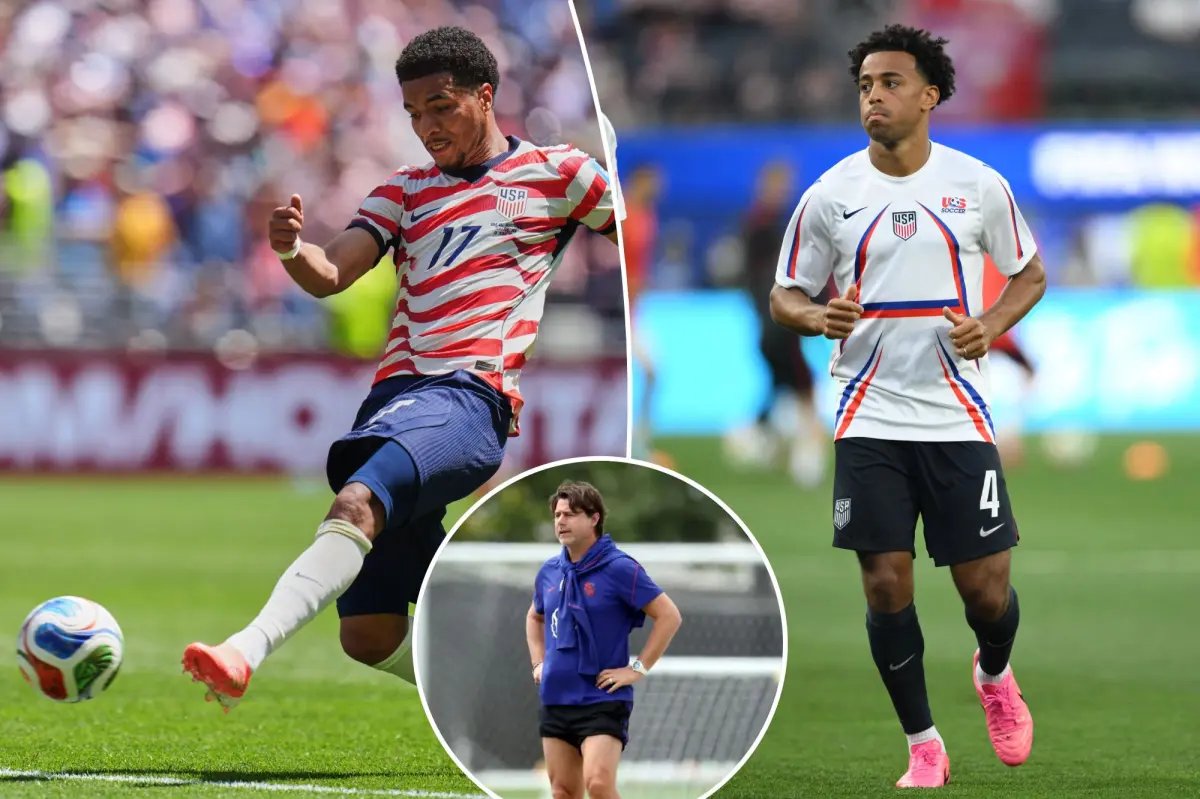


IRVINE, Calif. — Every World Cup contender has a pressure point. For some, it’s goalkeeping. For others, it’s a shaky back line or an inability to finish chances.
For the United States, it’s the midfield.
Not because the Americans lack talent. Quite the opposite. Tyler Adams, Weston McKennie and Malik Tillman form one of the strongest midfield trios the U.S. has ever taken into a World Cup. The problem is what happens if one of them disappears.
That’s where the foundation begins to crack.
Mauricio Pochettino entered the tournament by taking a gamble — Tanner Tessmann, who started most of the qualifying cycle alongside Adams in the midfield as a double pivot, was left off the roster.
Middlesbrough midfielder Aidan Morris and Atlético Madrid’s Johnny Cardoso were both told to stay home as well.
That left Adams as the lone true elite defensive midfielder on the roster.
Suddenly, one yellow card, one awkward tackle or one pulled hamstring threatens to become a tactical nightmare for the Americans.
That scenario was on display in Team USA’s 3-2 loss to Turkey. Yes, Pochettino rotated almost his entire starting lineup, but in doing so, he revealed something that was impossible to ignore. Strip away Adams, Tillman and Cristian Roldan and suddenly the U.S. looked vulnerable in the center of the pitch. Turkey’s speed exposed huge gaps. Possessions felt rushed and haphazard. Defensive transitions were chaotic.
Was it one bad night or a preview of what awaits the U.S. if injuries or suspensions strike during the knockout rounds?
Pochettino didn’t seem to have any regrets after leaving Tessman, Morris and Cardoso off the roster, but do Roldan’s injury and Gio Reyna’s inconsistency provide pause now?
Pochettino openly discussed asking McKennie or Tillman to drop deeper to help Adams dictate possession, believing that technical quality can outweigh defensive conservatism. It’s risky. It asks players to sacrifice the very qualities that make them so dangerous and forces them into roles they may not be comfortable or familiar with.
That’s the trade-off.
Thankfully, it’s a topic none of the players are losing any sleep over.
“I know just speaking to players in the squad, we have so many guys that can play in the middle of the field,” Adams said confidently.
“All these guys … they can play in the midfield as well. So we have flexibility.”
Maybe.
But versatility isn’t always the same as depth.
Every match of the FIFA World Cup will air on either FOX or FOX Sports 1. If you don’t have cable, you can take advantage of a DIRECTV free trial to stream it all.
Prefer to check out the action live and in person? Shop World Cup 2026 tickets on SeatGeek and make sure to use promo code NYPOST10 for $10 off purchases over $250 at checkout if you’re a first-time SeatGeek user.
Roldan’s quad injury only magnifies the concern. He did modified training on his own Monday during the team’s final session at its base camp here. Roldan suffered the injury following the victory over Australia on June 19 and hasn’t trained fully since.
Reyna has shown flashes but looked lackluster against Turkey.
“A few things have to be a little bit cleaner,” Reyna said of his performance. “Of course I wanted to play a little bit better, but I feel great. I’ll be ready to go and give it my all.”
Sebastian Berhalter, meanwhile, may have delivered the biggest silver lining against Turkey. He scored his first World Cup goal and added an assist. His performance may have given the U.S. another reliable option in the midfield.
“We know anyone can step at any given moment,” Berhalter said when asked if he could step into that role in the midfield if need be in the knockout rounds.
Berhalter played well, but asking him to become Plan A in a do-or-die elimination game would be unfair. He was able to earn more trust, but it doesn’t erase the concern that the USA’s midfield hopes in this tournament revolve around Adams.
Even if the Americans can survive against Bosnia-Herzegovina, their midfield could be tested against one of the greatest midfielders of all time in Belgium’s Kevin De Bruyne in the Round of 16.
Championship teams survive injuries because their depth can absorb the blow.
But right now, the U.S. midfield doesn’t have that luxury.
It’s balancing on a knife’s edge, and one wrong step could send their World Cup dreams crashing down.
