
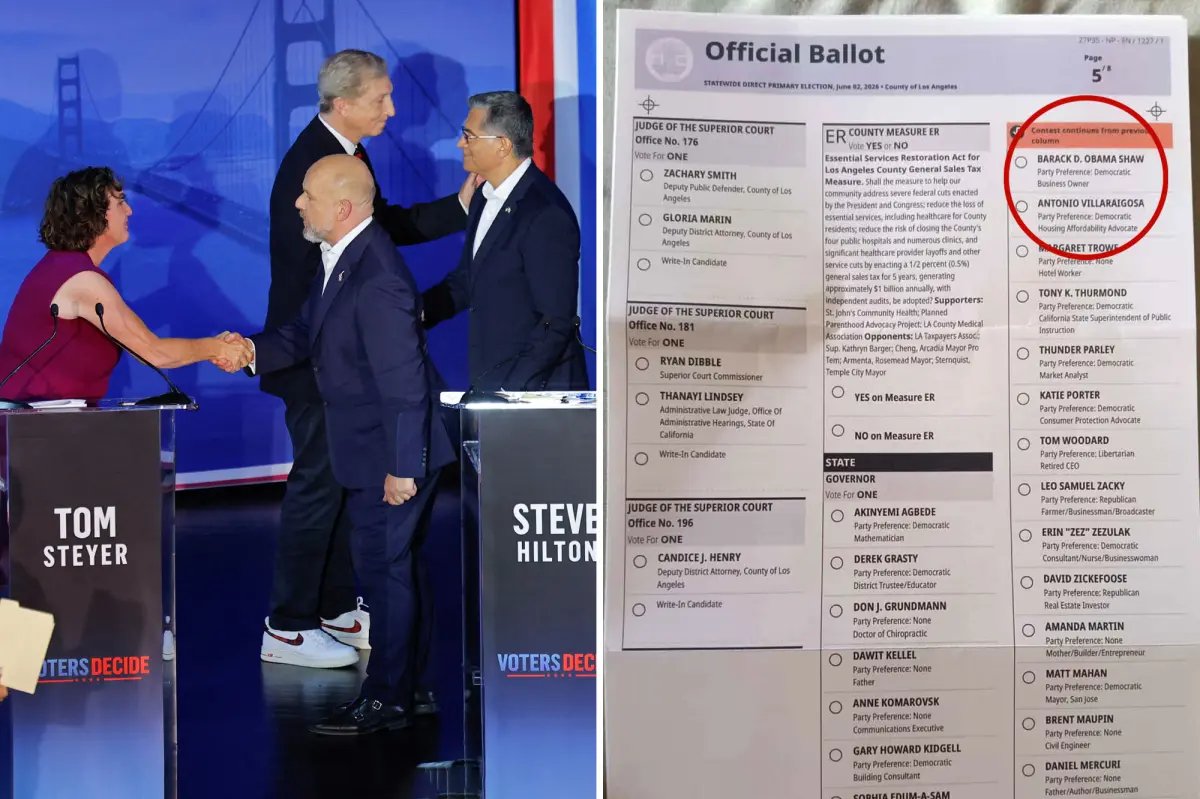


Mail-in ballots have arrived in homes across California — along with some confusion.
Xavier Becerra, Steve Hilton, Chad Bianco, Tom Steyer, and Katie Porter are among the names voters are familiar with as they consider who to advance to the November election.
But when voters open their ballots to mark their choices, the exhaustive list of 61 candidates running for governor may come as a surprise.
Yes — 61 candidates appear on the ballot, taking up two pages and five columns in the voter pamphlet.
“It’s unusually high. It’s an absurdly large number,” Eric McGhee, policy director and senior fellow at the Public Policy Institute of California, told the California Post. “It’s not great to have that many candidates on the ballot.”
On June 2, California’s jungle primary will be held, where the top two candidates — regardless of party — advance to the November runoff. Most reports have focused on only eight to ten candidates in the race.
Eric Swalwell, who faces sexual assault allegations, and Betty Yee have both dropped out of the race, but their names remain on the ballot because the deadline to remove candidates had already passed.
Outside of the politically motivated and poll-leading candidates who have managed to secure at least 3% in pre-election polling, there are dozens who have only garnered a few thousand supporters — and that is enough for them to qualify for the ballot.
“Basically, you just have to be willing to pay the money or gather a reasonably large number of signatures,” McGhee said.
While a candidate must be a U.S. citizen, a registered voter, and free of certain felony convictions, the process for qualifying for the ballot is not especially restrictive.
To qualify for the primary, a candidate must pay a filing fee of $4,918.58 — which is 2% of the first year’s salary — or, alternatively, submit 6,000 valid signatures in lieu of that fee by February 4, 2026.
However, even after paying the fee, all candidates (except write-ins) must still collect between 65 and 100 nomination signatures from registered California voters and file several formal documents.
“Courts have placed limits on the barriers to candidate filing, so the cost can’t be too exorbitant. But 60 candidates is a lot and places a burden on voters to find the candidates they’re looking for,” McGhee said, noting that in 2022 and 2018 — when Newsom ran — there were fewer than 25 candidates in each primary.
Some candidates on the ballot, while not well known, stand out due to their names.
For instance, “Barack D. Obama Shaw” immediately stands out due to the similar name to the 44th president of the United States.
Shaw describes himself as a “politician, musician and an international promoter of products and services that are the best in the world.”
“It’s great people who are running for governor. But if you don’t like those people, don’t vote for them. Vote for Barack D. Obama Shaw,” he says in one of his Instagram videos, where he has a following of around 300.
Similarly, another candidate whose name jumps out is “Livingforgod Andcountry Demott,” who appears to have a campaign website describing him as “a candidate of faith, integrity, and unwavering commitment to the people of California.”
He has shared photographic evidence confirming his legal name is LivingForGod.
“Living a life reflecting the good character of Jesus Christ — it is my foundation, my operating system, and compass.
As a chaplain, it is my opinion that any success built on the foundation of deceit and corruption is like building a castle on sand,” he said.
When running for governor in California, the name provided on the Declaration of Candidacy is exactly what appears on the ballot. While candidates cannot use random aliases, the law allows flexibility such as initials, common name variations like “Bill” for William, or nicknames in quotation marks, as long as they are paired with a registered last name.
However, there are strict prohibitions against including professional titles or academic degrees like “Dr.” or “Esq.,” and candidates cannot use a name changed within one year of the election unless that change resulted from marriage or a court decree.
McGhee said he hasn’t “encountered this particular issue before,” but is confident about the confusion it could create for voters.
“It makes it much harder for people to actually find the candidates they want to choose,” he said.
Candidate names do not appear in A–Z alphabetical order, but instead are listed using a randomized alphabet under California law, according to McGhee.
On the 82nd day before an election, the Secretary of State draws a randomized alphabet to determine the order of candidates’ names on the ballot.
For example, if two candidates are named Anderson and Brown, whichever last-name letter (A or B) appears first in the randomized alphabet determines who is listed first. If two candidates share the same first letter — like Adams and Allen — the second letter is used.
“Beyond the volume, there’s the added confusion of the randomized alphabet,” McGhee added. “Sixty candidates is a lot and places a burden on voters to find the candidates they’re looking for.”
California also mandates that, along with names and party affiliation, a candidate’s occupation must appear on the ballot.
For now, all 61 candidates are eligible to qualify for the general election despite not being “notable” candidates.
“To be a notable candidate, you usually need significant fundraising — or your own money, in a case like Tom Steyer — to gain visibility. You need connections to the political world so other leaders amplify your candidacy and the media covers you,” McGhee said.
“All of those things are about getting attention, which is a much higher bar than simply getting your name on the ballot,” he added.
See full list of names on ballot below:
- Akinyemi Agbede: Democratic | Mathematician
- Derek Grasty: Democratic | District Trustee/Educator
- Don J. Grundmann: No Party Preference | Doctor of Chiropractic
- Dawit Kellel: No Party Preference | Father
- Anne Komarovsk: No Party Preference | Communications Executive
- Gary Howard Kidgell: Democratic | Building Consultant
- Sophia Edum-a-Sam: Democratic | Project Manager
- Mauro Alberto Orozco: No Party Preference | Small Business Owner
- Barack D. Obama Shaw: Democratic | Business Owner
- Antonio Villaraigosa: Democratic | Housing Affordability Advocate
- Margaret Trowe: No Party Preference | Hotel Worker
- Tony K. Thurmond: Democratic | California State Superintendent of Public Instruction
- Thunder Parley: Democratic | Market Analyst
- Katie Porter: Democratic | Consumer Protection Advocate
- Tom Woodard: Libertarian | Retired CEO
- Leo Samuel Zacky: Republican | Farmer/Businessman/Broadcaster
- Erin “Zez” Zezulak: Democratic | Consultant/Nurse/Businesswoman
- David Zickefoose: Republican | Real Estate Investor
- Amanda Martin: No Party Preference | Mother/Builder/Entrepreneur
- Matt Mahan: Democratic | Mayor, San Jose
- Brent Maupin: No Party Preference | Civil Engineer
- Daniel Mercuri: No Party Preference | Father/Author/Businessman
- Betty T. Yee: Democratic | Family Care Navigator
- Nancy D. Young: No Party Preference | CEO/Businesswoman/Pastor
- Alicia Olivia Lapp: Republican | (No Ballot Designation)
- Matthew Chase Levy: Democratic | Entrepreneur/Physicist
- Duane Terrence Loynes Jr.: No Party Preference | (No Ballot Designation)
- Randeep S. Dhillon: Republican | Economist/Farmer/Businessman
- Livingforgod Andcountry Demott: No Party Preference | Logistical Professional/Chaplain
- Patricia De Luca Basualdo: Republican | Real Estate Broker
- Louis A. De Barraicua: Democratic | Teacher/Business Owner
- Raji Rab: Democratic | Aviator/Educator/Entrepreneur
- Satish Rao: Democratic | Professor
- Ramsey Robinson: Peace and Freedom | School Social Worker
- Lewis Herms: No Party Preference | (No Ballot Designation)
- Rafael M. Hernandez: Republican | Businessman/Songwriter/Author
- Jon Henderson: No Party Preference | Business Owner
- Steve Hilton: Republican | Small Business Owner
- Naomi Bar-Lev: No Party Preference | Musician/Proprietor/Writer
- Xavier Becerra: Democratic | Voting Rights Attorney
- Carolina Buhler: Democratic | Civil Rights Advocate
- Chad Bianco: Republican | Riverside County Sheriff
- Joseph Cabrera: No Party Preference | Business Administrator
- Elaine Culotti: No Party Preference | Entrepreneur/Farmer/Developer
- Joel E. Jacob: Democratic | Business Owner/Entrepreneur
- Max Fomin: No Party Preference | Business Owner/Father
- Lukasz Adam Filinski: No Party Preference | Father
- Serge Fiankan: No Party Preference | Real Estate Broker
- Leo Naranjo IV: Republican | Retired Military Sergeant
- Tim Nelson: Republican | Diplomat/Rights Advocate
- Tom Steyer: Democratic | Climate Advocate
- Eric Swalwell: Democratic | U.S. Representative
- Scott P Shields: Democratic | Chief Executive Officer
- Frederic C. Schultz: No Party Preference | Human Rights Attorney
- Christine R. Sarmiento: No Party Preference | Public Health Nurse
- Reza Safarnejad: No Party Preference | Small Business Owner
- Sam Sandak: No Party Preference | Filmmaker
- Gretha Solórzano: Republican | Retired Nuclear Engineer
- James Athans Jr.: Republican | Real Estate Agent
- Larry Azevedo: Democratic | Businessman
- Mohammad Arif: Democratic | Immigrants Organizer
