


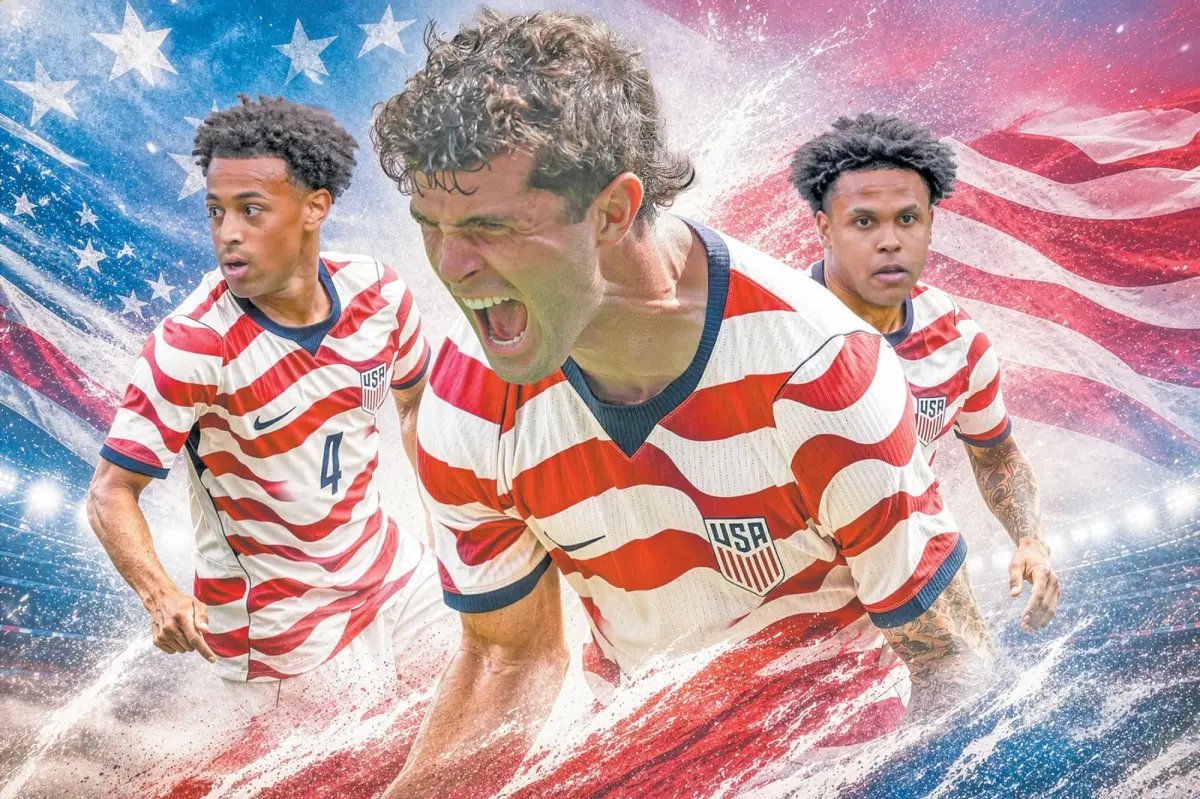

Tyler Adams was standing in the bowels of Soldier Field, six days away from a World Cup that will be the most important competition of his career, talking about the moment when the story of this U.S. men’s national team began.
Still a month away from his national team debut, he watched it on the couch with his stepdad, Daryl Sullivan.
Trinidad and Tobago 2, USA 1.
At some point, he said, Sullivan turned to him. “You could help this team,” Sullivan told him.
Adams was 18 years old, starring for the New York Red Bulls, still a few months away from moving to Germany to play for RB Leipzig. A 19-year-old Christian Pulisic scored the only U.S. goal that night and cried on the field when the devastating result confirmed that the USMNT would miss the 2018 World Cup in Russia, failing to qualify for the first time since 1986.
“I was knocking on the door, I feel like, for my first call-up at that point,” Adams said. “Maybe if they would’ve qualified, I would’ve gone to that World Cup. Obviously we didn’t qualify, and I got my foot in the door right after that.”
A month later, Adams and Weston McKennie made their national team debuts on the same night in a 1-1 draw against Portugal. The next time Pulisic was in the squad, a friendly against Bolivia in May 2018, the starting 11 included McKennie, Timothy Weah, Antonee Robinson and Josh Sargent. The process of hiring a new coach — Bruce Arena had been fired over the failure to qualify — included identifying talent that was 15-17 years old at the time and would be in their primes in 2026, when it was confirmed over that summer that the United States, Canada and Mexico would be co-hosting the World Cup.
“That was the core group of guys,” Gregg Berhalter, who got the job and managed the U.S. through the last World Cup cycle, told The Post. “It was Christian, Weston, Tyler. Timmy Weah was one of them. Sergiño [Dest] was a guy that was starting to be talked about. [Joe] Scally was a guy. Mark McKenzie, another one. Brenden Aaronson was another one. Some of these young talents that were starting to emerge were certainly thought of as: ’26 could be their prime.”
The intersection of the national team’s most talented generation of players in history with the world’s biggest sporting event coming to the U.S. when most were in their prime meant that the eight years in between would be constantly framed with this summer as the end goal.
Now it’s here.
Though there’s no set list of players who make up the golden generation — as recently as the 2022 World Cup, Sargent and Yunus Musah would have been included; since then, players such as Folarin Balogun and Chris Richards have emerged as crucial pieces — Adams, McKennie and Pulisic (all of whom are now 27) are the common denominators who have helped bring the USMNT to this juncture.
“I just feel super ready at this moment,” Adams said. “I’ve been prepared for it. I feel like nothing really fazes me at this moment in time, which is a great thing, and I’m super passionate about representing it.”
The goal for this team is not as simple as making a certain round, though everyone on the outside seems to have coalesced around the idea that a quarterfinal — a benchmark the USMNT hasn’t reached since 2002 — would be a success.
Rather, the journey that started eight years ago, and which begins to reach its climax Friday night when the U.S. faces Paraguay at SoFi Stadium, has a more existential purpose.
“We all have that responsibility to do our best in our roles,” goalkeeper Matt Turner said. “To ultimately change soccer here forever.”
At the halfway point, the USMNT looked on track.
Going into the 2022 World Cup, the Americans had reestablished themselves in North America’s hierarchy, winning the Nations League and making right on its disastrous 2018 qualifying campaign by getting through to Qatar.
Thanks to Pulisic’s heroic effort to score on a play that put him in the hospital and a nerve-racking defensive performance to beat Iran in a geopolitically charged environment in Doha, the USMNT advanced out of its group. They lost in the round of 16 to the Netherlands, but the Americans left with a sense of accomplishment.
They had brought the youngest team in the tournament and made the knockout stage. And there were American players dotted across Europe, with more and more playing in the UEFA Champions League every year.
“The near future was the World Cup in ’22 and wanting to perform there as well,” said Earnie Stewart, U.S. Soccer’s sporting director from 2019-23. “But also, realizing that four years later, it’s gonna be in your own country once again, and these guys being at their peak when they’re 27 years old, you have the experience, you’re at the peak of your performance mode at that time, that piece is really, really good.”
It wasn’t until after the tournament that cracks started to show. A massive scandal exploded with the revelation that Gio Reyna’s mother, Danielle, had told U.S. Soccer about a 1991 incident in which Berhalter kicked his future wife, Rosalind — seemingly disclosing the incident in response to Gio’s limited playing time at the World Cup.
Berhalter eventually was given a new contract by U.S. Soccer after an internal investigation, only to be let go after the 2024 Copa America ended with a calamitous group-stage exit. The federation replaced Berhalter with Mauricio Pochettino, a splashy hire with a history of success managing club teams in Europe, but the 54-year-old Argentine had less than two years to impose his tactics and culture on a group that, in his mind, needed a slap in the face.
“We started to fight,” Pochettino said, “against a very relaxed place.”
Right after Pochettino was hired, Pulisic told reporters he hoped the manager was “someone that’s going to come in and really change the culture around here.” The face of the program, though, was made an example of last summer when he asked to come in for two friendlies and then skip the Gold Cup — a request Pochettino refused.
The manager’s point — one he’s driven home again and again across his tenure — was that representing the national team is something that players in the world’s best soccer nations would crawl over broken glass to do. For American players to prioritize something else, Pochettino thought, was exactly why the culture needed to change.
“I am the head coach,” Pochettino said in a press conference at the time. “I am not a mannequin.”
It was at that Gold Cup, in which the Americans lost to Mexico in the final, where Pochettino’s culture started to take hold. In the September window, a switch to a 3-4-2-1 formation that resulted in a 2-0 win over Japan looked like the next step.
Pochettino was still mining the pool for talent in each window, insisting that no spot was guaranteed, an approach that resulted in players such as Alex Freeman, Sebastian Berhalter and Matt Freese emerging as key parts of this World Cup roster, but at the cost of limited time with his best possible group. Nevertheless, an identity was emerging.
Every match of the FIFA World Cup will air on either FOX or FOX Sports 1. If you don’t have cable, you can take advantage of a DIRECTV free trial to stream it all.
Prefer to check out the action live and in person? Shop World Cup 2026 tickets on SeatGeek and make sure to use promo code NYPOST10 for $10 off purchases over $250 at checkout if you’re a first-time SeatGeek user.
“You play with the intensity, but with the fluidity and flexibility you have to think,” said Tim Ream, the group’s elder statesman at age 38 and its captain at this World Cup. “You have to use your brain. And it was tough, I think, in those early moments to use your brain while physically you were killing yourself because you wanted to be a part of the group that is physically able to do it.
“And now you’re seeing guys who are physically in top, top condition and able to do it. And they don’t have to think about the movements. It just becomes automatic.”
So what’s the status of a roster that has had more money, emotion and energy invested into it than any in American history?
At the club level, the golden generation has more or less lived up to its billing. Fifteen years ago, there were only a handful of Americans in Europe’s top leagues. The majority of the 26-man roster Pochettino brought to this World Cup plays club football on the continent, and has seen success there.
At the international level, it’s murkier. A loss to Germany in the final pre-World Cup tuneup left the USMNT without a victory over a European opponent under Pochettino, and knowing that its first time in a knockout-stage game against truly elite opposition at the World Cup will need to be its first win under such circumstances.
Twelve players on this team made their USMNT debuts between 2016 and 2020, and that is — mostly — the group on whose shoulders success will rest over the next month. They’ve grown up together in the national team.
“Honestly, it feels like a family,” Pulisic said. “We’re always hanging out. Doing things and just hanging out as a group. I feel like no one’s really on the outskirts. It’s a really enjoyable group to be around. I really like coming back into camp. It feels great going into this tournament.”
They’ll never have a better chance than this.
“We had great moments that everybody had great trust and belief again, because we were winning,” Dest said. “Sometimes we lost against better opponents, so I feel like it’s been ups and downs. But in the end, this is what matters.
“If we have a great run this tournament, I think everybody will forget about the process before.”