


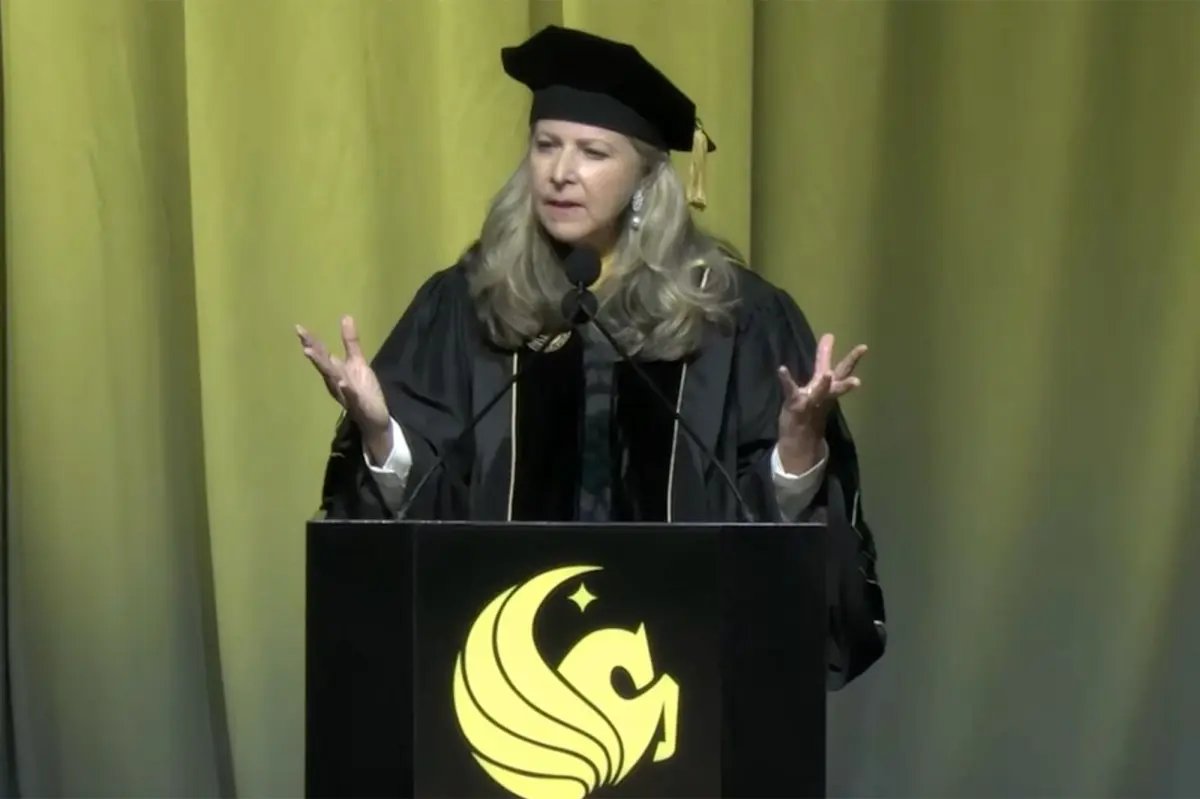

A Florida real estate bigwig faced mockery and boos for proclaiming “artificial intelligence is the next industrial revolution” during her commencement speech at the University of Central Florida last week.
Gloria Caulfield, the Vice President of Strategic Alliances at Orlando-based Tavistock Development Company, made the highly ridiculed remark in front of communication and media graduates at the university’s Addition Financial Arena Friday night.
“The rise of artificial intelligence is the next industrial revolution,” Caulfield said as a loud chorus of boos rained down on her.
Caulfield was left confounded by the crowd’s response and backed from the podium to ask other educators on stage, “What happened?
“Ok, I struck a chord. May I finish?” Caulfield asked the crowd as murmurs continued to fill the arena.
In her speech, Caulfield shared some of the lessons she had learned during her professional career and found that most successful leaders don’t worry about disruption while “embracing innovation,” including the relatively new expansion into the “AI realm.”
She name-dropped several big moguls, including Amazon founder Jeff Bezos, Presidents George W. Bush and Bill Clinton, and Lakers legend-turned-businessman Magic Johnson, as “dreamers” with passion and large goals that came to fruition.
“We are living in a time of profound change. That’s an understatement, right? Profound change. Change is exciting. Very exciting. And let’s face it, change can be daunting,” she said, leading up to her hotly contested statement.
The speaker regained control of the crowd and returned to her prewritten speech, if only for a second.
“Only a few years ago, AI was not a factor in our lives,” she said to a resounding applause and cheering.
“OK, alright, we’ve got a bipolar topic here, I see,” Caulfield joked before losing half the crowd again.
“And now AI capabilities are in the palm of our hands,” she added to a mixture of boos and applause.
“Oh, I love it, Caulfield said through her laughing. “Passion. Let’s go.”
Caulfield, a former healthcare executive, continued her speech describing the major “industrial revolution” she had seen in her lifetime with the invention of the internet, email and the dramatic change of the cellphone since they were first launched.
“I know it sounds amusing, but at the time we had no idea how any of these technologies would impact the world and our lives,” Caulfield said.
“These were some of the same trepidations and concerns we are now facing. But ultimately, it was a game-changer for global economic development and the proliferation of new businesses that never existed,” she added.
As she rounded up her speech, Caulfield shared her belief that artificial intelligence is capable of being a great tool for the world if properly controlled.
“Being an optimist here, AI alongside human intelligence has the potential to help us solve some of humanity’s biggest problems,” she said. “Many of you in this graduating class will play a role in making this happen.”
Caulfield’s AI remarks, which took up three minutes of the 11-minute speech, left a sour taste in the mouths of the graduates in attendance, as they started searching for jobs in the expanding world of artificial intelligence.
“To stand in front of a graduating class of artists and communicators and discuss Jeff Bezos and Howard Schultz, is to spit on our efforts to flip the script,” Nicholson School of Communication and Media graduate Houda Eletr told the Orlando Weekly. “I’m embarrassed to have had to endure the most embarrassing, unskippable, tone-deaf, ad-like commencement. Boo to AI and boo to your agenda.”
“It will not be the rise of AI that is the next Industrial Revolution; it will be the boo-ers who refuse to take a check from the top 1% to present an empty agenda. It will be humans for humans,” Eletr added.