


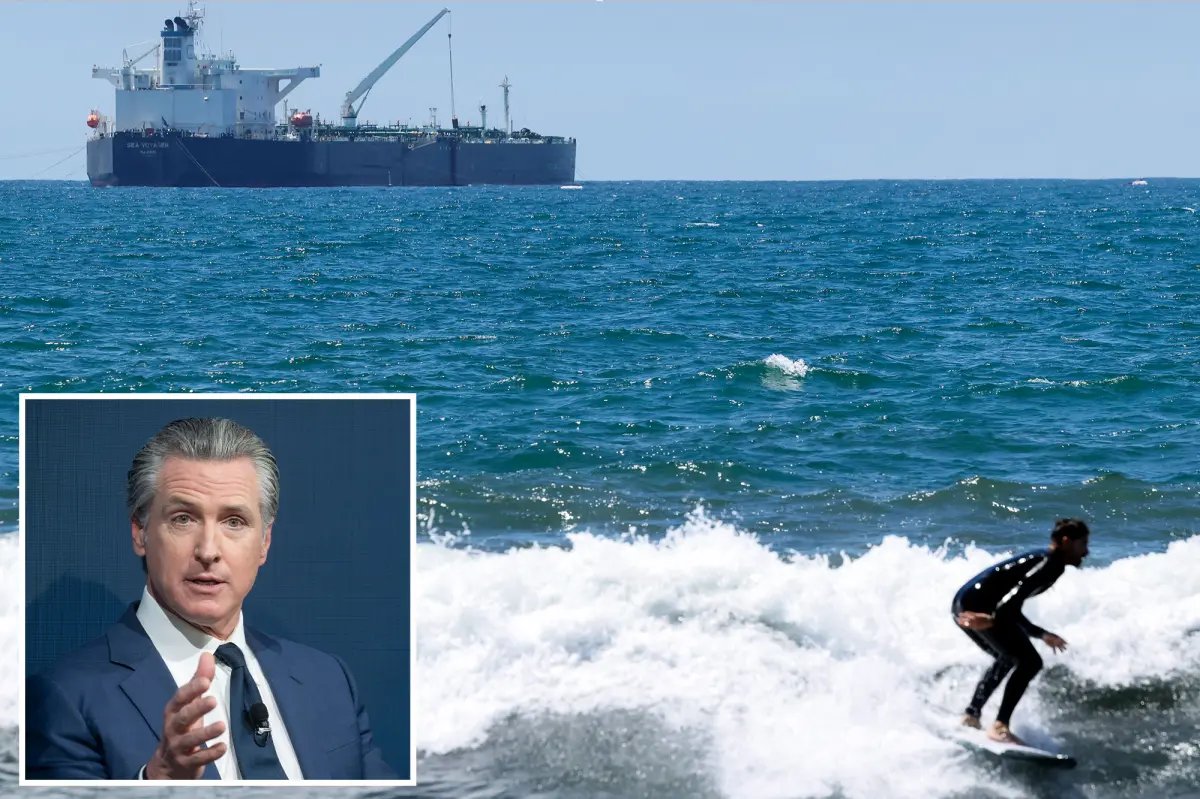

California’s summer travel season is facing mounting uncertainty as a global oil crunch and shrinking jet fuel reserves threaten to disrupt flights, drive up prices and complicate plans for millions of travelers.
“People don’t know exactly how this is going to escalate,” Mike Duignan, a hospitality expert and professor at Paris 1 Panthéon-Sorbonne University, told the Los Angeles Times.
“There’s a huge black cloud over the sea for the World Cup and the travel slump that we’re seeing is all linked to this oil shortage.”
The warning comes as the state’s jet fuel supply has dropped to its lowest level in more than two years.
“Current production and inventory levels of jet fuel are within historical ranges,” a spokesperson for the California Energy Commission said. “Although supply is tight, no structural deficit has emerged yet.”
California’s in-state oil production peaked in the mid-1980s, specifically around 1985 at approximately 424 million barrels annually.
Since then, production has experienced a long-term, steady decline, with current production falling significantly to about 285,000 barrels per day.
In 2025, more than 61% of the state’s crude oil came from foreign sources. At the same time, refinery shutdowns by Phillips 66 and Valero have wiped out roughly 17% to 20% of California’s gasoline production capacity.
“It’s real terrible timing for California to see the loss of two refineries at a time when Asia is struggling with oil supplies of its own,” Patrick De Haan, a petroleum analyst told Fortune.
The shrinking refining capacity is hitting jet fuel the hardest, as it is typically the first product affected when output declines.
As supplies tighten, airlines are already scaling back operations and adjusting prices.
“Jet fuel prices have doubled since the start of the Iran conflict, affecting some lower profitability routes and flights which now are no longer economically feasible,” Air Canada said in a statement.
The airline has suspended all service to New York (JFK) from Toronto and Montreal from June 1 through October 25, 2026.
Other carriers have also begun cutting routes, scaling back flight schedules, and increasing fares.
Lufthansa is reportedly leading with about 20,000 summer flight cancellations to conserve fuel, while Norse Atlantic has fully withdrawn from Los Angeles, dropping all summer Europe routes.
Domestically, Delta is trimming at least eight regional routes — including Detroit–Sacramento and JFK–Memphis — as jet fuel prices near $15 per gallon at LAX make many non-hub flights unprofitable. Smaller California airports are already seeing reductions, with larger hubs potentially next.
“It’s not so much gasoline supply on the West Coast that I’d be worried about yet, but it’s jet fuel,” De Haan said, noting that more cancellations could be on the horizon as airlines attempt to conserve fuel.
The timing is especially challenging.
The summer travel season is one of the busiest times of the year, and Los Angeles, is set to host a significant share of visitors for the 2026 World Cup beginning in June.
Los Angeles International Airport is consistently ranked among the world’s busiest, handling over 76 million passengers in 2024. With this in mind, any disruption to flight availability or pricing could ripple across tourism, hospitality, and related industries.
Beyond aviation, the fuel crunch could have wider economic consequences.
Diesel, which is essential for trucking and shipping, is often impacted after jet fuel during supply shortages. That could lead to higher costs for goods and services across the region.
Gas prices are currently around $6, roughly $2 above the national average, while diesel is nearly $7.50 per gallon, compared to about $5 per gallon a year ago, according to AAA.
Underlying these immediate concerns are longer-term structural issues.
California’s in-state oil production has been declining for decades, while regulatory hurdles and high operating costs have made it difficult to sustain refining infrastructure. As a result, the state now relies heavily on foreign imports to meet its energy needs.
“California’s had issues prior to the war,” Jesus David, senior vice president of Energy at IIR Energy, told the Los Angeles paper. “Nothing new has been built over the past 30 years, and California has closed a lot of capacity.”
Efforts are underway to improve the situation, including proposed pipeline projects that would connect California more directly to domestic fuel supplies. However, those solutions are years away from completion, leaving the state exposed in the near term.
The ongoing war between the United States/Israel and Iran has led to a near-total blockade of the Strait of Hormuz, causing severe disruption to global oil supplies and triggering significant market volatility.
In the meantime, policymakers have taken steps to ease logistical constraints, allowing more fuel shipments from other parts of the country. But experts say those measures offer only limited relief if global supply disruptions persist.
If oil flows remain restricted and demand continues to climb, California could face sustained pressure throughout the summer — and possibly beyond.
For travelers, that uncertainty may translate into higher ticket prices, fewer options, and last-minute changes. And with the calendar inching closer to peak travel season, the window to avoid significant disruption is narrowing.
“Fuel price is more susceptible to supply weakness on the West Coast than anywhere else in the country,” United Airlines chief executive Scott Kirby said.
As one analyst put it, the problem isn’t just the current shortage — it’s how quickly conditions could deteriorate if the global supply chain tightens further.
“If we don’t have some concrete [peace] deal here in the next three weeks, then I’m really nervous for the West Coast this summer in terms of jet fuel,” De Haan told Fortune. “That’s not going to be great for California’s economy.”