
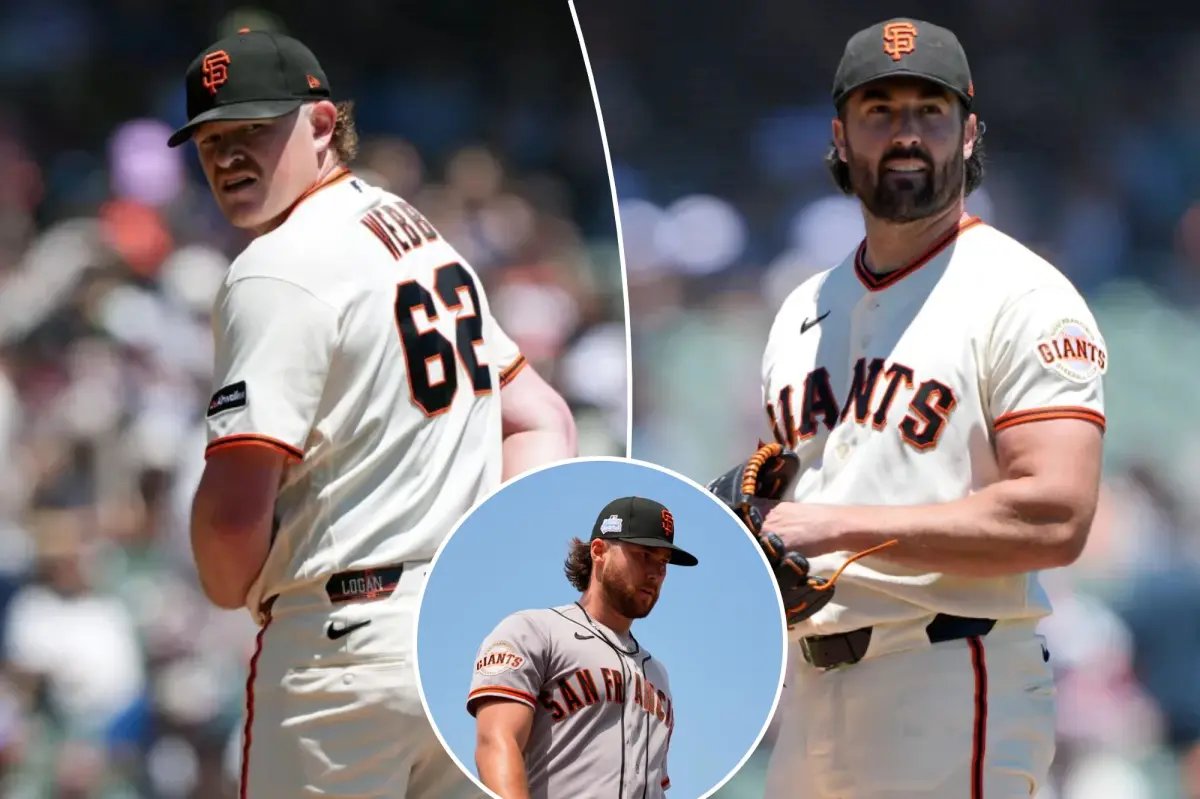


MIAMI — The run Logan Webb is on is like nothing seen by a Giants pitcher, at least since Madison Bumgarner or Matt Cain.
Those are the last two San Francisco starters to string together three straight starts of eight or more innings, and neither quite matched Webb’s dominance of late: Three earned runs in his past 31 innings, a 0.87 ERA.
The explanation for Webb’s ascension into another dimension?
Himself, in a way.
The Giants’ ace began calling his own pitches — most of them, anyway — in his second start back from the injured list, flirting with a perfect game in seven one-hit innings in Milwaukee.
“I didn’t throw the best until then. I just came back and [thought] I’ve done it before, I haven’t thrown to these guys a lot,” Webb said. “I mean I was with [Patrick Bailey] for a long period of time. There’s a trust factor in those sorts of things.”
It worked out so well that Webb has continued the practice, trusting himself over two new catchers to keep batters guessing.
As the Giants’ new catching tandem — Daniel Susac and Eric Haase — tries to catch up to the institutional knowledge that was sent packing when Bailey, a two-time Gold Glove winner, was traded to Cleveland, the rest of the staff has started to follow in Webb’s footsteps.
“It’s definitely a learning process for all of us, so we’re encouraging our guys to maybe call their own games,” pitching coach Justin Meccage told The California Post. “You saw Robbie [Ray] do it a little bit in Atlanta. [Landen] Roupp did it a little bit.”
And so did Trevor McDonald, albeit with less favorable results.
It’s something Adrian Houser wishes he would have experimented with before he was demoted to the bullpen this weekend. He told The Post that it’s been more difficult to get on the same page with the Giants’ catchers than any of the backstops he worked with last season.
“I don’t think we’re doing a very good job of pitch sequencing right now or setting up good pitches,” Houser said. “We’re kind of falling into holes, falling into traps that hitters are setting up versus pitching how I should be pitching and attacking guys how I should be attacking guys.”
Clearly, the seismic move to trade the light-hitting defensive whiz just six weeks into the regular season sent ripple effects through the organization that are still being felt more than a month later.
Bailey, for what it’s worth, has not hit any better with the Guardians. And some defensive metrics have rated Susac about as favorably for his arm and pitch-framing.
Bailey’s game-calling also wasn’t flawless. For example, when he called for sinkers on 20 of Ryan Walker’s 21 pitches in the first of two eventual walkoff losses to the Phillies on April 30.
But trading the catcher who spent all of spring training working with a pitching staff that expected to throw to him for the majority of the regular season has been “a challenge,” Meccage acknowledged.
Look no further than their catchers’ ERAs.
With Bailey, the Giants’ staff posted a 3.63 ERA in 238 ⅓ innings. With his replacements, including Jesus Rodriguez, their ERA has been more than a full point higher: 4.91.
“Anytime you look at something that stands out, you want it to be the sole ‘Aha’ reason, but there are a lot of variables involved,” manager Tony Vitello said, for example, pitching differently with a large lead. “But there’s some truth to things too.”
That said, Vitello added, “I think at this point it would only be an excuse if you said there was lack of familiarity.” Meccage, however, acknowledged the roadblock presented by replacing Bailey with a rookie and a backup who only plays sparingly and doesn’t catch the same pitchers consistently.
“The youth, the inexperience just by itself it a lot,” he said. “I really think it’s easier for the pitcher [to call his own pitches] when you’re talking about a young catcher. … Haase has obviously been here so he kind of understands it. But he only catches once every three or four days.”
Haase, whose catcher’s ERA is a staggering 6.57, agreed with Meccage that himself and Susac have “been going through it a little bit” in terms of getting up to speed with the pitching staff.
“Just trying to get on the same page,” he said. “The reality is Patty’s not here anymore and it’s on us to do it. So there might be a little lag, it might take a little bit of time to have the same kind of handle on the staff that Patty did, especially with just the respect that he had.”
Both catchers agreed: They don’t care where the call comes from. When it’s the pitcher pressing the PitchCom button, that means they’re going to throw the selection with conviction.
In Ray’s case, he had more confidence in his new two-seamer than his catchers.
Those were the only pitches he called himself, he said. Similarly, Roupp “did it like four pitches the entire game,” according to Susac. McDonald called his own for the first inning or two of his last start but switched back, preferring not to worry about using the device on his belt loop.
“Outside of Webby,” Susac said, “it’s pretty much like, if I’m gonna shake, here’s the next pitch. … It’s typically their best offspeed or it’s like a heater to their strength side. It’s usually, say, late in the count and it could go either way. It’s just usually they’re guessing the other one.”
Ultimately, it’s a good sign the catchers aren’t so stubborn that they refused to relinquish their traditional duties. They see it as an opportunity to learn their pitchers’ preferences better.
The issue is that it’s not spring training anymore; the season is almost halfway over and this $200 million roster has already played itself out of playoff contention.
“It took Patty about five or six games for me to trust him,” Webb said. “I think it’ll get better each time. … Hopefully, in a start or two, I’m not having to call my own pitches.”
