


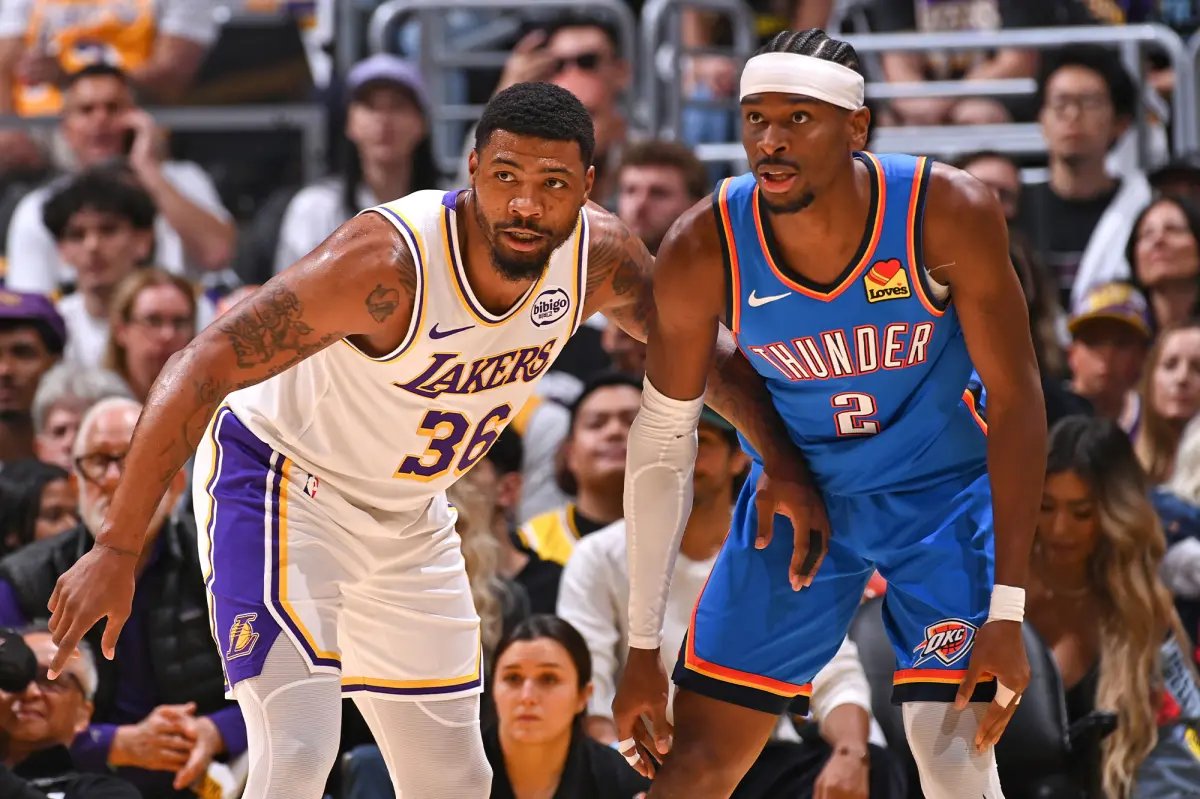

The Lakers made it clear from the beginning of their second-round playoff series against the Thunder what they would be willing to live with.
What they weren’t willing to live with: Thunder superstar Shai Gilgeous-Alexander going 1-on-1.
Which led to automatic double teams in the first two games of the series in Oklahoma City, getting the ball out of Gilgeous-Alexander’s hands and forcing the other Thunder players to beat them.
The problem for the Lakers: The Thunder’s “others” did beat them.
And even in Game 3, with the Lakers being less aggressive with their defensive coverages against Gilgeous-Alexander on Saturday night at Crypto.com Arena, it was still the non-Gilgeous-Alexander Thunder players who stepped up in the Thunder’s 23-point win.
Chet Holmgren, the Thunder’s leading scorer for the series, was a difference-maker. Second-year guard Ajay Mitchell continued his breakout season, recording playoff career highs of 24 points and 10 assists in the Game 3 victory. Instead of it being Jared McCain like it was in the first two games, Isaiah Joe was the Thunder guard who packed the scoring punch off the bench, and Cason Wallace continued his stellar two-way play.
The Lakers have dared everyone on the Thunder but Gilgeous-Alexander to beat them.
Which is why it’s time for the Lakers to challenge Gilgeous-Alexander to try to beat them.
And Gilgeous-Alexander is perfectly capable of doing so.
The reigning MVP, who’ll likely win the award again this season, is arguably the NBA’s best player.
But it’s time for the Lakers to live with more of Gilgeous-Alexander being the driving force behind the Thunder’s success. Through three games, it’s become clear the rest of the team is more than good enough to beat the Lakers, even with 2025 All-NBA honoree Jalen Williams sidelined.
“You’ve seen them over the years: They have a lot of bodies, and they got a lot of guys that can do multiple things on the floor,” LeBron James said. “It helps to have that depth.”
What would it look like for the Lakers to challenge Gilgeous-Alexander to beat them?
It starts with allowing Marcus Smart, who’s been the Lakers’ best defender this season and best defensive matchup against Gilgeous-Alexander, to guard Gilgeous-Alexander without help.
Smart is up to the task.
Toward the end of the third quarter of Game 3, with the Lakers trailing 87-79, Smart pressed up on Gilgeous-Alexander’s isolation near half court before backing up and putting his left hand up to signal to his teammates that he had Gilgeous-Alexander.
But rookie forward Adou Thiero showed gap help one pass away. Gilgeous-Alexander passed to Wallace (whom Thiero was guarding), and Wallace drove into the paint to put the Lakers in rotation during a possession that ended with a Joe catch-and-shoot 3-pointer that put the Thunder up by 11.
The Lakers trailed by double digits the rest of the game.
Let Smart see if he can stay in front of Gilgeous-Alexander and test his jumper. Gilgeous-Alexander is shooting 11-of-28 (39%) outside of the paint in the series.
Gilgeous-Alexander will get the best of Smart. That’s what league MVPs do. There isn’t one player who can stop Gilgeous-Alexander. Smart wouldn’t be expected to shut down Gilgeous-Alexander.
But Smart has the best chance of disrupting Gilgeous-Alexander 1-on-1. He’ll get the best of Gilgeous-Alexander, too.
And having less aggressive defensive coverages will lessen the likelihood of the Thunder getting 100-plus points from the non-Gilgeous-Alexander players on the roster.
This doesn’t mean the Lakers should completely go away from what worked.
Their flooding — man-to-man defense with zone principles in which a team loads up the strong side on wing isos — was effective in the first half of Game 3. It kept Gilgeous-Alexander out of the paint, the No. 1 priority.
But Gilgeous-Alexander was more comfortable in the second half against a worn-down Lakers defense that was showing the fatigue from being put in rotation while also trying to score on OKC’s league-best defense.
Letting Smart take Gilgeous-Alexander 1-on-1 more often should reduce the burden for everyone else. This could help the Lakers’ offense, which has averaged 45 points in the second half (the Thunder have averaged 63 second-half points) after averaging 56.7 points in the first half (the Thunder have averaged 58.3 first-half points).
If Gilgeous-Alexander has Austin Reaves or Luke Kennard guarding him after a switch or crossmatch? Flood and show gap help.
Switch less, allowing Smart to stay on Gilgeous-Alexander more and keep the defense’s backline bigger for rim protection and defensive rebounding. Be more aggressive with the defensive coverages on Mitchell.
And dare Gilgeous-Alexander to beat you.
It’s the last option that hasn’t been tested.