
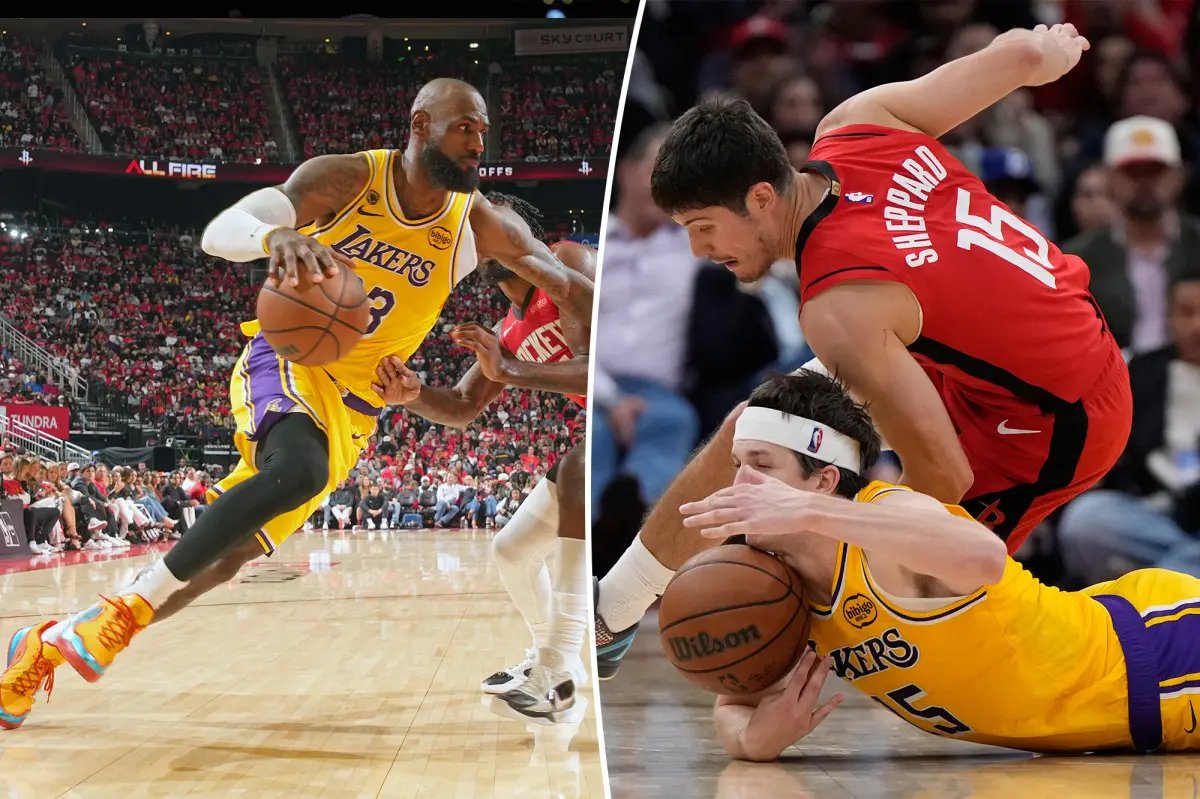


Before his team’s first round playoff series victory over the Rockets, Lakers coach JJ Redick laid out what needed to happen for his team to have success: take care of the basketball and prevent offensive rebounds.
The Lakers won early in the series despite struggling in those areas, before finding the right formula in a series-clinching Game 6 victory.
Now, they’re doubling down on the first emphasis ahead of their second round matchup against the Thunder, the defending NBA champions, with Game 1 set for Tuesday night at Paycom Center.
“The reality of their defense is that whatever moments we felt Houston pressuring, like the maximum amount of pressure they put on us, that’s OKC’s baseline,” Redick said. “That’s their core.”
The Thunder have had the league’s top-ranked defense for the last two seasons for multiple reasons.
They’ve been the best team in the league at protecting the rim from an accuracy standpoint for three seasons in a row.
In general, the closer opponents get to the basket, the stingier the Thunder’s defense gets.
But on the perimeter, they’re the most disruptive team in the league.
They were one of two teams, along with the Pistons, during the regular season to be top-five in deflections (league-most 20.7), steals (second-most with 9.7), blocked shots (second-most with 6.4) and turnovers forced (second-most with 16.7).
But unlike the Pistons, they don’t commit a lot of fouls, ranking No. 7 in personal fouls per game during the regular season compared to the Pistons being last in the league (No. 30).
“You’re talking about a team that’s top five in every category that’s disruptive-base: Steals, blocks, turnovers forced, all that stuff,” Redick said. “And they don’t foul. They somehow do all of that without fouling, which is one of the most remarkable things I think in NBA history.”
Whether Redick was being sarcastic with his comment about the Thunder’s lack of fouling, that’s the challenge the Lakers will be facing during against the Thunder: Taking care of the ball and trying to create quality offense against a Thunder defense that has very few weaknesses.
This was one of the biggest struggles for the Lakers during the four games of their regular season series against the Thunder.
They committed 17.5 turnovers per game against the Thunder, including 20 in the Nov. 12 loss and 18 in the April 2 loss in Oklahoma City.
Download The California Post App, follow us on social, and subscribe to our newsletters
California Post News: Facebook, Instagram, TikTok, X, YouTube, WhatsApp, LinkedIn
California Post Sports Facebook, Instagram, TikTok, YouTube, X
California Post Opinion
California Post Newsletters: Sign up here!
California Post App: Download here!
Home delivery: Sign up here!
Page Six Hollywood: Sign up here!
The Thunder averaged 25 points off turnovers in those home wins over the Lakers, and 22.3 per game during the regular season series.
“You can’t hear yourself,” Ayton said of the environment at Paycom Center. “It’s definitely the “Thunder” for a reason. Their fans are thunderous. You can hear the floor shaking, the bleachers, you can’t even hear a play call. You gotta be super dialed in.”
Realistically, the Lakers can’t be expected to have a low turnover rate.
Even in their losses, the Thunder won the turnover battle by a decent margin, still recording 14.2 takeaways per game.
Their physicality forces and playstyle force errors.
And with the Lakers being a more frequent passing team with the absence of Luka Doncic, there will be openings for the Thunder to take advantage of.
The Lakers’ focus will be on limiting their mistakes.
Limiting the types of turnovers that feed the Thunder’s ability to go on quick runs that put the game out of reach.
“They’re really good at runs, and part of that is how good their defense is, their ability to create turnovers,” Redick said. “The live-ball turnovers really kill you. And they don’t get out in transition a ton, but when they do, they’re the best in the NBA in terms of [points per possession]. Limiting their runs, [Pacers coach] Rick Carlisle is the master of that, the quick timeout.
Redick added: “I’ve already told the staff, already told the players, I’ve got to be more diligent than I normally am. I like my timeouts, I like going into the fourth quarter with four timeouts, I like having two in the last 30 seconds. I don’t think you have the luxury of worrying about that because the games get away from you so quickly because of how explosive they are when they go on their runs and they do that to everybody. It’s what they do. Mitigating the 12-15-point runs, I think, is really important.”
