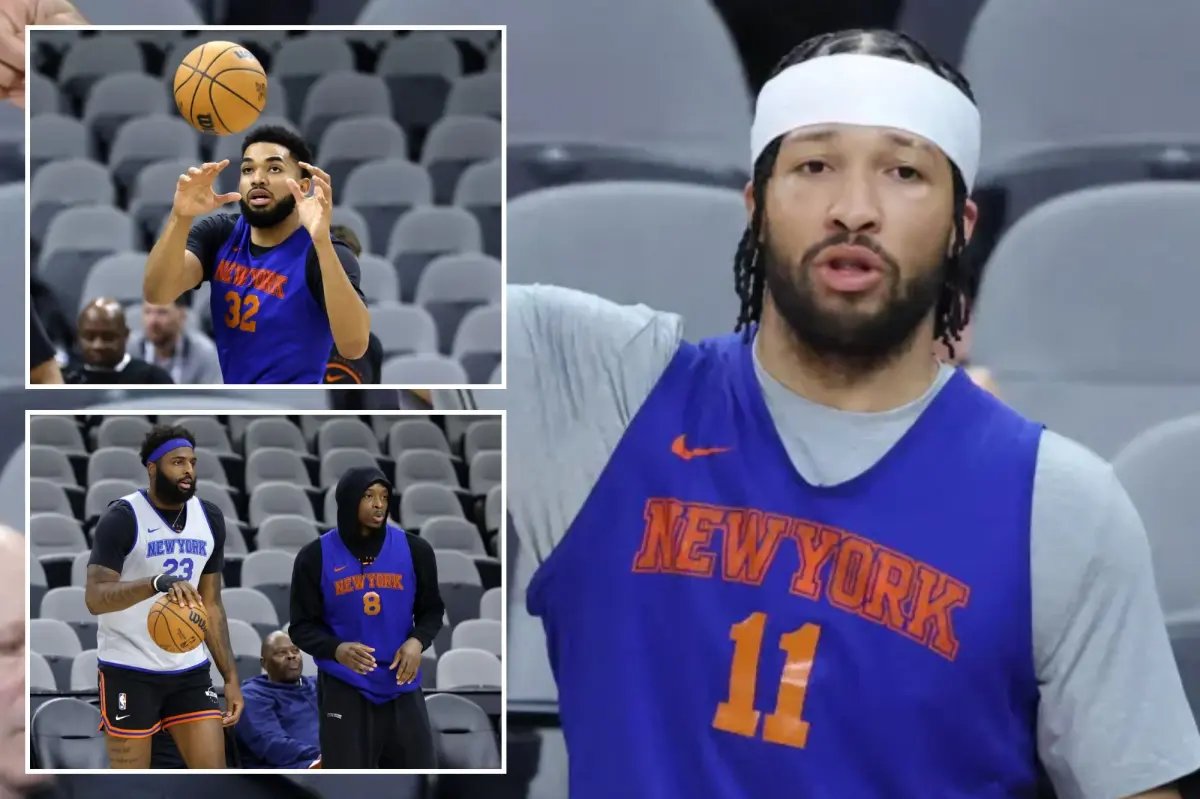


Leon Rose and the Knicks focused on trades and free agency to construct their core, San Antonio mostly became a contender again by maximizing its draft capital, leading to a rematch of the 1999 NBA Finals, won by the Spurs.
The Post dissects how the Knicks took shape.
Jalen Brunson
When he arrived: 2022
How he was acquired: Inked a four-year, $104 million deal in free agency that seemed like a reach but has since become a bargain.
How he’s helped them get here: He’s the franchise point guard. Captain Clutch.
The superstar who left money on the table with his extension two years ago. Brunson has single-handedly shifted the reputation of the Knicks, turned them into a contender and etched a place on their Mount Rushmore, averaging 26.3 points per game while unlocking another tier of that production on the postseason stage.
Karl-Anthony Towns
When he arrived: 2024
How he was acquired: A connection years in the making, the Edison, N.J., native arrived via trade in exchange for a package headlined by Julius Randle and Donte DiVincenzo.
How he’s helped them get here: Towns, who grew up a Knicks fan, is one of the best shooting centers of all time and was pegged as the missing piece, the superstar to complement Brunson. The six-time All-Star has averaged 22.2 points and 12.3 rebounds per game across his two seasons with the Knicks, and his point-center role this postseason ignited the offense.
OG Anunoby
When he arrived: 2023
How he was acquired: When the first domino in a series of Leon Rose trades fell, Anunoby (and Precious Achiuwa) arrived in exchange for RJ Barrett and Immanuel Quickley.
How he’s helped them get here: Known for his defensive skills, Anunoby has added a dynamic scoring ability since coming to the Knicks — and has averaged 19.7 points per game during this playoff run. He’s an unassuming two-way star who typically draws the most difficult matchup, keeps getting snubbed from All-Defensive First Team honors and makes the most expensive contract in Knicks history ($212.5 million) worth every penny.
Josh Hart
When he arrived: 2023
How he was acquired: Ahead of the trade deadline in 2023, Hart landed from the Trail Blazers for a package that included Cam Reddish.
How he’s helped them get here: Hart’s career with the Knicks has been defined by adjusting on the fly and fitting into a variety of roles.
He has started and has come off the bench. He’s demanded defensive matchups and taken over games offensively. His friendship with Brunson and Mikal Bridges from their days at Villanova — and his personality — make every press conference a must-see too.
Mikal Bridges
When he arrived: 2024
How he was acquired: Via a blockbuster that sent five first-round picks back to the Nets.
How he’s helped them get here: Bridges, known for his durability and defense, could never quite escape the price that Rose paid to land him and the price the Knicks paid to keep him (a $150 million extension) last summer. It led to a polarizing relationship with fans, especially when he’d get benched.
But the Knicks’ 11-game winning streak has perhaps altered his image for good, with Bridges averaging 16.6 points per game on a sizzling 62.6 percent shooting.
Miles McBride
When he arrived: 2021
How he was acquired: In the second round after the Knicks traded down to No. 36 on draft night.
How he’s helped them get here: McBride’s three-year, $13 million extension in 2023 was an absolute bargain, as he has embraced his role coming off the bench and providing a spark. He can rip off 3-pointers in bunches (career-best 41.3 percent on 6.6 attempts per game during the regular season) and has answered questions about whether he could make it at this level with his 6-foot-2 frame.
Mitchell Robinson
When he arrived: 2018
How he was acquired: Drafted in the second round in 2018 at No. 36 overall.
How he’s helped them get here: The oft-injured Robinson is the longest-tenured Knick and has seen it all. He ceded the center position to Towns while still being their best offensive rebounder and interior defender.
His most encouraging stat this year? Robinson’s 73 games between the regular season and playoffs, the most of his career and proof of a season-long load management plan working.
Landry Shamet
When he arrived: 2024
How he was acquired: The Knicks signed Shamet two weeks before training camp began in 2024, and he re-signed with them last summer on a non-guaranteed contract.
How he’s helped them get here: Who knows what would’ve happened if Shamet’s 3-pointer didn’t bounce in and help force overtime in Game 1 of the Eastern Conference finals? The 29-year-old overcame a pair of shoulder injuries the past two seasons and regained his lost spot in the rotation this year before becoming a forever name because of that shot.
Jordan Clarkson
When he arrived: 2025
How he was acquired: After agreeing to a buyout with the Jazz, Clarkson signed with the Knicks on a veteran minimum deal.
How he’s helped them get here: It hasn’t been the smoothest of seasons for the former Sixth Man of the Year, as he fell out of Mike Brown’s rotation before recovering a spot late in the year thanks to a commitment to defense.
But he assisted the Knicks by signing for the minimum in exchange for a chance at a title. He averaged a career-worst 8.6 points per game during the regular season but has turned back the clock on occasion.
Jose Alvarado
When he arrived: 2026
How he was acquired: The Brooklyn native arrived from the Pelicans ahead of the trade deadline, in exchange for Dalen Terry and two second-round picks, to boost the Knicks’ guard depth.
How he’s helped them get here: This was a homecoming made in basketball paradise. Alvarado is the energizer off the bench capable of thriving in the spotlight of the Garden, someone who can hit 3s — like he did eight times against the 76ers in February — or frustrate opponents to the point of turnovers.
Ariel Hukporti
When he arrived: 2024
How he was acquired: The Knicks landed the rights to Hukporti — the No. 58 overall pick by the Mavericks — on draft day in 2024.
How he’s helped them get here: As the Knicks’ third center, Hukporti has been thrust into critical moments when one or both of Towns and Robinson were out — or when Hack-a-Mitch returned. A Dec. 7 win, when Hukporti earned the team’s Defensive Player of the Game against a tough Magic team, served as a tangible sign of his value, too.
Tyler Kolek
When he arrived: 2024
How he was acquired: The Knicks moved up to No. 34 to take Kolek in exchange for three second-rounders.
How he’s helped them get here: Kolek quickly became a fan favorite as he competed for backup point guard minutes, delivering memorable performances in the NBA Cup final comeback and on Christmas Day to help save the Knicks. He has fallen out of the rotation since but has two more years of team control remaining to snag a role.
Mohamed Diawara
When he arrived: 2025′
How he was acquired: The Knicks took him with the 51st overall pick in 2025.
How he’s helped them get here: The Knicks don’t win their Dec. 29 game against the Pelicans without Diawara, who collected a career-best 18 points, and he adds wing depth with his rangy length and athleticism. He won’t log meaningful minutes in the Finals unless something goes terribly wrong, but Diawara — on an expiring deal — flashed enough potential to become an intriguing offseason decision.
Jeremy Sochan
When he arrived: 2026
How he was acquired: Sochan, the No. 9 pick in 2022, signed with the Knicks in February after getting waived by the Spurs.
How he’s helped them get here: Signed as bench depth, Sochan struggled to carve out a role in Brown’s rotation. But when Robinson missed Game 2 of the Eastern Conference semifinals, the Knicks needed him to log 55 seconds of meaningful time with both Towns and Hukporti in foul trouble. He’s a break-in-case-of-emergency option.
Pacôme Dadiet
When he arrived: 2024
How he was acquired: Dadiet was drafted No. 25 overall, joining the Knicks as an 18-year-old forward from France.
How he’s helped them get here: Dadiet remains a G-League player (23.1 points, 4.8 rebounds per game for Westchester this year) logging NBA minutes during garbage time, but on a team filled with expensive veterans, he has two seasons remaining — if the Knicks pick up the final option — to become an inexpensive rotation piece.
