
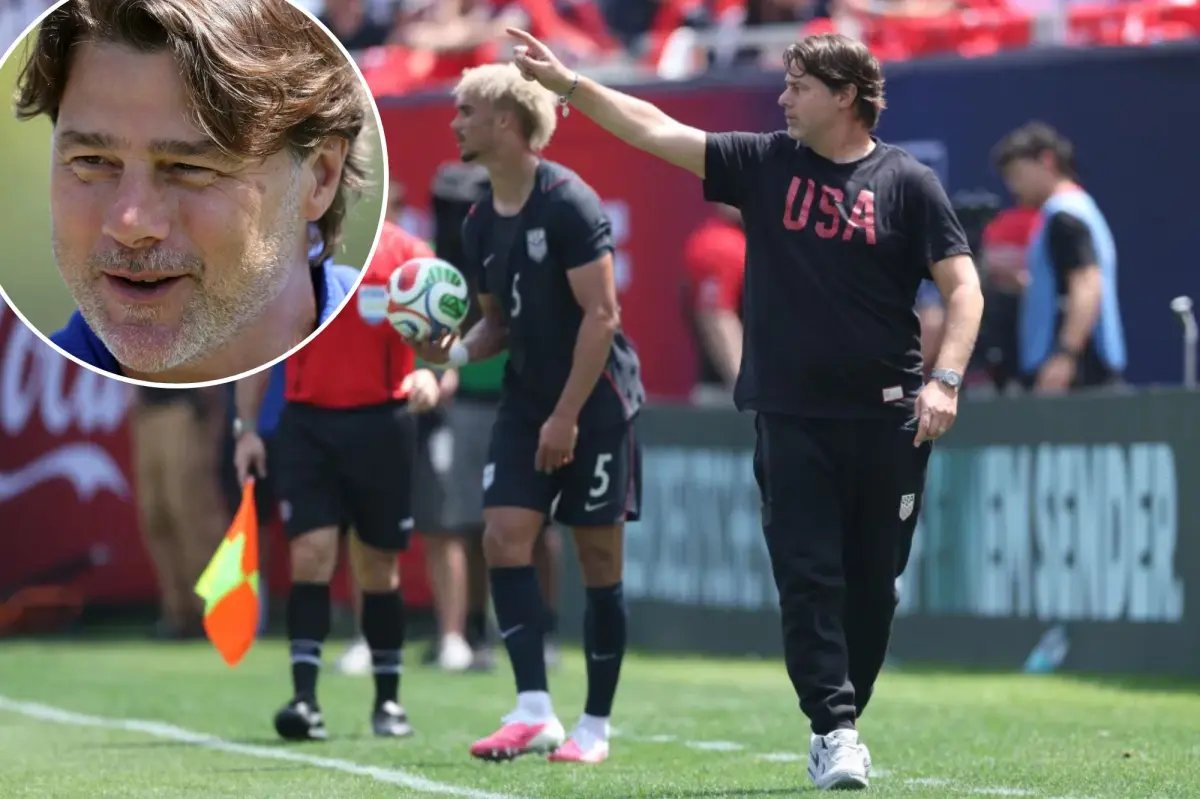


Less than two years out from what was long hoped to be a watershed moment — a World Cup on home soil advertised as the biggest sporting event in world history — the U.S. men’s national team was in deep trouble.
The Americans had been bounced in the group stage from Copa America, the biggest competition they would play in during the run-up to the World Cup, also on home soil. Gregg Berhalter — the coach they had controversially brought back for a second World Cup cycle — was inevitably fired.
That meant the first two years of this cycle were, by some measures, a waste. And it meant that unless the U.S. Soccer Federation nailed Berhalter’s replacement, it would be left holding the bag for a failure to capitalize on a once-in-a-generation opportunity.
The man they ultimately hired, Mauricio Pochettino, was asked last week to reflect on why he wanted the job.
“To be involved in a World Cup, it was my dream when I was a player,” said Pochettino, who played for his native Argentina in the 2002 World Cup after being one of the final cuts from the team in 1994 and 1998. “And after, you are a coach, it’s another dream that is in your head to one day be involved in the World Cup.”
This is the story of how the 54-year-old Pochettino was hired.
Less than a year earlier, after the U.S. women’s team had crashed out of the 2023 World Cup in the Round of 16, the USSF responded by hiring Emma Hayes, widely regarded as the best women’s coach in the world.
Now they needed to go out and get someone on the men’s side who could bring similar gravitas to the table.
“I think a really important thing for us was making sure that this is a coaching staff who can lead our team in an incredibly high-profile moment, a World Cup at home,” federation CEO J.T. Batson told The Post. “Having experience managing in high-pressure competitions and environments was certainly important.
“They needed to be winners. They needed to have success. They needed to have the ability to have coached in different environments, with a proven ability to win with different rosters and different compositions of players.”
More than that, Batson said, whoever they hired needed to believe in what the USMNT and U.S. Soccer more broadly were selling.
Pochettino, who had taken Tottenham Hotspur to the Champions League final along with stops at Paris Saint-Germain and Chelsea, had the sort of résumé that would fit. He also had worked with then-U.S. Soccer sporting director Matt Crocker at Southampton and alongside Hayes when he was managing the men and she was in charge of the women at Chelsea.
By the time U.S. Soccer’s leadership was in France for the 2024 Olympics, just over two weeks after Berhalter was fired, Batson and the rest of the federation’s leadership were already deep into a game of shuttle diplomacy. They flew “a handful of times” to Barcelona — where Pochettino and his right-hand man, Jesús Pérez, are based — to meet in person and left impressed, according to Batson.
“Mauricio and Jesús had done their homework on the men’s national team and came with a lot of data, and a lot of insights on the player pool, around the opportunity we had in front of us. And of course we had done our research as well,” Batson said. “Very quickly, I think, it was clear that there was mutual excitement.”
Among other ideas, Pochettino talked about wanting to expand the player pool, something he put into action in the year leading up to the World Cup.
It’s obvious too that part of Pochettino‘s appeal was that he would bring a different culture than the one everyone recognized needed to change.
“Mauricio, Jesús and the full staff have been very, very intentional about the approach between now and then,” Batson said.
The federation secured support from donors, including hedge fund mogul Ken Griffin, to make sure money wouldn’t be an obstacle — Pochettino, according to tax filings, made a hair over $5 million in his first seven months as the USMNT’s head coach — but he was still under contract at Chelsea while being courted.
That presented an obstacle, but one that — once it became clear that U.S. Soccer and Pochettino wanted to work together — was ultimately navigable.
Hayes, who had connections on both sides, continued to play a role selling the program to Pochettino and vice versa, even as her team was on its way to winning gold in Paris.
“It’s invaluable,” Batson said of Hayes’ contribution to the process. “As you think about U.S. Soccer more broadly and you look at our ability to attract great talent, it’s directly related to the fact that there is great talent here already that people want to work with.”
Word leaked out that Pochettino was U.S. Soccer’s pick just five days after the women’s team won gold. It became official a little under a month later.
The ultimate verdict on Pochettino’s hire has yet to be rendered. That will come over the next month, at the World Cup he was brought here to coach.
While rumors have swirled about Pochettino’s future — reports at the start of USMNT camp linked him to the open job at AC Milan in Italy — Batson reiterated to The Post that a contract extension is possible after the World Cup.
“We’ve very much enjoyed our experience working together and would be excited about a future together,” he said. “And those conversations are very much ones that we’ve been having.”
But that is tangential to the World Cup itself. If Pochettino delivers a run that can galvanize the country, it doesn’t matter what he does next — he’ll never pay for a meal in the States again.
“I think it’s the adrenaline,” Pochettino said, “that you want to be with the best and you want to challenge the best. For me that is one of the most important things, but also to help [this] organization that is very young in the USA. To help soccer keep going. That is a great challenge. It’s a challenge that I really, really love to do.”
