
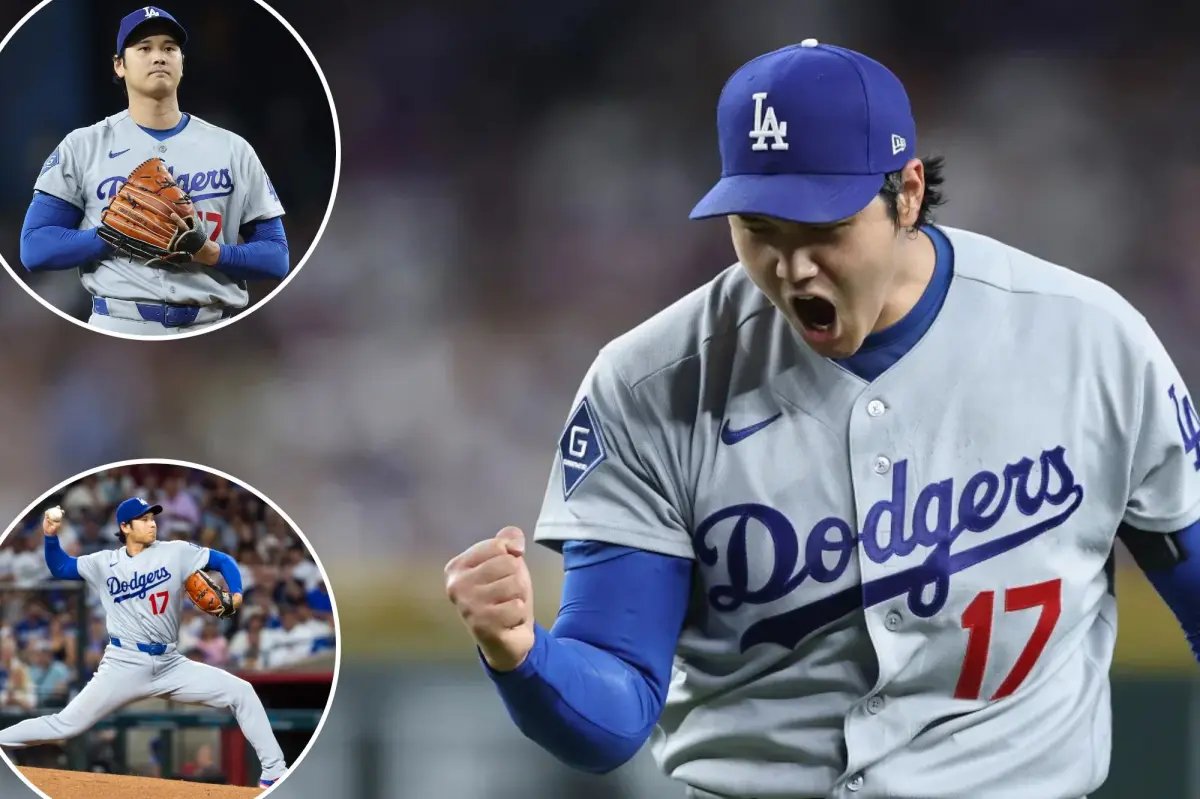


Shohei Ohtani seemed to be starting Geraldo Perdomo out easy last week.
In reality, the Dodgers’ two-way star was simply laying another trap.
Coming off three perfect innings to begin his most recent pitching outing on Wednesday night against the Diamondbacks, Ohtani opened the bottom of the fourth against Perdomo by firing a get-me-over, softer-than-usual fastball at 95.4 mph, catching Perdomo taking for a called first strike on the outside corner.
Just like that, advantage Ohtani.
He would quickly press it for an unforgiving strikeout.
On the 0-1 offering, Ohtani turned to one of his signature pitches, snapping off a splitter that seemingly started at Perdomo’s ribs, only to twist back over the plate as the Dbacks infielder leaned away from the plate.
With the 0-2 pitch, Ohtani then turned up the dial, reaching back for 99.4 mph heat –– four full ticks faster than his first-pitch four-seamer –– that was perfectly placed at the top of the strike zone; drawing not only a called third strike, but a failed ABS challenge from Arizona’s befuddled batter.
“He’s from a different planet,” Perdomo had told reporters before the game.
And then, once again, Ohtani elevated his game to a different universe.
Entering his next scheduled trip to the mound in Pittsburgh on Wednesday, the right-hander is in the midst of an early-season pitching performance that, even for his four-time MVP standards, few had seen coming.
Ohtani’s ERA is 0.74 through his first 10 starts this year, the third-lowest 10-start mark in MLB history since earned runs became a stat in 1913.
Equally remarkable is that, before this season, Ohtani had never personally experienced such a similarly dominant stretch as a pitcher, coming closest in 2022 (a 1.48 ERA over his final 10 outings that year) before undergoing his second career Tommy John surgery a year later.
“May just ended. So once the first half [of the season] is over, I think it will be good if I can make adjustments after looking at the numbers and the kind of condition I’m in,” Ohtani said in Japanese last week, sidestepping the opportunity for self-praise even after what finished as a scoreless six-inning start at Chase Field. “But I think I’ve been able to maintain a good pace.”
It’s the kind of pace, it’s easy to forget now, that once felt unrealistic for the 31-year-old superstar in the wake of his second Tommy John procedure. Only a handful of pitchers have ever regained consistent productivity following two such operations. Fewer still recaptured their previous form.
Ohtani, on the other hand, has seemingly leveled up this year –– pitching better than he has before, and better than almost anyone else currently in the sport.
So what exactly has he done differently?
“I think he just has a really good feel for the game,” catcher Will Smith explained. “What hitters are trying to do off him. When to slow guys down, speed guys up, make them a little uncomfortable, attack the zone.
“He’s got good stuff, obviously,” Smith added. “But, yeah, just really good feel for the game.”
Indeed, the biggest changes with Ohtani as a pitcher this year have less to do with stuff and more to do with approach.
Granted, his fastball is slightly up from before his second Tommy John, averaging 97.8 mph this year compared to 96.8 mph in 2023. His sweeper also has marginally more spin. His curveball is bending with a little extra break.
Still, for Ohtani to be this good, it has required other intangible improvements in the way he can dictate a game.
“There’s a lot of nuances that he’s got really good feel [for],” manager Dave Roberts said, echoing Smith’s observation.
Case in point, Roberts noted from last week’s start, was the three-pitch strikeout that completely locked Perdomo up.
On one throw, Ohtani could take his foot off the gas with his fastball –– the best weapon in his seven-pitch repertoire, according to Roberts –– but still put enough behind it to surprise a hitter in the zone.
On the next, he could play one of his secondary pitches off it, create a deceptive tunneling effect with his splitter that made the late-biting offspeed offering all the more impossible to hit.
And then, finally, he could reach back for near-triple-digit velocity almost on cue, ambushing an opponent with full-throttle fastball speeds while also maintaining (most of the time, anyway) pinpoint command of where the throw goes.
“He was probably 94, 95 and then he went with the 98, 99 top-rail fastball to get him looking on a strikeout,” Roberts remarked after the game. “[That] checked me up, surprised me … It’s just to a point where he has an ability to slow the game down to a snail’s pace. And that’s when you really reach a certain level.”
There have been numerous other examples of that dynamic this season, both with Ohtani’s ability to vary speeds and develop other little ways to keep hitters out of rhythm.
With his fastball, for example, he averages just 97.5 mph when there aren’t runners in scoring position, pitching more to contact with only a 27% whiff rate. Once someone reaches second or third, however, the velo picks up, similar to how he put away Perdomo. With runners in scoring position, the pitch averages 99 mph and gets a whiff 36% of the time.
“He’s got a little old-school,” pitching coach Mark Prior said. “He’s able to throttle his fastball, and he goes and get things when he needs it. There’s still a couple guys that do that here or there. But for the most part, guys kind of live with what they have, throw [as hard as they can] all the time.”
Ohtani can manipulate other pitches, too.
Last week, his typical mid-70s mph curveball bottomed all the way out at 68 mph. His sweeper ranged from 78 to 89 mph. He also mixed cutters and sinkers into his arsenal of fastballs, giving opposing hitters countless speeds, breaks and locations to try and anticipate.
“There are times you throw as hard as you can and times you don’t,” Ohtani said afterward. “There’s the question of how to best use variations of the fastball. That could lead to pitching deeper into games.”
Such adaptability can also help Ohtani conserve energy and manage fatigue, which has been an ongoing battle during his return to full-time two-way duties this year.
“[He knows] how to navigate an at-bat, a game,” Roberts said. “Pitching with a governor at times, to then ramp it up when he needs to.”
Ohtani has other little tricks, too.
Roberts noted how he can use the pitch clock against hitters, occasionally coming set early only to let the timer run down and force a hitter to hold a prolonged stance at the plate.
“He’s got the luxury of hitting, and understands the value of what a pitcher with some feel can do to a hitter,” Roberts said.
Then there’s the slide step delivery he can break out at any time –– like he did during an April start against the Mets to put Francisco Lindor away at the end of a long at-bat.
“He’s got pretty good baseball IQ, when it comes to that,” Prior said. “Because he’s a hitter, he understands how he has to time certain things [when he’s at the plate]. So he knows how to disrupt that timing as best he can.”
Put it all together, and it has helped Ohtani not only succeed in his return to pitching, but unlock a level of dominance that (albeit in a smaller sample size of innings this year) no one in the majors has been able to match.
“He’s come a long way,” Roberts said.
The way he’s pitching right now, his run of dominance might have a long way to go.
