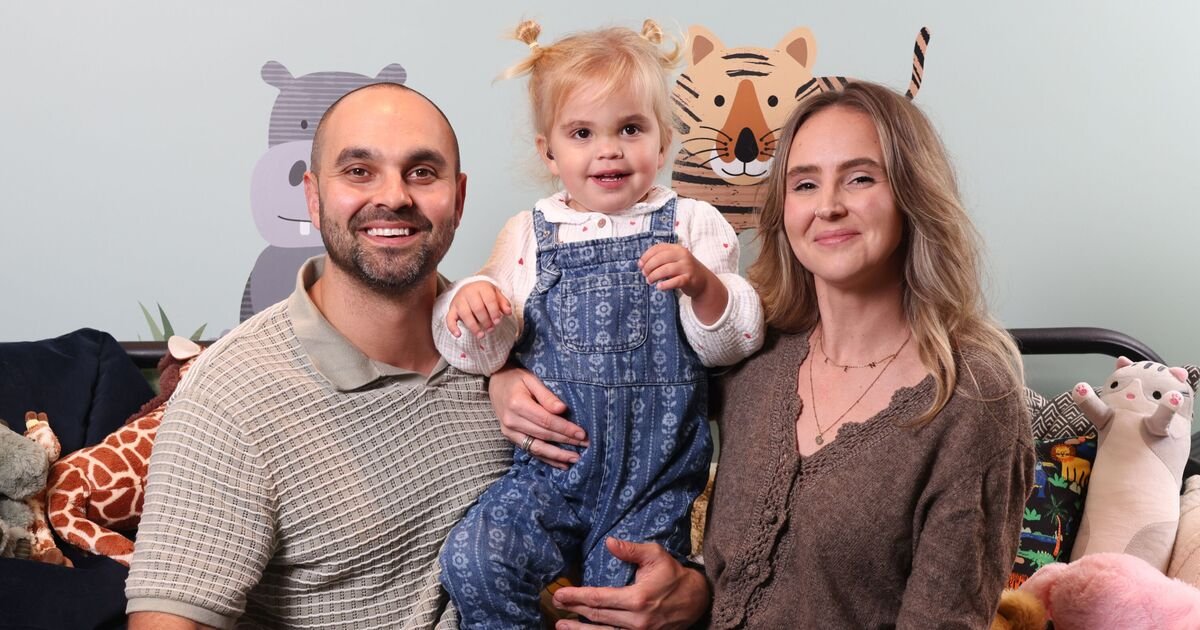


Angus and Emily were told their daughter, Leni, aged three, has childhood dementia (Image: Humphrey Nemar)
Leni is confident, smiley, caring and funny. She comforts her family when they are upset, she likes wearing sunglasses indoors on a rainy autumn day, and she’s over the moon when she’s allowed to stand on the sofa. But without intervention the skills Leni is learning now will gradually slip away. She will lose the ability to walk, talk and play before forgetting all motor and cognitive skills and the illness takes over. Most children die before their 18th birthday. It sounds like dementia, and it is. Except Leni is just three years old.
Her parents Angus, 36, and Emily Forrester, 34, didn’t have any concerns when she was just 15 months old. The early signs can be easy to explain away. Severe hyperactivity and sleep disturbances are often mistaken for autism or ADHD. A speech delay could be linked to the hearing aids Leni wears. A low nose and bridge, bushy eyebrows, a large head, ear infections and diarrhoea are seemingly unrelated and can be linked to many quirks of a growing child.
But a family member’s positive gene test for Sanfilippo syndrome, a rare neurodegenerative condition that causes childhood dementia, slowly started ringing alarm bells.
“As first-time parents with a young child, all of those things in isolation are fairly normal, particularly as kids are developing. But then it got to the point where nursery kids were starting to talk. It’s not something we would have been overly concerned about, but at that point, these symptoms we’ve been reading about became a concern,” said Gus.

Leni’s parents describe her as a ‘lovely character’ and ‘pure soul’ (Image: Humphrey Nemar.)
‘The feeling was primal’
They hoped to be reassured after taking the genetic report to their paediatrician. But after six months of investigations, when a geneticist fast-tracked a rare ‘rapid response test’ reserved for the “most urgent and worst cases”, their hopes began to crumble. The young family went on holiday, unaware it would be their last before life changed on a devastating video call.
“We were told by the consultants that basically there’s no cure, there’s no treatment, go home, love your child, make memories, give them the best life you can. The feeling was primal. Your role as a parent is to protect your child, and suddenly your whole future for your family, for your child, everything that you had imagined in one 15-minute conversation, gets absolutely flipped,” Emily shares.
She and Gus were left facing a future they could barely comprehend. Sanfilippo, a rare, degenerative condition affecting around one in 70’000 births, means that Leni cannot produce a vital enzyme needed to break down a complex sugar molecule. The accumulation causes childhood dementia.
“It’s just grief, I think it’s the only way you can describe it. You’re mourning what you thought your life was going to look like with your child and the opportunities that they’re going to have, and then you’re faced with a very, very dark reality,” Gus shares.

Emily said the feeling was primal when they received the devastating news (Image: Humphrey Nemar.)
Because Sanfilippo is inherited when both parents are carriers, Gus’ false-negative test offered a glimmer of hope and allowed them to be “blissfully ignorant” on holiday before their world was turned upside down. It transpired his variant had never been identified before.
“We are just so grateful that we had that time, because life now has flipped to before diagnosis and after diagnosis,” says Emily.
Now, they are trying to do the impossible of grasping every ounce of joy their daughter brings, while dealing with the heartbreaking “anticipatory grief” of their future. They have moved from their south London flat to live with Emily’s dad in Kent to give Leni more outside space. Emily’s sister has moved from Australia with her six-month-old twins to spend as much time with them.
“She’s just such a lovely character and such a pure soul. Everyone falls in love with her and we’re incredibly proud of who she is. She’s amazing. But it also makes it really painful because you see this is what we’ve got to lose, this incredible little personality that’s coming out. Our job is to just give her the best opportunities that we can, and we’ll just we’ll fight as hard as we need to fight to make that happen.”

Leni’s parents are desperately fundraising for a medical trial in the UK that could help her (Image: Humphrey Nemar.)
‘We will fight as hard as we can to save her’
They are far from giving in. Gus and Emily are desperately fundraising to start a trial in the UK after discovering an enzyme replacement therapy trial in the US – which infuses the body with the enzyme on a weekly basis – yielded promising results before it was cut short.
“The kids were responding really, really well, and then it ran out of funding and then just got put on the shelf. All these kids who were responding really well then started to decline,” Gus shares heartwrenchingly. “Had that carried on, there could be an approved drug right now for Leni, so that conversation could have been very different.”
In Australia, a child with Sanfillipo received an experimental gene therapy infusion at 12 months old, which is a different, one-dose treatment. Now nine, Tilly Page’s family says she has developed typically. Gus and Emily feel distraught at what they believe could have been achieved in the UK, had funding been made available.
“The cures exist, the treatments exist, but because of funding and red tape and bureaucracy, it basically just hasn’t got to a point. If you treat this at birth or in the first year of life, they can leave a near-normal life, completely normal, as a normal child,” says Gus. “We were in this deep, deep grief, we’re told there’s no treatment, there’s no cure, but looking more and more into it, there are treatments they’re just not available,” Emily adds.
Now aged three, they are racing to get the trial underway as Leni approaches the age when Sanfilippo can take hold. Despite their devastating circumstances, they feel fortunate to have secured a diagnosis within six months, which they attribute to their gene test.

Angus and Emily count themselves lucky they were able to get such an early diagnosis (Image: Humphrey Nemar.)
Families are trapped in ‘diagnostic odyssey’
Leni is the only child under five in the UK currently diagnosed with type B, and many parents spend years searching for answers while irreversible damage takes hold, known as the ‘diagnostic odyssey’.
“At that point, it’s too late to intervene,” said Gus. “We know other families who have gone to their paediatricians who’ve just been dismissed, and said, it’s so rare, don’t worry about it. Getting a diagnosis is really, really hard and you’ve got to fight really, really hard.”
Gus and Emily want prenatal testing to become routine. It already exists in the UK, but British clinics only test for 11 health conditions at the 20-week scan. Since sharing Leni’s story, they have heard from hundreds of parents who are either battling for diagnosis or told to go home and make memories, just like they were.
“If your child gets diagnosed with cancer, there is a framework, a strategy, support in place for families. There is nothing like that for dementia. Even terminal cancer usually receives some treatment to prolong life and improve quality of life. Imagine having a child with cancer in a doctor’s office and being told, sorry, nothing we can do, off you go, suffer on your own with no support. The fact that that happens for these families with children with dementia causing conditions, this is so wrong and I just don’t understand why,” Emily shares.

Leni turned three in October (Image: Humphrey Nemar.)
Childhood dementia kills as many children as cancer
More than 140 conditions cause dementia symptoms in children, yet the term is not recognised in UK policy. Experts have called for urgent action, since it receives far less funding than childhood cancer, despite causing a comparable number of deaths in high-income countries.
“While childhood cancer survival rates have improved dramatically over the past 20 years, there has been no notable improvement for children with dementia,” wrote Professor Simon Jones, consultant in paediatric inherited metabolic diseases at Manchester University NHS Foundation Trust. “The disparity is stark — only seven FDA-approved drugs exist for childhood dementia compared to 51 for childhood cancer, and those seven drugs only help about 10% of diagnosed children.”
Gus and Emily believe that uniting these conditions under a single term could give families a stronger voice. They want Andy Burnham to include childhood dementia in his £48million dementia strategy, which currently encompasses adults.
The fight is draining, but they see it as the only way, and after they secure a trial, they hope to create a charity so no other family has to navigate childhood dementia alone.
Emily shares: “It wasn’t really a decision. You will do anything you can for your kid. It doesn’t matter how uncomfortable it feels. We would never have shared our child with the world so publicly, but that is the mechanism, as we see it, to start moving the dial.”
A Department of Health and Social Care Spokesperson said: “Neurodegenerative conditions such as Sanfilippo syndrome have a devastating impact and our thoughts are with Leni and family.
“We are making sure patients with rare diseases get a definite diagnosis faster, while improving access to specialist care, treatment and drugs.”
“The government is also investing significant sums into research, and the UK Rare Diseases Framework is focused on faster diagnosis and better access to treatments.”
