


There’s a moment in our film “The American Revolution” when the historian Jane Kamensky, now president of Thomas Jefferson Foundation at Monticello, reflects on the lasting meaning of the war: “Everybody, on every side, including people denied even the ownership of themselves, had the sense of possibility worth fighting for.”
That line captures something essential about the Revolution that can get lost beneath the familiar portraits and marble monuments. The Revolution was not only a war for independence but also an argument about possibility — who counted, who belonged, and whether so-called ordinary people could claim ownership over their own lives and their own future.
In 1776, citizenship itself was a radical idea. Most human beings in history had been subjects. On the eastern edge of British North America, a group of imperfect, ambitious, often contradictory people began to imagine something different: that legitimacy might flow upward from the people rather than downward from a throne.
At first, of course, that promise applied only to a narrow few, mostly white men with property. But once the language of liberty entered the world, it could not be contained, especially as more and more people were called up to fight and support the war. As the war was fought and won, as much by so-called ordinary people — teenagers and those who didn’t own property — who knew they were as deserving of the blessings of liberty as the elites meeting in Philadelphia.
That is the unfinished genius of the American founding. It created this sense of possibility for more and more people, a standard larger than the people who first proclaimed it.
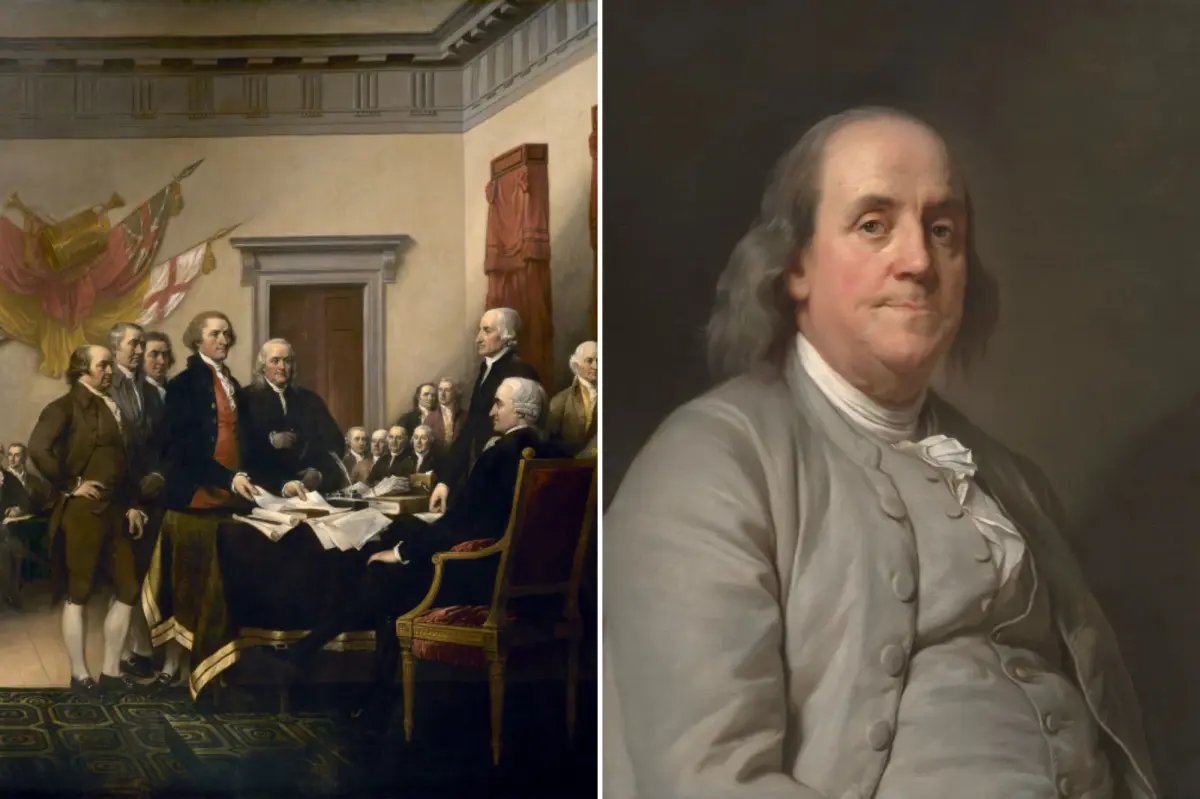
No figure embodies that sense of American possibility more fully than Benjamin Franklin.
Without George Washington, as historians Annette Gordon-Reed and Christopher Brown told me and my collaborators in our film, there is no US. He is the indispensable man of the Revolution. But if anyone shares that title, it is Franklin.
Franklin is older than the other founders and, in many ways, more recognizably American. He is not born into the Virginia gentry like Thomas Jefferson. He is born in Boston, the son of a candle maker. He is, for a time, effectively indentured to his own brother in a printing shop. He runs away to Philadelphia with almost nothing. He arrives with little more than intelligence, appetite and the dangerous belief that a person might make himself into someone new.
He is a printer, then a publisher, then a writer. He becomes a scientist, astonishing Europe by proving that lightning and electricity obey the same laws. He invents practical things like the lightning rod, bifocals and the Franklin stove, finding in their usefulness a sense of civic virtue. He builds libraries, hospitals, volunteer fire departments and civic associations. He understands that private ambition without public obligation is just vanity.
Long before independence, Franklin warned that the colonies would fail if they could not imagine themselves as one people. His famous “Join, or Die” cartoon is remembered now as a clever image, but it was a profound political argument about the power of Union, something that was essential to the success of the Revolution, as it would be to the strength of the country almost a century later and today as well.
We live in another fractured American moment, one full of distrust, anger and the easy temptation of cynicism. We speak constantly about rights and far less about obligations. We celebrate freedom but often resist the real work that makes freedom sustainable: shared sacrifice, civic participation, the discipline of self-government.
Franklin would have recognized that danger immediately.
He understood that democracy is not self-executing. It depends on habits of citizenship and ongoing improvement, something the founders thought of as virtue: reading, arguing, serving, compromising, building. Republics fail when people decide politics is something done by other people, somewhere else.
He also understood contradiction because he lived it.
Franklin owned enslaved people in his household as a younger man. He benefited from a system he later came to condemn. Over time, he changed. By the end of his life, he became president of the Pennsylvania Abolition Society and submitted one of the earliest anti-slavery petitions to Congress.
His story reminds us that the American story is not one of purity, but of moral struggle. The founders were not saints, nor should we pretend they were. They were human beings with all the complexity and blemishes that we see in human beings today.
Franklin appears again at the Constitutional Convention in the summer of 1787 as an old man. He helps forge compromises that are both genius and tragic. The Constitution that emerges is a magnificent achievement and a morally compromised one, preserving the evil of slavery even as it creates the framework for self-government.
And yet even there, Franklin offers one of the clearest windows into the American character, and his own: not perfection, but persistence. The belief that flawed human beings can still build durable institutions.
There is a famous small moment in the drafting of the Declaration of Independence that says a great deal. Jefferson wrote that “we hold these truths to be sacred and undeniable.” Franklin suggested a change: “self-evident.”
It is one of the greatest edits in history. “Sacred” asks for belief. “Self-evident” demands recognition.
Franklin transformed liberty from a theological claim into a democratic one. Rights were not gifts from kings. They belonged naturally to human beings because reason itself made them obvious, even when they may not appear obvious at all. There was nothing self-evident about equality in 1776. There still isn’t. That is precisely why the phrase matters.
Frederick Douglass would later make that same argument when he asked what the Fourth of July meant to those denied its promise. He condemned the hypocrisy of the nation, but he did not abandon the founding principles. He demanded that we honor them.
Franklin’s life is a magnificent performance as a human being. He doesn’t fire a gun in anger, but his weapon — his tongue and his mind and his heart and his understanding — is that the cause, as he says, is not just for us; it’s for everybody. What’s so extraordinary about the Founders — Jefferson, Adams, Washington and Franklin — is they are talking about us all the way through. They don’t have a snowball’s chance in hell on Lexington Green in the spring of 1775, but they’re still thinking about the “untold millions yet unborn,” as John Adams says. And that’s us.
The Founders are not asking us to worship them. If anything, they would probably distrust that impulse. They are asking us to continue the argument they began, namely, to widen the definition of “We the People,” to make real what was only partially imagined, to insist that liberty belongs not to the lucky few but to all of us.
And so, as we commemorate — and celebrate — our founding 250 years later, the responsibility of all these images and all these faces staring back at us is really a pretty accurate mirror that is asking, What are you going to do? How will you take this possibility that is America and make it better?
