
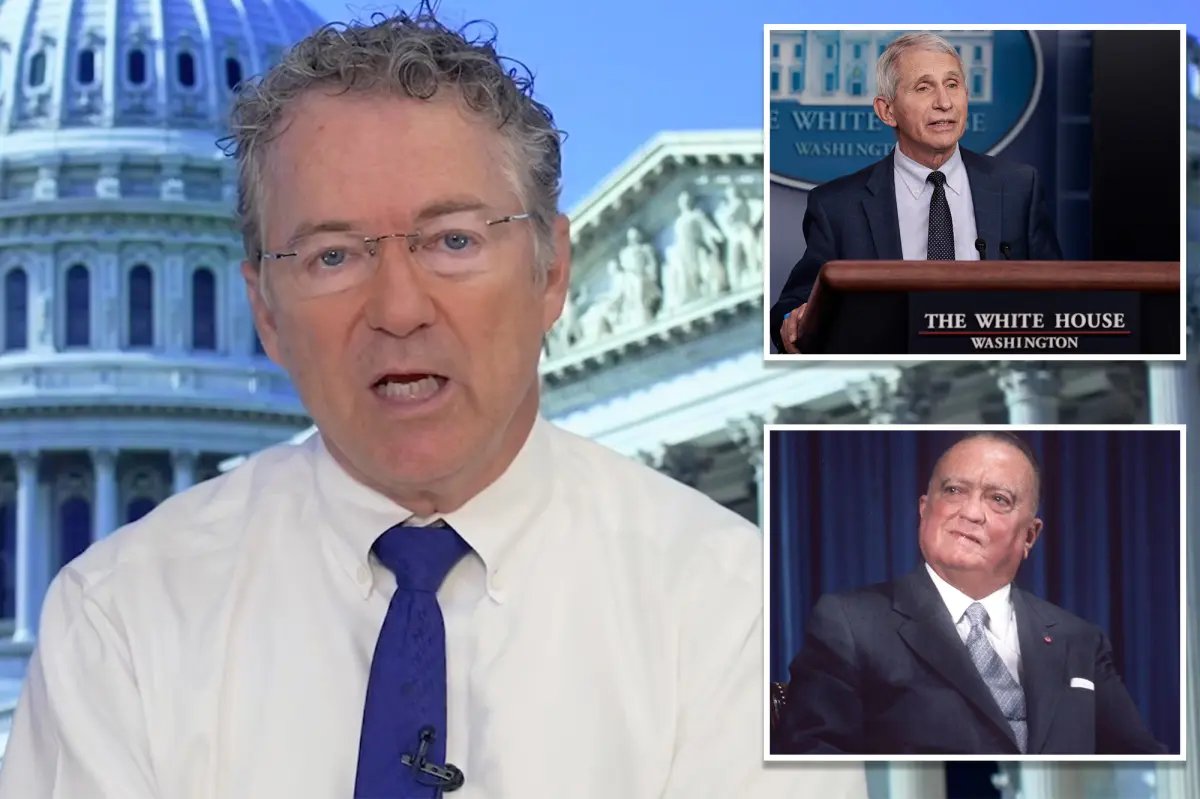


WASHINGTON — Sen. Rand Paul (R-Ky.) accused Dr. Anthony Fauci of abusing his power during a 40-year career in government, to the extent that even notorious FBI boss J. Edgar Hoover “has nothing on” the ex-National Institutes of Health official.
Paul told The Post’s Miranda Devine in an interview with “Pod Force One,” released Wednesday, that the former National Institute of Allergy and Infectious Diseases director had exerted a powerful influence for decades on US-funded research.
But whistleblower testimony and internal government emails related to the COVID-19 pandemic have since revealed the degree to which Fauci also involved himself in the publication of controversial articles in scientific journals about SARS-CoV-2 — and “influenced” US intelligence assessments about its origins.
“People talk about J. Edgar Hoover,” Paul said. “J. Edgar Hoover has nothing on Anthony Fauci — 40 years of placing all his lieutenants in all the positions, and then after 9/11, the funding for bio-research and bio-terrorism went through the roof, and he became the kingpin that had access to all of that money.”
Fauci has testified in congressional hearings about holding a “pretty high level” security clearance since 2004, when he was helping to set up a US biodefense program in the wake of the anthrax attacks.
He also told Congress that he had broad authority to “sign off” on thousands of federal grants annually for research when serving as NIAID director from 1984 to 2022.
But the former public health official has consistently denied that US-funded, gain-of-function research at the Wuhan Institute of Virology may have sparked the COVID-19 pandemic, maintaining that SARS-CoV-2 most likely originated in a natural spillover from animals to humans.
“The NIH has not ever and does not now fund gain-of-function research in the Wuhan Institute,” Fauci declared in a heated line of questioning from Paul during a May 2021 Senate hearing.
That testimony was later disputed by NIH Principal Deputy Director Lawrence Tabak in a May 2024 House hearing.
“It depends on your definition of gain-of-function research,” Tabak answered. “If you’re speaking about the generic term, yes, we did.”
“This is research, the generic term [gain-of-function], is research that goes on in many, many labs around the country. It is not regulated. And the reason it’s not regulated is it poses no threat or harm to anybody,” he added.
However, Ex-CDC Director Dr. Robert Redfield, who has supported the so-called “lab leak theory” of the pandemic, has noted that even unfunded projects and proposals can be tested under other research grants that got funding, when speaking on a biosecurity panel in October 2024
Paul has repeatedly accused Fauci of lying to Congress during their initial exchange and referred him to the Department of Justice for criminal charges for the allegedly false statements as well as purported destruction of federal records.
When testifying before a House subcommittee in June 2024, Fauci also denied that experiments that received NIH and USAID grants fell within the definition of gain-of-function research, which involves making viruses more infectious or transmissible.
Paul’s reference to records came after he uncovered emails in which Fauci instructed then-NIH Director Francis Collins to “delete this e-mail after you read it.”
“I referred him twice to the DOJ under Biden for criminal prosecution. They never acted on it. I referred him twice to the Trump DOJ without action on it,” Paul said.
“They may say because of his pardon, they can’t prosecute him. I think that’s an open question. I think the courts, in all likelihood, probably will side with the pardon, but there are some questions.”
Former President Joe Biden pardoned Fauci on his final day in the Oval Office, calling his ex-White House COVID czar a “public servant” who “served our nation with honor and distinction” and didn’t deserve to be the target of a “politically motivated” prosecution.
The clemency document granted a “full and unconditional pardon” to Fauci “for any offenses against the United States which he may have committed or taken part in” from Jan. 1, 2014, to Jan. 19, 2025.
“Can you pardon somebody for a nonspecific crime? Is it too vague to say, ‘I’m going to not prosecute you and pardon you for anything you did in the last ten years?’ I think there’s a possibility the court says that’s vague and not specific, and you can’t give people some kind of pardon for everything and over such a long period of time,” Paul mused.
“I think there’s a chance we’d win that. I think it ought to be fought,” he added.
On Monday, Paul issued Fauci a subpoena to testify again before Congress, this time in front of the Senate Homeland Security Committee, which the senator chairs.
The subpoena came on the heels of Paul and outgoing Director of National Intelligence Tulsi Gabbard releasing a trove of internal government emails that showed Fauci colluding with scientists and other high-ranking government officials to downplay the COVID lab-leak theory and quash a whistleblower complaint.
“Anthony Fauci has been influencing the process, and from the very beginning, it looks like his interference in a lot of different segments — his interference in the scientific journal articles, interference in intel — but he had a 40-year abuse of power career,” Paul said.
“Really, he orchestrated a cover-up that involved, if not dozens, hundreds of people in government that were loyal to him that went to bat because they also were part of the funding stream going to Wuhan, China, and they would suffer the same sort of culpability.”
