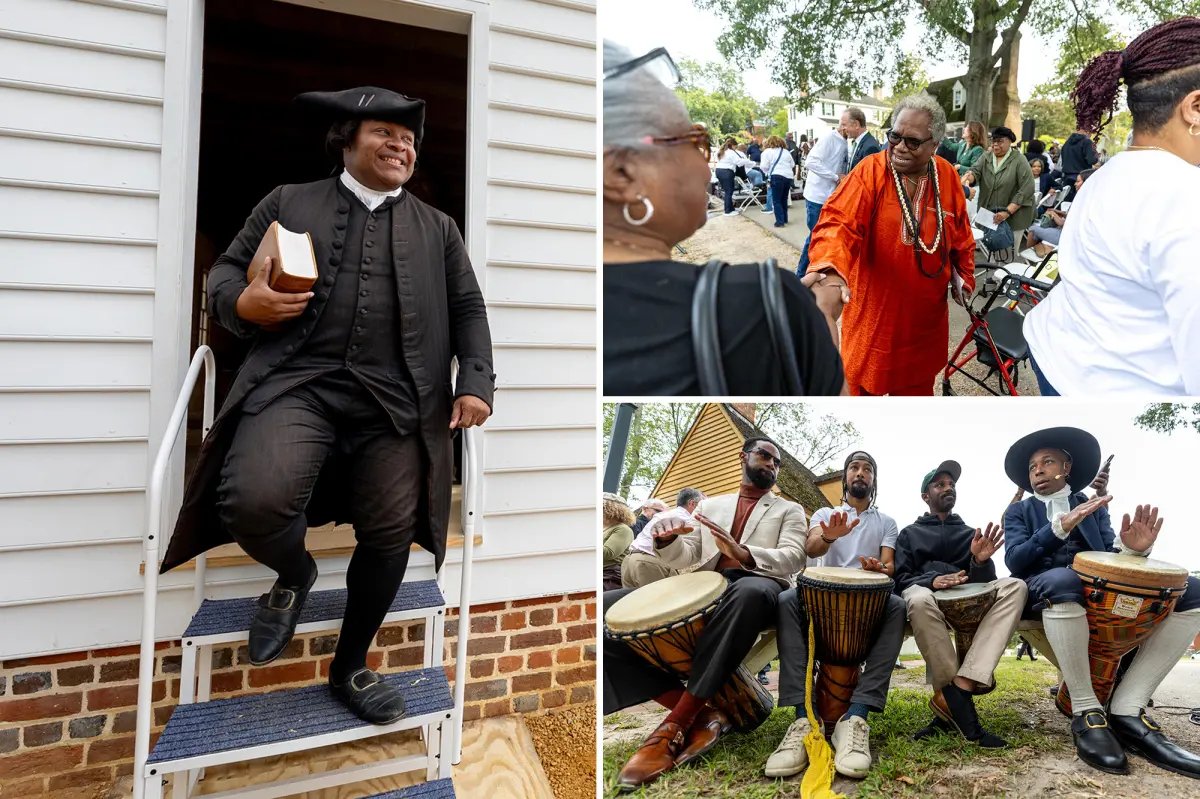


The reconstruction of one of the nation’s oldest Black churches, where congregants gathered in secret before building a meeting house in Virginia, was celebrated Friday.
Hundreds of residents gathered for a community-wide re-dedication of the original First Baptist Church of Williamsburg, which was established in 1776 by enslaved and free African Americans in defiance of laws that prevented them from congregating.
In 1805, its original parishioners built the church house, known as the African Baptist Meeting House, with recycled bricks and materials they scrounged. A tornado in 1834 destroyed the church, which was rebuilt in 1856 before it was turned into a parking lot a century later by the Colonial Williamsburg Foundation, a living history museum, because it didn’t match the 18th century aesthetic of the town at the time.
Since then, the 16-foot by 32-foot church has been reconstructed, after archaeologists in 2021 uncovered the church’s original foundation, as well as 62 graves linked to the congregation.
“What this day means and shows is that Black history is American history, and we’re an example for the rest of the nation,” Reginald F. Davis, pastor of First Baptist, told The Associated Press on Friday.
“A church that has a history that was during the signing of the Declaration of Independence, you cannot erase us out of American history because we have been at the outset and formulation of the nation,” said Davis, who leads the current 215-member congregation in a 20th century church on Scotland Street, less than a mile from the original site.
For decades, Colonial Williamsburg didn’t tell the story of the church’s history as a pioneer of Black American faith traditions. More than half of the 2,000 people who lived in Williamsburg in the 18th century were Black, with few of them free. But in recent years, the museum has resuscitated the church’s traditions, starting with Friday’s celebration of the building’s 250th anniversary.
“I wanted them to know that we were always here, where when the doors of the Colonial Williamsburg Foundation first opened, the restoration, and even before then, we were sometimes present, but not able to speak,” said Janice Canaday, community engagement manager at the Colonial Williamsburg Foundation.
“This is a reclamation, a reclaiming of the narrative,” she said.
From past to present
On Friday, the event began with a procession symbolizing the ways the historic congregation has continued a multigenerational fight for education, faith, and freedom.
The mood was set with a performance by the Nassau Street Remembrance Choir, before an invocation from Davis and speeches from Virginia state Senator Mamie Locke and James Ingram, a museum interpreter who has for 26 years portrayed Gowan Pamphlet, First Baptists’ pastor when the original church structure was built.
In a 2025 AP interview, Ingram said Pamphlet was “a precursor to someone like Frederick Douglass, who would be the precursor to someone like Martin Luther King Jr.”
Pamphlet, an enslaved tavern worker, preached about equality in the face of laws that prohibited large gatherings of African Americans out of fear of slave uprisings. Ingram handed the mantle off to the new Pamphlet interpreter, Brandon Lee, who debuted at the dedication.
‘We were just so elated’
In addition to discovering the original church’s foundation, archaeologists uncovered the graves of 62 community members. DNA tests and bone analyses for three sets of remains linked them back to the African Baptist Meeting House congregation.
But it was oral tradition that served as the first hint in the discovery, where stories of ancestors buried in the area led to a search.
“We knew the building was here, and we knew that there were maybe burials behind it,” said Jennifer Wilkoski, director of architectural preservation and research at Colonial Williamsburg.
When the church’s original structure was discovered in 2021, Davis called it “a rediscovery of the humanity of a people.”
“We were just so elated that those people who had been buried and forgotten, have now been unearthed and given the recognition as human beings, as they should have been,” he said. “It’s a wonderful time to shed light on our history in light of the erasure of so many things within our history.”
Construction is nearly finished
The meeting house reconstruction, built at its original site, honors its original character. Archaeologists and Colonial Williamsburg’s construction team modeled the new church out of pine and white oak woods, and recreated details like the original half-round brick steps.
Wilkoski said the materials for the original church demonstrated the resourcefulness of the congregants, who likely included carpenters with the skills necessary to build the church.
Modern renovations include an HVAC system for Virginia’s hot summers, a refreshed altar table for sermons, shutters, and handblown glass windows. Last year, Colonial Williamsburg considered glassless windows but has since had to reconsider to build the cooling HVAC system.
“It’s not church stained glass, but we call it restoration glass, handmade like they would’ve had in the 18th and early 19th century,” Wilkoski said.
Finishing touches on the church will wrap in the next few months and will include an ADA- accessible ramp.
Davis, the First Baptist pastor, said the meeting house structure is overdue recognition for “those of us who are still working to make America a more perfect union.”
