
Germany’s ongoing SuedOstLink high-voltage electric powerline project – designed to transport electricity from northern Germany to Bavaria in the southeast – is one of the country’s largest ongoing infrastructure enterprises. But construction along the 105-mile-long transmission route is also yielding some of Germany’s most impressive and surprising archaeological finds in years.
Now, archaeologists have uncovered a dozen 5,000-year-old sacrificial pits near Gerstewitz in Saxony-Anhalt, which have offered an insight into haunting ancient ritual practices. Initial studies have associated the pits with the Salzmünde Culture (c. 3400 to 3050 BC), a people whose ceremonial burials appear to reflect a violent and difficult world. Known for their unique burial customs, this Funnel Beaker culture often placed their dead in crouched positions beneath layers of pottery shards and remnants of burnt homes. Even partial skeleton reburials, most often skulls, have been discovered in these graves.
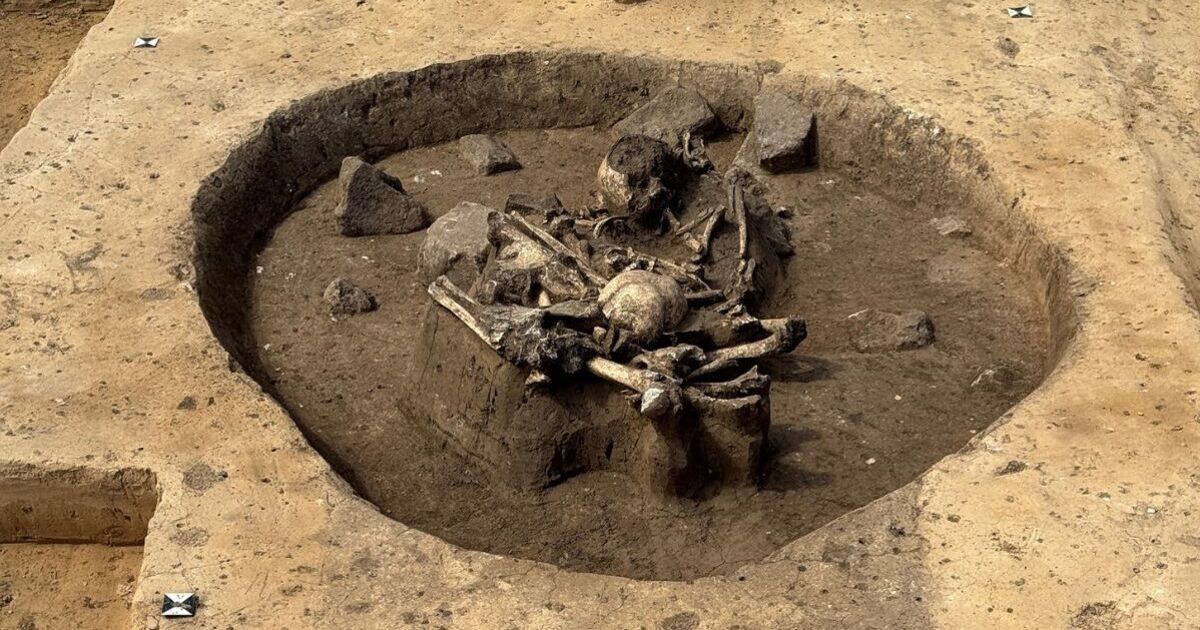
Researchers uncovered 12 deep, circular pits – each some seven to 10 feet wide and up to eight feet deep – enclosed within a ditch system. These pits held the charred remnants of buildings, complete ceramic vessels likely used as sacrificial offerings and bones from both animals and humans.
Particularly striking were the remains of a dog, still in anatomical position and showing signs of fire damage, found beside an intact human skull. The contrasting conditions suggest extended or staged burials, perhaps involving temporary display or storage of the remains before their final burial.
“This suggests that the pits remained open during extended ceremonies, or that the dog bones were kept in another place for a prolonged period of time,” the researchers explained in a statement.
In fact, one converted oven pit revealed the burial of two individuals who had likely decomposed elsewhere before being laid to rest, also pointing to a deliberate, multi-phase ceremonial process.
Archaologists think the process reflected the harsh era in which the Salzmünde Culture lived. Both physical artefacts and climatological data indicate that Central Europe during the late 4th millennium BC witnessed cooler and more erratic weather patterns. This would have dramatically affected agricultural communities such as the Salzmünde.
Meanwhile, another Neolithic group, known as the Bernburg Culture, began expanding into the region from the north around this time, possibly adding even more stress on both the community and local resources.
“The rituals, by which people were apparently seeking the support of their ancestors, can be understood in the context of this period of crisis,” the team explained.
Archaeologists first discovered evidence of the Salzmünde Culture in 1921 and have since documented multiple sites linked to the group.
