
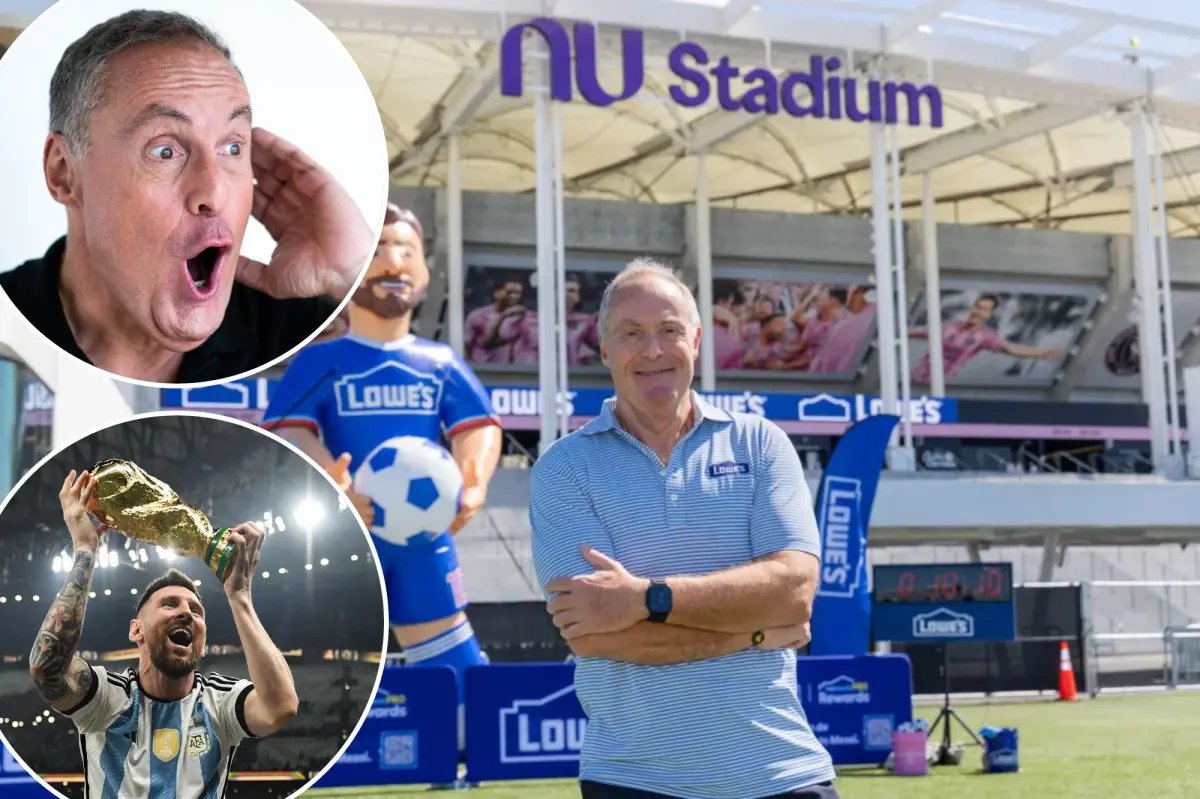


As Telemundo broadcasts the biggest World Cup ever, spanning three host nations and reaching millions of fans across the Americas, there is no voice more synonymous with the beautiful game than Andrés Cantor, who is calling his eighth World Cup.
Telemundo will deliver more than 700 hours of FIFA World Cup programming from June 11 to July 19 — the most ever for a Spanish-language presentation in the United States — including all 104 matches live, with 92 matches airing on Telemundo and 12 on Universo.
Cantor recently fielded some Q&A with Post columnist Steve Serby.
Q: How flattering is it to be known as the voice of soccer?
A: It’s extremely flattering because more and more, I get people saying to me that I’ve been the soundtrack of their lives when it comes to soccer, obviously. That they’ve listened to my calls throughout the years. I’ve been working on television now almost for 40 years calling games. I would say at the beginning of my career was an average of 200 games per year, now it’s probably a little bit less. To get stopped and be recognized by my voice and not by my likeness or face, and for people to turn around in an airport line or a supermarket line and say, “Man, you’ve been the soundtrack of my life, I’ve listened and watched you for so many years,” is extremely flattering, and I take that to heart, and obviously it’s super-nice when that happens. For anybody that just taps me on the shoulder and says, “Hey, I heard you, aren’t you Andres Cantor?” That’s super, super, super nice.
Q: Is 43 seconds your longest GOOOOOOOOAL call?
A: [Laugh] Actually an NBC upfronts executive told me that they have an average short time of 23 seconds and a long average I believe of 43. Honestly, I have no idea, and I never have any intention of making it even shorter or longer. The way it comes out, it comes out naturally, organically if you will. It depends on the play, it depends on whether my setup to the goal is easier than not, because sometimes you have a scramble in the box with 20 players and the ball bounces around and then it goes in, whereas on a counter attack where it’s three against one, it’s easier to predict that the goal is coming so my setup will be different. And then, the importance of the goal, the moment of the goal — a goal in the middle of the first half is not the same as the winning goal in the 90th minute — and I guess the most important thing is how much air I have in my lungs. That is what will dictate how short or long I go at least on the first goal, because if it’s short because I don’t have any air, probably GOOOAL and then GOOOAL again, and if the goal is very, very important, I’ll yell GOOOAL three times.
Q: Could you reach 44 seconds maybe?
A: I have no idea. Hopefully the World Cup final with Messi scoring the winning goal, maybe I’ll give it a go.
Q: Some people have called it a gimmick, right?
A: People that don’t watch soccer on a regular basis, yeah, perhaps think it’s a gimmick. It is the way I’ve been calling goals and every Latin American announcer has been calling goals in their countries and here. I always say I didn’t invent anything, I just helped also popularize the way that we call the goal calls in Latin America. So it’s definitely not a gimmick
Q: Who are the teams to beat?
A: I think the teams to beat are France, which I think they will reach their third consecutive final. Argentina, I fancy their chances again to make it to the last week. Predicting soccer is so hard. I will narrow my final week for these four teams: France, Argentina, Spain and England. I think they will be around in Dallas and Atlanta for the semis, and then anything can happen.
Q: Long shots?
A: I don’t think I can consider Portugal a long shot. I don’t think there is a long shot, a dark horse, to be honest. In the sense of a new country winning the World Cup, I think Portugal has a very, very good chance, they have a very good team with very good players — Cristiano Ronaldo, Bruno Fernandes, Bernardo Silva, Ruben Dias. They have a very solid team. So I wouldn’t be surprised if they have a good run and make it far.
Q: How far can the U.S. team go?
A: [Coach Mauricio] Pochettino late last year told me he wants to win the World Cup. I think that is the right mindset that any coach needs to instill in his players, whether it’s attainable or not. I don’t know if it is. I think reaching the quarters will be good, and hopefully win the quarters and getting to the semifinals, it will be so beneficial in so many terms for the National Team programs, for soccer in America in general.
Q: Who are some of the American players the viewers here should be excited about?
A: I will go one by one: Matt Freese, the goalkeeper; Sergiño Dest, the right fullback; Chris Richards, the center back; Tim Ream, the center back; Antonee Robinson, the left back; Weston McKennie, right midfielder; Tyler Adams, holding midfielder; Christian Pulisic, Timothy Weah, Folarin Balogun, all of them. Obviously Pulisic is the one that everyone knows or is best known. … Hopefully at the end of this World Cup, they will all be superstars in here.
Q: Is there more pressure on them because it’s in the U.S.?
A: I believe it probably will. Obviously they know that the attention will be greater and there will be so many more eyeballs on them. … They’re used to handling pressure at the club level, which is totally different than handling pressure at the World Cup, but still, they’re not rookies, they all played in World Cups before, but the fact that the national team and the national anthem will be played in Los Angeles probably will put a greater deal of pressure than ever before.
Q: Some of the other most compelling players to watch?
A: I would say Lamine Yamal from Spain, he’s only 18 and he’s extremely talented, he has already won the European Cup with Spain and just won the title with Barcelona. He’s a terrific and very exciting young and upcoming player, upcoming in the sense that he’s only 18 [laugh], but he already has established and made a name for himself. … I think Erling Haaland, who is finally playing his first World Cup for Norway. I don’t think he’s going to score as many goals as he scores usually in Manchester City, he’s in a very tight group, but it will be very interesting to see him play against France and Senegal in that group of what I call the Group of Death. … England has Jude Bellingham, if he’s in top shape, and Harry Kane are great players. Harry Kane is just one of the best players in the world. … Luis Diaz from Colombia is a very electric, fast, good, solid winger forward — he will be very exciting to watch as well. … Michael Olise from France, he exploded this year at Bayern Munich. France has so many good players. Ousmane Dembélé.
Q: Compelling storylines?
A: The most interesting storyline would have to be the U.S. national team. They have a very good coach, very experienced coach at the club level in Mauricio Pochettino, the World Cup is in our backyard, the expectations of the group of players that have been playing professionally for so many years in Europe is great for them, but also for making back that legacy that a good run will have for soccer in general in our country. … Messi, Cristiano Ronaldo and Memo Ochoa, the goalkeeper for Mexico, are going to be playing in their sixth World Cup. That is a storyline of its own. Players in their professional lives dream of playing one minute in one World Cup, but these three superstars are playing in their sixth. … Luka Modric, at 40, he had a broken cheekbone, I think he’s gonna be around. I think it will be the storylines of the Last Dance for Messi, for Cristiano, for Luka Modric, it’s another storyline in itself. And I think the most beautiful storylines will be fandom that we will live, not only in the stadiums where the World Cup will be played, not only in the cities where the World Cup will be played, but throughout the country. It will be terrific to live the World Cup in any city around the U.S. The engagement of the Hispanic community will be incredible throughout the country. It will be a wild party for 39 days.
Q: A lot different than it was in ‘94.
A: That’s for sure. Not as many people knew what soccer was, let alone the World Cup. Now obviously with the new technologies and the fact that you can watch any match from anywhere around the world, not only on your television but on your phone, on your tablet on the go, you can be in a cab, on a plane, watching soccer is totally different than it was in ’94 where people had no idea that soccer in the rest of the world was called futbol.
Q: Whatever comes to mind: Landon Donovan.
A: The greatest U.S. national team player of all time so far. I remember vividly that cold night in Pretoria [at the 2010 World Cup in South Africa] when he scored. It’s crazy that one of my biggest goal calls in 40 years was for my radio company Futbol de Primera, even though it was a goal that only qualified the U.S. to the next round. It was as important as making it out of the group phase as it was from saving the U.S. from embarrassment of being knocked out in the group phase. It was the last play of the match literally. … Landon had a 75-yard run to end up scoring that winning goal that put the U.S. through to the next round. I have a very fond [memory] of that goal and that night.
Q: Carli Lloyd in 2015.
A: That was one of my greatest calls as well. Scoring one goal in a World Cup final is memorable. Scoring a hat trick and the way she scored the third from 45 yards out and beating the Japanese goalkeeper, I think that probably is one of the greatest World Cup final goals of all times regardless of gender, I don’t care whether it’s men’s or women’s. I was honored and privileged to be part of that moment in history for the U.S. women’s national team program, and especially for Carli, who I admire so much as a player.
Q: Do you have a favorite call?
A: Obviously for what it meant to me personally, the winning penalty call in Qatar when Argentina won the World Cup, it’s probably the one that I hold closest to my heart, that is for sure.
Q: Any other memorable moments?
A: I remember Cristiano Ronaldo’s tying goal for Portugal against Spain in Russia, because it looked like I was on cue with everything that happened before it was shown on television because I knew the way he prepared himself for every free kick. I said, “He’s going to drop the ball, put it on the ground, take three steps back, one to the left, he’s going to inhale, exhale,” and then I said, “He’s going to shoot right-footed for the tying goal.” And everything happened on cue, but not because I was watching and saying it, but because I was saying it before it happened. I said, “He’s gonna take a step to his left,” and then the camera showed him taking a step to the left, and then I gambled and said that he’s going to score the tying goal.
Q: If Argentina wins this year, will you cry?
A: [Laugh] I have no idea. I will be overcome by emotion just by the fact that they’ve won the World Cup again, that is for sure. The crying had been a long time in waiting, 36 years waiting for that moment. … Now it’s three and a half years. So if they win again, I will cry again on national television in the final.
Q: You admired José María Muñoz, Chick Hearn and Vin Scully.
A: Because I grew up listening to Jose Maria Munoz in Argentina, he had 90 percent share of the audience even though he was a radio play-by-play announcer. Radio was the big medium in my growing-up days. I remember his style. And then when I lived and moved to L.A., I listened to Chick Hearn’s simulcast on Channel 9, and I forget what radio station it was of the Laker broadcasting, I thought he was the closest thing to a soccer play-by-play announcer with his rhythms and his phrases. And then I listened to Vin Scully because of his poetry. I learned so much about his style, his cadence, and basically the way he made poetry out of the nine innings that he was calling. And then came Al Michaels. … I’ve watched a lot of sports on American television and learned from the best, I guess.
Q: How would you characterize your broadcasting style now and how it has evolved over the years?
A: I was a writer, and had no clue how to do this when I got my first gig after the audition that we did way back in February of 1987. I got called into an audition to tape two soccer matches that aired on national television. … I found my rhythms, I found my voice, the play-by-play style evolved in the sense I became more secure on how I needed to call matches because I had no prior experience. And now I’m extremely conscious as well that I need to … not adjust my style, but I am super-aware that the public that is watching now, my audience now, is probably watching the game with their phone in their hands, just like I watched when I’m in front of the TV, and that anything that I say can be double-checked in a second by my audience. So I need to be as sharp in my preparation with my notes, with my player profiles, with rules, with everything more than ever. I’m not saying that I wasn’t before, but I know that I will be judged instantly and I will know because they will tag me on “Hey, that wasn’t a corner, it came off the other player,” or whatever. It hasn’t changed my style, it has sharpened it to the max.
Q: What will that New Jersey-New York crowd be like for the final?
A: Obviously they elected New York because it’s the capital of the world, I guess, even though the stadium is in New Jersey. Wherever they put the World Cup final, honestly, it’s going to be a crazy day. The World Cup itself is the most fantastic event in the planet, let alone the World Cup final. So July 1 will be a huge party in New York. I know there’s a lots of festivities going on a couple of days prior in Manhattan. But then everything comes down to the best two teams in the world playing for 90 minutes on that July 19, and I think the crowd will be electric, the atmosphere will be as it usually is in that stadium for a big soccer match. We lived it with the Club World Cup, we lived it with Copa America, so it’s going to be great.
Q: What’s the adrenaline like for you broadcasting a World Cup final?
A: You get carried away by the atmosphere around you. I remember in Qatar, especially the Argentina matches with the Argentinian fan base singing and jumping … it’s music in my ears … it’s part of the soundtrack of the broadcast. It gives you that much more energy — not that I need more energy [laugh] — but it’s super-nice to be in that moment and loving not only what is going on in the pitch but also what is going on in the stands.
Q: You called your first World Cup in 1990.
A: I remember when I got the assignment, the network trusted me to be the only play-by-play announcer, not only of 1990 but also of 1994 and ’98. I called every single soccer match of those three World Cups, which in today’s world is kind of crazy to think that one person can call three matches in a day. From the prep that goes into the games, to the energy that is exerted and the emotional expenditure if you will that I put into every broadcast … my recollection of those World Cups is like, “Whoa, I did that, really?” That is absolutely crazy to me that it happened that way, but for the first World Cup, I was 26, so I guess that had a lot to do with it.
Q: Favorite Messi anecdote or memory?
A: I was invited weeks ago to do the coin flip at Inter Miami game, and it was a surreal experience being there among him and the other captain and the refs. He came towards me with a grin and said hello, and I said to him in his ear: “Thanks for so many happy moments.”
Q: Favorite Maradona anecdote or memory?
A: Being in his home in Naples when they won the Scudetto for the first time in history, and celebrating with him, his family and his entourage after the game was one of many very intense moments I had with Diego.
Q: “The Simpsons”?
A: Definitely one of those things that marked my career as well. Appearing in “The Simpsons” episode with name and likeness and with my own voice in the caricature is something that I will cherish forever.
Q: Broadcasting with your son Nico?
A: It was kind of surreal, because even though Nico is a seasoned professional, he is still my son, so I had mixed emotions in the sense that I was on national TV with a fellow broadcaster that happened to be my son. I was full of joy inside, but I tried not to be distracted by that fact during the game
Q: Your grandparents fled the Nazis.
A: My paternal grandparents fled Poland and my maternal [fled] Romania. My mom lived in Israel before settling in Argentina, and she recalls to this day how they bunkered during the war and how when she left Romania, they stripped her and my grandparents of pretty much all belongings.
Q: Three dinner guests?
A: Maradona, Messi, Michael Jordan.
Q: Favorite movie?
A: “Hair.”
Q: Favorite actor?
A: Robert De Niro.
Q: Favorite actress?
A: Meryl Streep.
Q: Favorite singer/entertainer?
A: Billy Joel.
Q: Favorite meal?
A: Asado (Argentinean BBQ).
Q: What will your schedule be like for this World Cup?
A: I will be throughout the country. I start in L.A., I’m going to be in Kansas City, Dallas, Houston, Miami, Vancouver, Guadalajara. . . And New Jersey obviously for the final.
Q: I guess you have no regrets that you never became a sportswriter.
A: [Laugh] Not at all. It’s kind of crazy because I really honestly never thought I would end up doing TV or radio, which has been obviously a big part of my professional life. I published my first article when I was 16, and worked as a writer until I got my first job in television in 1987. So no regrets at all now going into my 12th World Cup.
Q: What are you most proud of about your career?
A: I would say that I helped popularize the game of soccer in America with the notoriety perhaps of my work on television has gotten. I always say that if I did a tiny little bit to grow the awareness of the game in America, that probably will be my greatest accomplishment. And I say this with the love that I have for the game, for the U.S. National Team program, for U.S. soccer in general, because I’ve lived in this country pretty much my entire life, I moved when I was a teenager. So definitely I have lived way more many years in this country than I did in Argentina. And being a soccer lunatic as I am and since the minute I started kicking the ball around when I was probably three or four, and not having any soccer professional league here when I was growing up, and definitely when the World Cup in ‘94 came around, if I helped during that time to make the game a little bit more popular. . .however tiny that contribution was, that is probably my proudest accomplishment of my career.
