

Apple iPhone Duo review (Image: APPLE)
What we love
- Perfect design for a foldable
- Nano-texture screen is a masterstroke
- Big screen a joy for movies and gaming
- Great battery life
- Fast performance
- Apps look great when optimised
- MagSafe charging
What we don’t
- Price is too high
- Apps look bad when not optimised
- No Face ID
- Cameras can’t match the Pro
Foldable phones aren’t anything new. Samsung announced its very first device with a flexible screen all the way back in 2019, and numerous Android rivals followed with their own takes on this clever technology. Despite almost all manufacturers launching foldables, Apple has stayed well away from this concept. That’s until now. The US firm’s very first device with a screen that opens like a book is finally here. The question is, has the iPhone Duo been worth the very long wait, and has Apple ironed out some of the flaws many have had with Android foldables in the past?
I’ve been one of the very first in the UK to have the Duo tucked inside my pocket, and it certainly lives up to all the hype it’s received.
As you’d expect from Apple, it’s beautifully made, incredibly intuitive to use, and there are some lovely software tweaks designed to make full use of the larger form factor.

Apple iPhone Duo review (Image: APPLE)
A foldable screen that finally gets it right
The Duo’s biggest selling point is, naturally, its dual-screen design.
On the outside sits a compact 5.4-inch display, which is bright, colourful and perfectly usable for everyday jobs such as texting, taking photos and scrolling through social media.
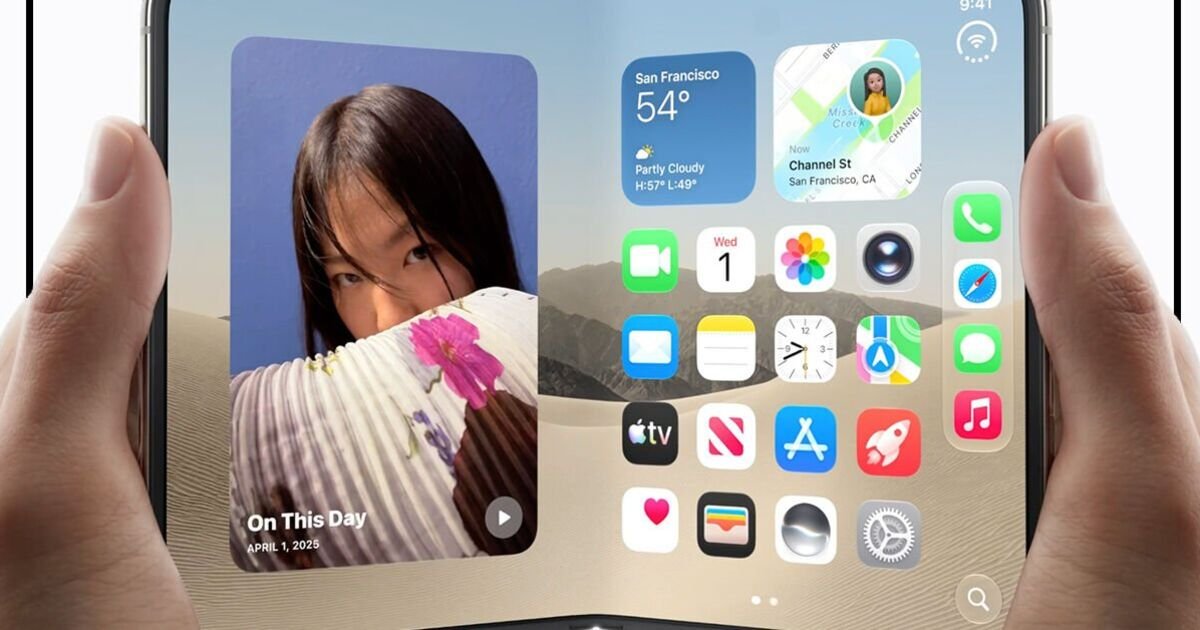
Open it up, however, and things get much more interesting. You’re greeted by a generous 7.6-inch Super Retina XDR display with Apple’s distinctive nano-texture finish.
It’s a masterstroke. The special coating cuts glare when you’re watching films or bingeing box sets, while making the crease running down the middle of the screen remarkably difficult to spot.
Look closely and you’ll still notice a slight dip, but it’s barely visible in everyday use. I’ve always found the crease one of the biggest drawbacks of Android foldables, and Apple has done a superb job of minimising it.
Samsung has steadily improved its own folding screens, but the Duo sets a new benchmark for how seamless this technology can look and feel.
The nano-texture finish also gives the display a pleasing feel under your fingers and helps keep fingerprints at bay. Apple has even hidden the main selfie camera beneath the screen, avoiding the distracting black dot that blights some rival devices.
There’s more protection, too. Apple says the display’s advanced polymer finish is up to 40 per cent stiffer than competing materials, helping it resist scratches and dents. The screen feels reassuringly solid when you’re typing, gaming or scrolling through TikTok.

The iPhone Duo is great for watching movies (Image: EXPRESS)
A passport-sized design makes perfect sense
The Duo’s unusual proportions might take some getting used to, but I think Apple has made the right call.
Open the phone and its wider, passport-style layout feels much closer to an iPad mini than the squarer screens found on some rival foldables, including the Galaxy Z Fold8 Ultra.
That makes a real difference when reading, watching videos or running apps side by side. There’s room to spread out without everything feeling cramped.
Apple’s approach is already attracting attention, with Samsung’s latest Z Fold8 also adopting a passport-like design and other manufacturers, including Xiaomi, moving in a similar direction. Expect more rivals to follow as the Duo’s influence spreads.
Of course, folding a phone in half inevitably raises questions about durability. I haven’t used the Duo long enough to say whether it will last as long as a conventional iPhone, but Apple has clearly put plenty of engineering into making it feel robust.
The precision hinge uses aerospace-grade aluminium and specially designed support ribs for added strength. The frame is made from tough Grade 5 titanium, giving the handset a suitably premium feel.
Despite its sturdy construction, the hinge opens smoothly, making it easy to access the larger display without a struggle.
It’s also stiff enough that it can be partially opened and then stood up on its own, which is surprisingly handy when you want to snap a photo hands-free. Whether it will withstand years of folding and unfolding remains to be seen, but first impressions are reassuring.

Once opened you get a huge 7.6-inch screen (Image: EXPRESS)
The Duo isn’t just about impressive hardware. Apple has also introduced a raft of software tweaks to make the dual-screen experience feel natural.
You can run apps side by side, use the phone as a desk stand in standby mode, bend the screen and turn it into a mini latop and access the Dynamic Island on either display. Subtle animations as you open the handset add a polished touch, while a redesigned circular status bar keeps essential information such as battery life, mobile reception and Wi-Fi within easy reach.
Even the app dock has moved to the side to free up more screen space.
Some developers have already updated their apps to take advantage of the larger display. Netflix, for example, makes it easy to browse films on the cover screen before opening the phone to enjoy them on the bigger panel.
It’s a clever way to switch between a conventional smartphone and a pocket-sized entertainment centre.

The front panel is perfect for day-to-day use (Image: EXPRESS)
Blistering speed and battery life that impresses
Making sure it keeps pace with all these software updates, it’s powered by the latest A20 Pro processor, which is supremely fast, and I’ve had no issues when multitasking, playing games and performing intensive tasks such as photo and video editing.
It’s a seriously capable handset, and there’s plenty of power in reserve.
The chip also supports Apple’s latest Intelligence features and its new Siri assistant, which can help organise calendars, answer questions and locate files or photos. Apple’s AI ambitions are still evolving, but the Duo has the hardware to keep pace with future improvements.
Battery life is another highlight. Despite having two screens to power, the Duo has comfortably lasted me a full day without leaving me desperately hunting for a charger.
Helping to keep those screens glowing are also two high-energy batteries placed on each side. Apple has created a system that manages them both seamlessly so they operate as one.
When things do run flat, they can be refilled via MagSafe charging or a standard USB-C socket.
Having MagSafe on a foldable is a particularly welcome addition, making charging more convenient without adding another compromise to the design.

The rear cameras could be better (Image: EXPRESS)
Cameras are good, but not the best
Of course, as well as the battery, power and displays, the cameras are an important part of any smartphone, and the Duo gets four of them.
A selfie camera on the cover screen, another hidden beneath the main display and two rear cameras.
There’s a decent selection of features, including Photographic Styles, Cinematic mode and Dolby Vision video recording at up to 4K and 120 frames per second.
One particularly useful trick lets you take selfies using the rear cameras, with the outer display acting as a viewfinder. That means you can use the more impressive dual cameras to get a perfect photo of your face rather than relying on the front-facing snapper.
Smart Take is another welcome addition. Using the A20 Pro chip, on-device AI and the phone’s ability to stand up on its own, it follows a scene and automatically captures a shot when everyone is ready. It’s a handy way to get group photos without racing against a timer. Parents will also love Kids Cue, which shows a fun Snoopy animation on the outer display. That should entice the younger members of the family to stare at the device and give grown-ups a better chance to snap the perfect photo of them.
It’s decent stuff, but the Duo’s cameras don’t quite match the photographic capabilities of the iPhone 18 Pro. Low-light performance is also a weakness, while the selfie cameras aren’t as impressive for FaceTime calls as those on Apple’s Pro models.
For most everyday photos, the Duo does a perfectly decent job. But if photography is your priority, Apple’s conventional flagship remains the better choice.
SEE THE CAMERA SAMPLES BELOW

iPhone Duo review: Camera test (Image: EXPRESS)

iPhone Duo review: Camera test (Image: EXPRESS)

iPhone Duo review: Camera test (Image: EXPRESS)

iPhone Duo review: Camera test (Image: EXPRESS)
The missing features that frustrate
There’s clearly lots to like about the Duo, but it’s not all been plain sailing.
Firstly, applications that haven’t yet been optimised for the Duo look really odd when used on the main screen, as they appear as mini versions of standard apps with huge black space around them. It’s not a good experience.
Apple is hoping more developers will jump on board but, at the time of writing, my banking app, BBC apps, mobile network and even TikTok aren’t ready. The biggest annoyance is the absence of Face ID. Instead, Apple has fitted a Touch ID fingerprint scanner into the side of the handset.
Apple says this makes sense for a foldable that can be used in different positions, but I still miss the convenience of simply looking at my phone to unlock it.
I’ve linked the Duo to my Apple Watch, which helps unlock the screen without having to enter a passcode. That’s a useful workaround, but payments and logins to secure services still require a fingerprint. which I just don’t find as quick or easy as Apple’s brilliant and very secure face scan.
In fact, it’s made this futuristic phone feel a bit stuck in the past.
There’s also no Action Button for quick access to favourite features such as the torch, silent mode and voice memos. It’s hardly a deal-breaker, but it’s another feature I would have liked to see.
At £2,000, the Duo costs a small fortune
And then there’s the price. At £2,000, the Duo costs a small fortune. You could buy an iPhone 17 (£899) and an iPad Air (£749) for less, giving you a conventional smartphone and a much larger screen for entertainment and work.
That brings me to the biggest question of all: do we actually need a folding phone?
I’ve genuinely enjoyed using the Duo. The larger screen is brilliant for reading books, playing games and watching films, and it’s easy to see the appeal of carrying a mini tablet in your pocket.
But most of my day involves much simpler tasks: sending messages, listening to Apple Music and checking the news. The 5.4-inch cover screen handles all of those perfectly well, meaning I often have little reason to open the phone at all.
Sometimes, flipping the handset open feels like an extra step rather than a genuine benefit. There’s even a small mental adjustment involved in deciding which screen to use.
Then there’s the size and weight. At 254g and 11.3mm thick when folded, the Duo feels chunky compared with Apple’s conventional handsets. It’s a noticeable trade-off for all that extra screen space.
For comparison, the iPhone 18 Pro weighs 211g and measures 8.75mm thick, while the iPhone Air is a remarkably slim 5.64mm and weighs just 165g.
The Duo is impressive, but you certainly feel it in your pocket.

Apple iPhone Duo review (Image: APPLE)
iPhone Duo final verdict
Apple’s first foldable is a triumph of design and engineering and you can instantly see why they have waited so long to release it rather than rushing things out.
The passport-style shape works brilliantly, the main screen comes remarkably close to looking crease-free, and the whole device feels every inch a premium product.
The software makes clever use of the two displays, the A20 Pro processor delivers serious performance, and the battery comfortably gets through a full day. MagSafe is the icing on the cake.
But this isn’t a flawless debut. App developers need to catch up, the lack of Face ID is irritating, and the cameras can’t compete with the excellent iPhone 18 Pro.
Most of all, there’s that £2,000 price tag. It’s an enormous amount of money for a phone that, for much of the day, does the same jobs as a far cheaper conventional iPhone.
Yet the Duo has something many Apple fans have been waiting for: genuine wow factor. It’s different, a lot of fun to use, and it will get everyone talking when pulled from pockets in the local pub.
Just make sure you really need a folding iPhone before tapping the buy button, as you could take delivery of an iPhone 17 and a MacBook Neo or iPad Air and still not get close to spending the same on this single phone.
So, it’s not quite top marks for Apple, but this is now the best foldable on the market, and that’s pretty impressive considering they’ve never launched one before.
