
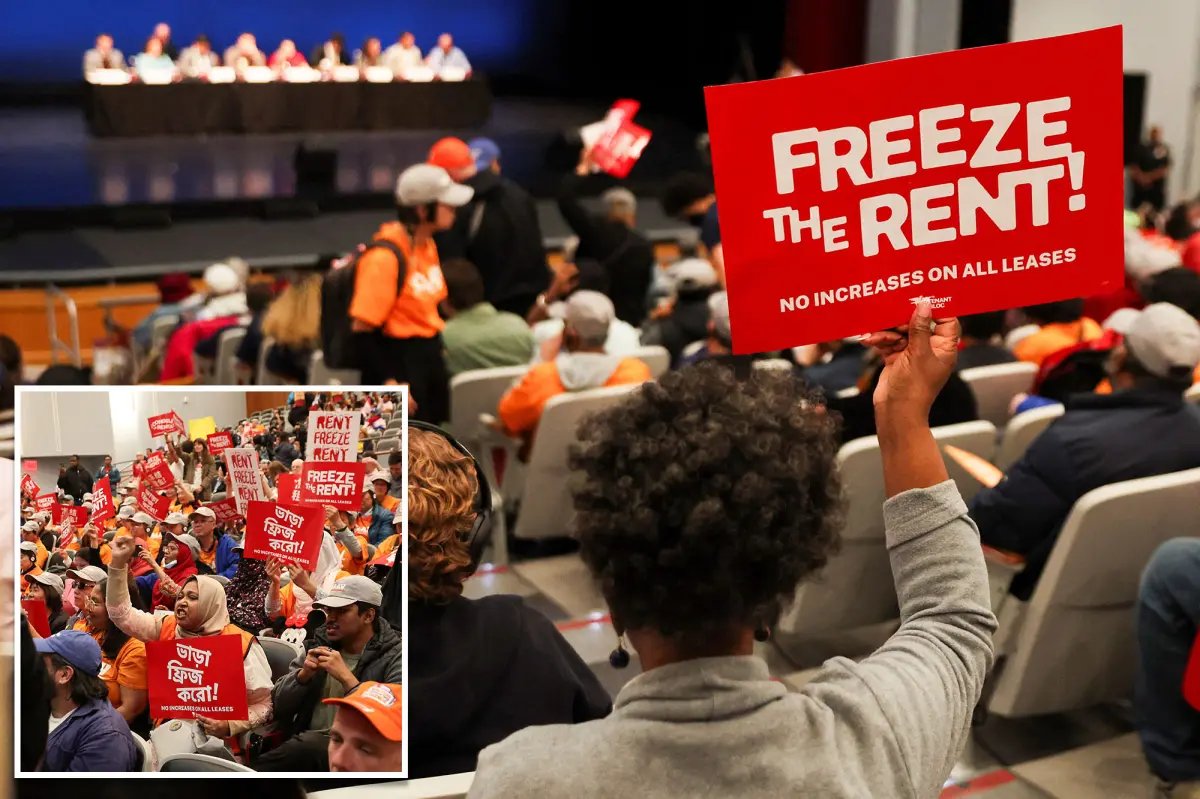

Members of the city’s Rent Guidelines Board signaled they’d potentially freeze the rent on New York City’s nearly one million rent-stabilized apartments during a preliminary vote Thursday.
The move by the board — which is packed with socialist Mayor Zohran Mamdani allies — was made after repeated warnings from landlords that the lefty mayor’s “freeze the rent” campaign would put them in a pinch.
The nine-person Rent Guidelines Board, which has six of Hizzoner’s personal picks, supported an increase of between 0% and 2% on one-year leases, and 0% and 4% increase on two-year leases for rent-stabilized apartments. A final vote to decide the fate of the city’s rent-stabilized units will be held over the summer.

The board, however, shot down a first motion that would have guaranteed a rent freeze or even a decrease in rent. Their vote against a -3% to 0% freeze on one-year leases and a -4.5% to 0% freeze on two-year leases drew a chorus of boos from the crowd at the LaGuardia Community College Performing Arts Center in Queens.
“New Yorkers are being crushed by the cost of living, and they need real relief. I’m encouraged to see the Board taking seriously the data around affordability, operating expenses, and the pressures facing both tenants and small property owners as it sets this preliminary range,” Mamdani said in a statement following the meeting.
“As the RGB begins its public hearings, tenants, owners, and New Yorkers from every borough should make their voices heard and speak directly to what this housing crisis looks like in their lives,” the mayor added.
The RGB also voted to approve a rent freeze on all rent-stabilized hotels.
The decision was met with dismay from Big Apple landlords, who called the board’s decision “reckless and irresponsible.”
“This vote continues a decade-long pattern of defunding privately owned rent-stabilized housing stock and clearly surrenders to City Hall’s political pressure,” said Ann Korchak, board president of the Small Property Owners of New York.
“It ignores the severe economic realities of mom-and-pop, generational, immigrant small property owners whose capped rent streams make it impossible to keep pace with skyrocketing property tax, insurance, utility, repair, and all other operating costs,” she added.

The board’s call to halt rent increases comes despite data presented at the board’s previous meetings this year – showing that more than 5,000 buildings in the five boroughs are near total financial collapse.
Costs increased for small property owners across the board in 2026, with rent-stabilized buildings built before 1974 bearing the brunt of rising insurance costs.
While the RGB argued that landlord income was up 6.2% across the board, owner advocates rebutted that the group is using a “millionaire average” in their calculations.
“If you take one millionaire and average it with minimum wage earners, you will not get a realistic average of wages, and you can’t do that with these buildings either,” said New York Apartment Association president Kenny Burgos at the group’s final meeting before the preliminary vote.
Burgos added in a statement after the meeting that the board’s supported increase range is “an example of politics over people.”
“The final vote impacts hundreds of thousands of tenants and owners. Politics has pitted the two groups against each other as if they’re not all New Yorkers who are investing in their communities and seeking the same thing: the means to live,” Burgos said after Thursday’s vote.
“An owner’s ability to pay for the costs of the building you’re living in should matter to every tenant. Rent isn’t going into the pockets of rent-stabilized owners, it’s going into keeping the buildings standing. This threat of a rent freeze nearly guarantees our owners and tenants will live in declining conditions for years to come.”
The move comes as billionaire bigwigs Ken Griffin and Marc Rowan are pulling thousands of jobs out of the Big Apple and setting their sights elsewhere over Mamdani’s “tax the rich” antics — stoking fears that a big-money exodus is underway.
The board will hold five more meetings, including four public hearings, before its final vote on June 25 – officially deciding whether to freeze or raise rents.
