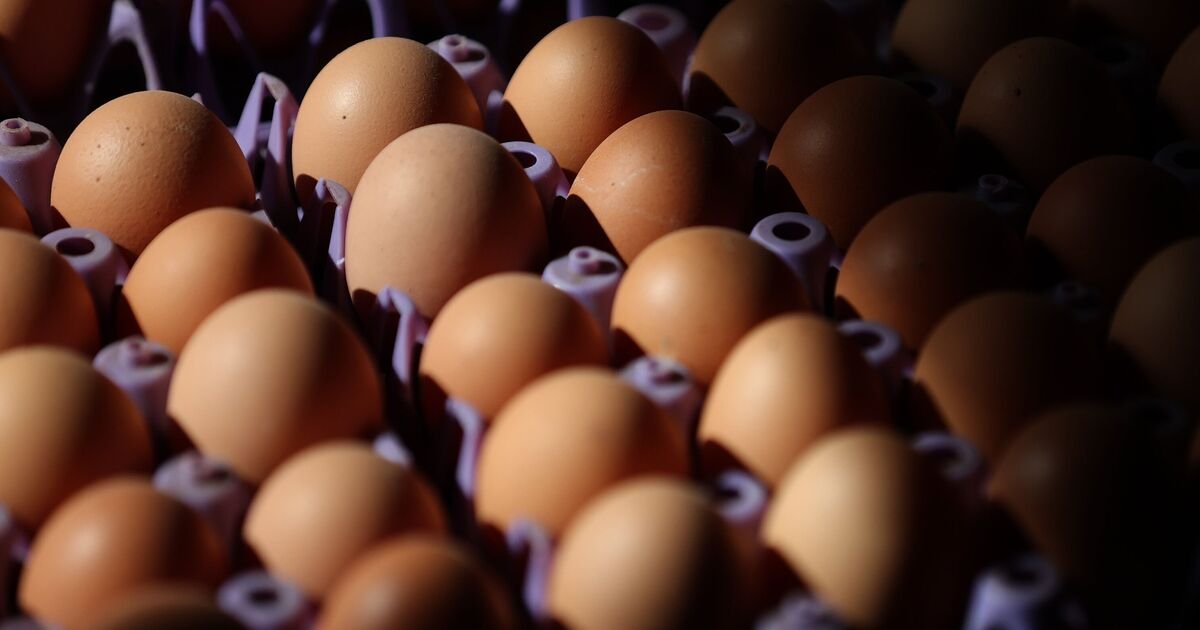


Have you ever wondered what the letters stamped on eggs mean? (Stock image) (Image: Getty Images)
Have you ever noticed the red numbers printed on eggs picked up from a supermarket or your local shop and wondered what they mean? Most eggs sold in the UK feature a red stamp showing a lion along with two lines of numbers, but not everyone knows what they are for.
TikTok account madegooduk, who has nearly 58,000 followers and regularly shares guidance on shopping more responsibly, ethically, and sustainably, has lifted the lid on what these codes actually indicate. The lower line of numbers is relatively simple – it’s a best before date – the hint is that they start with ‘BB’. The upper line, however, is rather more difficult to interpret if you’re unfamiliar with it, reports the Mirror.

One of the numbers tells you the conditions the hens which laid the eggs were kept in (stock image) (Image: Getty)
The code starts with a single digit ranging from zero to three, followed by the country of origin – usually UK – and then an additional series of numbers. madegooduk clarified that the initial number “tells you how the hen lived”. “One of those numbers means she lived in a cage with less usable space than a single A4 sheet of paper,” he stated.
He added: “Most people reach for a box that says free range on the front and assume, or hope, that the hens are living a lovely life outdoors. But the marketing on the box completely hides the reality, how crowded their living spaces (are), how much time they get outside, or whether their beaks are trimmed as chicks. None of that is printed on the carton, but that little red code stamped on the shell gives you the entire truth.”
He proceeded to explain that the number one signifies a free-range flock – although this may not align with shoppers’ expectations. “A standard free range flock can have up to 16,000 birds crammed into a single building,” he said.
“But in a crowd that big, the hens get stressed and start pecking each other. So to combat this, a common practice is to cut off up to a third of a chick’s beak.
“So how do you avoid having 16,000 hens squeezed in together with cut beaks? Well, you look for the number zero on the shell, which means organic. Zero changes everything. Organic caps the flock at 3,000 hens, gives them far more space inside, and doesn’t allow routine beak trimming, so chicks aren’t just automatically trimmed at the hatchery.”
He noted that a number two shows hens were kept indoors in a barn, though not in cages, while three signifies they were caged “with less usable space than an A4 piece of paper”.
Outlining what consumers should seek when purchasing eggs, madegooduk stated: “Our gold medal goes to purely organic. It’s code zero, so it gets the 3,000 flock cap, extra space, and no routine beak trimming.”
He also urged shoppers to look out for egg boxes bearing an RSPCA Assured badge, which confirms that farms have been assessed by the animal welfare charity, as well as a Soil Association label, though he pointed out this is rarely found outside farm shops. “It’s the gold standard,” he said. “Hens are let out at 12 weeks rather than 21, they get double the outdoor space, and beak trimming is completely banned.”
He wrapped up by saying: “So here’s our rule for the egg aisle. Read the first digit on the shell, not the front of the box as a friendly-looking brand and a cute message tells you almost nothing.”
Regarding the remainder of the red stamp, according to egginfo.co.uk, the Lion mark signifies that the hens responsible for producing the eggs have been vaccinated against salmonella, and that codes of practice were upheld throughout the entire production process. The concluding sequence of numbers on the top line identifies the specific farm where the eggs originated.
