


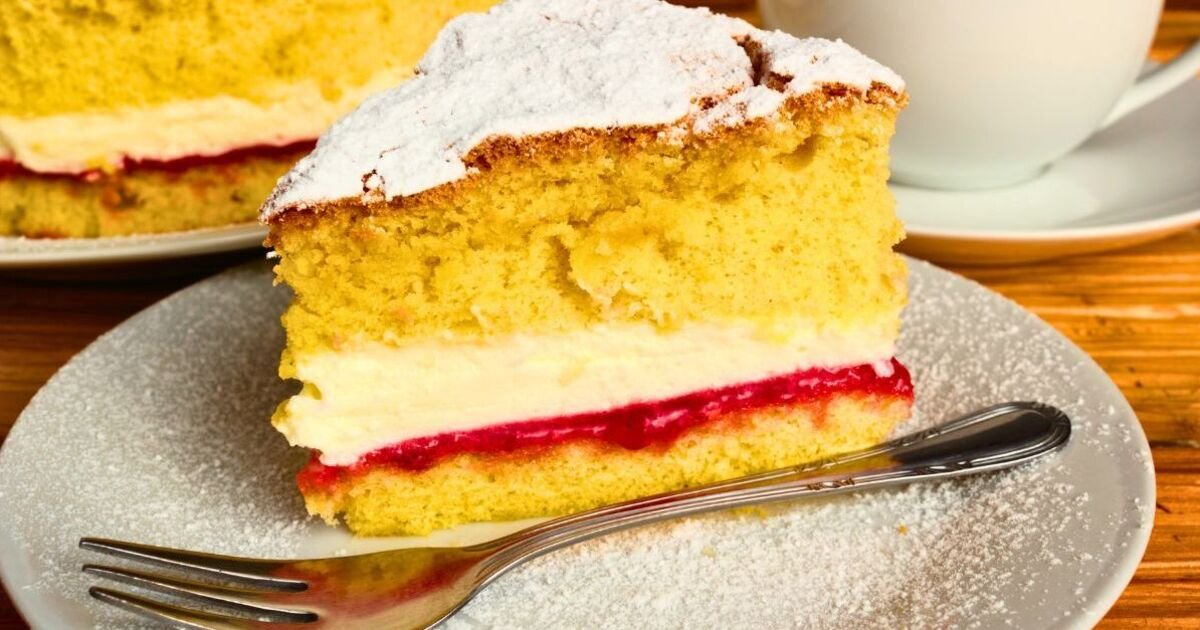
Victorian sponge cakes are one of the easiest desserts to make, and are perfect for a lazy evening when you want to bake something delicious without too much fuss. However, this cake type can sometimes not rise properly in the oven, and you need to be careful what ingredients you are using if you do not want a sunken sponge.
Rachael, the baker behind Tea with Mum, has revealed that the biggest mistake people make when following a Victorian sponge cake recipe is using eggs that have lost their freshness. She said: “If your eggs are older than about 1 week, your cake will be flat. How do you test it? Pour a glass of water and carefully drop an egg in it. If it sinks to the bottom on its side, the egg is fresh enough to use. If it sits on the bottom with its top or bottom pointing to the top, the egg is about a week old.”
Why do Victorian sponges need to be made with fresh eggs?
It might sound odd, but eggs are often the most important ingredient when baking a Victorian sponge, as they help the batter trap air, so the cake rises evenly.
Fresh eggs have firmer whites and much thicker yolks, and when the eggs are older, they will begin to break down, which will weaken the cake’s structure.
Older eggs are simply more watery, and using them will lead to the batter being heavier, which means it may not rise properly or split while cooking.
Victorian sponge cakes only have a handful of ingredients, which means the taste of each one matters, and even a small change can give it a much duller flavour. If you want to make the best cake possible, then use eggs.
Only use eggs that have been bought in the last few days, and store them in the fridge as soon as you get home from the supermarket.
How do you make the perfect Victorian cake?
You will need
For the cake:
- 225g of butter (room temperature)
- 225f of caster sugar
- Four large eggs (fresh)
- Two teaspoons of vanilla extract
- 200g of plain flour
- 25g of cornflour
- Three teaspoons of baking powder
- Three tablespoons of whole milk
For the filling:
- 200g of double cream
- Two tablespoons of icing sugar
- One teaspoon of vanilla extract
- Three tablespoons of raspberry jam
- 125g of fresh raspberries (optional)
Method:
1. To begin, preheat the oven to 170°C fan. Grease two 20cm cake tins with butter and line the bottoms with baking paper. Then, pour the caster sugar and butter into a bowl and stir together until you get a pale yellow and creamy consistency.
2. Crack the eggs one at a time into the mixing bowl, and stir again. Add the vanilla extract and briefly stir, but be careful not to overmix.
3. Sift the flour and baking powder into the mixing bowl, and fold them into the batter with a silicone spatula.
4. Slowly pour and mix the milk into the batter with a spoon, and then it is ready to go in the oven. Pour the batter into the prepared cake tins and use a spatula to smooth the cake tops.
5. Place in the oven and cook for 20 to 25 minutes until the tops of the cakes are golden. Once fully baked, that the cakes out of the oven and let them rest in the cake tins for 5 minutes.
6. Once the time is up, take them out of the tins, peel off the baking paper and leave them to cool completely.
7. To make the filling: Pour the double cream into a small bowl and also sift one tablespoon of the icing sugar. It is better to use a sieve, so there are no lumps in the filling.
8. Pour the vanilla extract into the bowl and mix everything together. When the cakes have fully cooled down, spread the filling on top of one of the cakes.
9. Spread the raspberry jam on the bottom of the second cake. Add some double cream and fresh raspberries as well. Place the second cake on top of the other cake. Dust with icing sugar and your incredibly tasty cake will then be ready to serve.