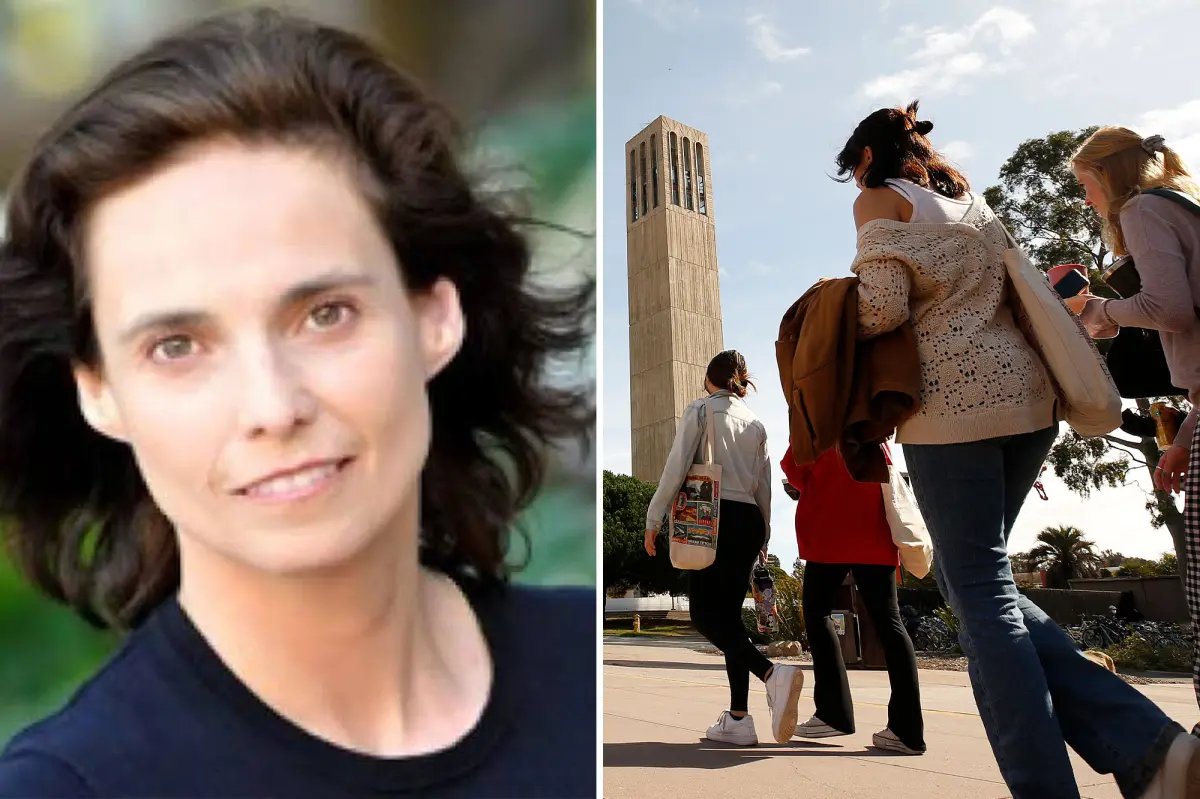


A female UC Santa Barbara professor was underpaid by nearly $3 million while a less experienced, white male colleague cashed in, according to a lawsuit.
Edwina Barvosa, a Harvard-educated professor of applied social and political theory who has taught at UCSB since 1998, claimed she was paid far less than a man hired eight years after her for the same job, according to the suit filed in Santa Barbara County Superior Court in June.
The complaint identifies the colleague only as “Professor Y.” The suit was first reported by the student-run paper, The Daily Nexus.
In 2023, Professor Y took home $232,050 in total pay while Barvosa earned $150,317. In 2024, the difference grew to $94,700: $251,700 for him and $157,000 for her.
Barvosa claimed she was underpaid at least $991,478 in base salary, or about $2.96 million with interest. Her lawyers argued the total hit exceeds $30 million once her pension losses are compounded over the next 39 years.
The suit claimed the two professors come from similar backgrounds. Both grew up working class and are of Mexican American heritage. Barvosa claims she has about a decade more experience.
“Dr. Barvosa has suffered and continues to suffer extensive harm as a result of defendants’ unlawful employment practices, including, but not limited to, extensive professional, financial, and non-economic damages, as well as physical injuries that have now led to life-threatening illnesses and related emotional harm,” the lawsuit alleged.
The suit names the UC Regents, UC President James Milliken, UCSB Chancellor Dennis Assanis, Executive Dean Pierre Wiltzius and Social Sciences Dean Charles Hale.
It accused them of violating California’s Equal Pay Act, discrimination, harassment, whistleblower retaliation and intentional infliction of emotional distress.
Barvosa is seeking back pay, damages, punitive damages and a court order barring the university from claiming ownership of her scholarly work.
UC Santa Barbara declined to comment. The UC Regents did not return The Post’s request for comment.
When Barvosa raised her “gender pay gap” with the executive dean of the College of Letters and Science, “he admitted that he knew Dr. Barvosa was underpaid but said there was not anything he could do about it,” the filing claimed.
The dean then decided she wasn’t worthy of a $200 raise or a promotion to full professor, the suit continued.
He said her book hadn’t been fully accepted by Cambridge University Press and she hadn’t spent four years at her current step, it went on.
But six to 12 months earlier, the same dean signed off on Professor Y’s promotion even though his book wasn’t finished, according to the suit.
The filing calls the double standard “nothing more than… gender discrimination.” Barvosa complained in writing about the pay gap in December 2020, according to the suit.
On June 14, 2021, she claimed she was hit with a baseless reprimand. That same day, she was passed over for a prestigious endowed chair, which went to Professor Y.
The suit described a toxic workplace:
- An associate dean “aggressively lunged across the faculty meeting table” to pressure Barvosa into voting for the aggressor’s own salary bump, it claimed.
- The school’s research office blocked her STEM discrimination study with the University of Texas, falsely accusing her of plagiarism, the suit argued.
- Her sabbatical was held up over a research report she had already turned in years earlier, it alleged.
The complaint also said her department was known for tension between white and minority faculty. It describes a professor who “insisted on the right to routinely use the ‘n-word’ slur, despite graduate student complaints.”
This year, her own department voted 9-0 to advance her, according to the suit. The school’s top personnel committee recommended no raise at all.
Barvosa claimed she lost part of a finger and suffered a permanent knee injury. She says years of workplace stress triggered a heart attack on Dec. 9, 2024, despite her having no other risk factors.
The suit comes as UCSB faces backlash over another discrimination controversy, this time involving its Alpha Phi chapter, whose members accused a volunteer recruitment adviser from the sorority’s national organization of sidelining women of color during fall recruitment.
Members alleged noticeably diverse group of prospective recruits disappeared from the candidate pool, while current sisters of color were left off recruitment schedules.
The adviser was removed, and the university said discrimination reports are reviewed by its Office of Discrimination and Harassment Prevention, but did not confirm whether it is investigating.
