


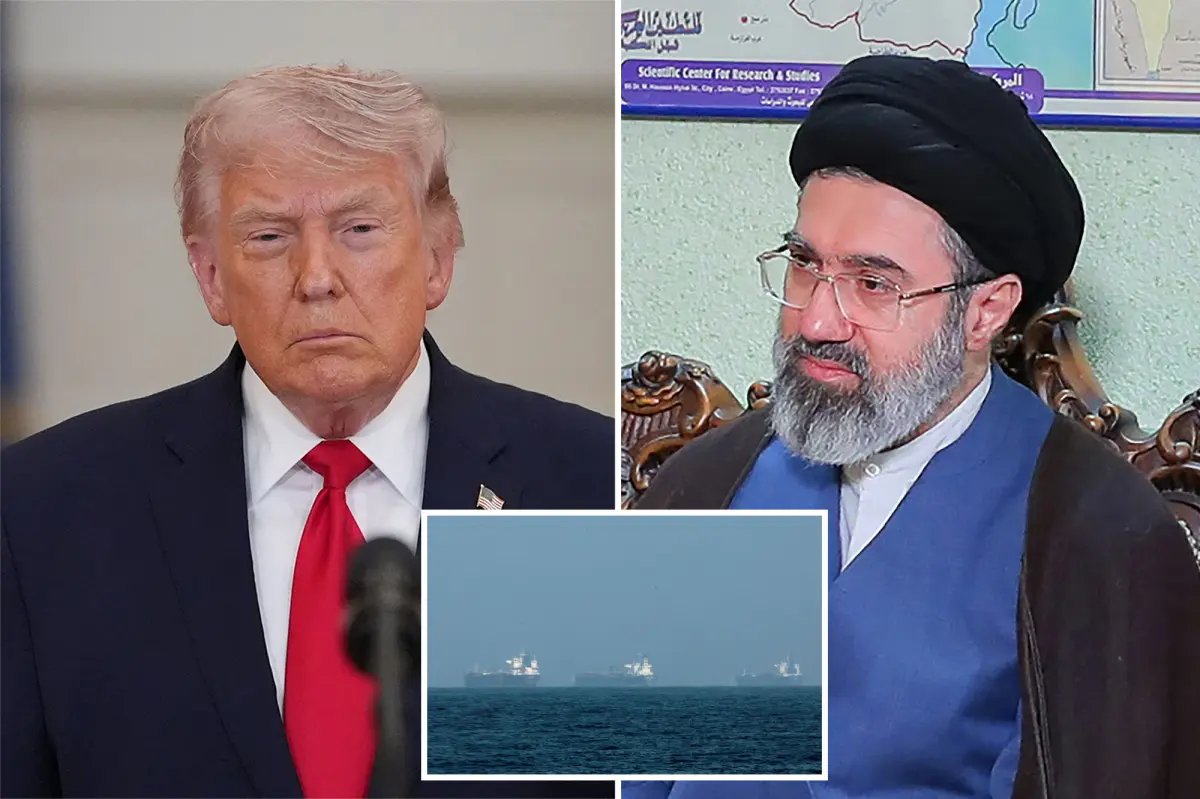

WASHINGTON — President Trump has warned Iran that a continuing cease-fire hinges on whether it reopens the Strait of Hormuz, as more than 300 commercial ships are awaiting passage through the critical chokepoint in the Persian Gulf.
Shipbrokers have said that just a “handful” of ships are exiting the strait, through which roughly one-quarter of the world’s seaborne oil is exported, but a United Arab Emirates noted Thursday that passage is still “being restricted, conditioned and controlled.”
“This moment requires clarity. So let’s be clear: the Strait of Hormuz is not open,” said Sultan Ahmed Al Jaber, an Emirati politician and the head of the Abu Dhabi National Oil Company.
The uncertainty caused crude oil prices to jump back up to around $100 per barrel as markets opened Thursday — after inching down to $95 apiece when the cease-fire was announced.
Trump posted on his Truth Social late Wednesday that US forces would remain in the region until Tehran made good on its agreement.
“It was agreed, a long time ago, and despite all of the fake rhetoric to the contrary – NO NUCLEAR WEAPONS and, the Strait of Hormuz WILL BE OPEN & SAFE,” the president said.
Deputy foreign minister Saeed Khatibzadeh told ITV News Thursday that it was open to ships pending approval from Iranian authorities.
Around 300 to 400 ships have been approved “under Iranian military coordination” to transit the waterway — with between 10 and 15 creeping through it a day starting April 8, according to a report from Athens-based Xclusiv Shipbrokers.
The Islamic Revolutionary Guard Corps has threatened vessels trying to exit “without permission will be destroyed,” charging up to $1 per barrel of oil — to be paid in cryptocurrency or Chinese yuan — for safe passage, the report stated.
Large crude oil tankers can hold up to 2 million barrels, per the US Energy Information Administration.
Trump has suggested that the US and Iran could both participate in charging tolls for the ships, though Tehran’s Supreme National Security Council is currently in control of charging vessels on its side of the strait, shipbrokers said. Oman is claiming authority over its side and has rejected any tolls.
“Despite this toll being totally illegal, it could offset a significant amount of additional war risk premium,” Xclusive noted in its report. “We have heard from sources on the morning of the 8th April that the extra war risk premium for vessels obtaining clearance has been substantially reduced.”
Around 820 commercial vessels currently remain trapped in the Gulf, with just five having exited on the first day of the cease-fire Wednesday, according to global ship tracking firm Kpler.
“All U.S. Ships, Aircraft, and Military Personnel, with additional Ammunition, Weaponry, and anything else that is appropriate and necessary for the lethal prosecution and destruction of an already substantially degraded Enemy, will remain in place in, and around, Iran, until such time as the REAL AGREEMENT reached is fully complied with,” Trump warned Iran late Wednesday in his Truth Social post.
“If for any reason it is not, which is highly unlikely, then the ‘Shootin’ Starts,’ bigger, and better, and stronger than anyone has ever seen before.”
Deputy foreign minister Saeed Khatibzadeh told ITV News Thursday that the strait was open to ships not expressing “hostile behavior” and pending approval from Iranian authorities.
Before the war broke out, roughly 135 freely sailed through the strait per day, carrying crude oil, fertilizer, grain, medical supplies and other critical goods.