


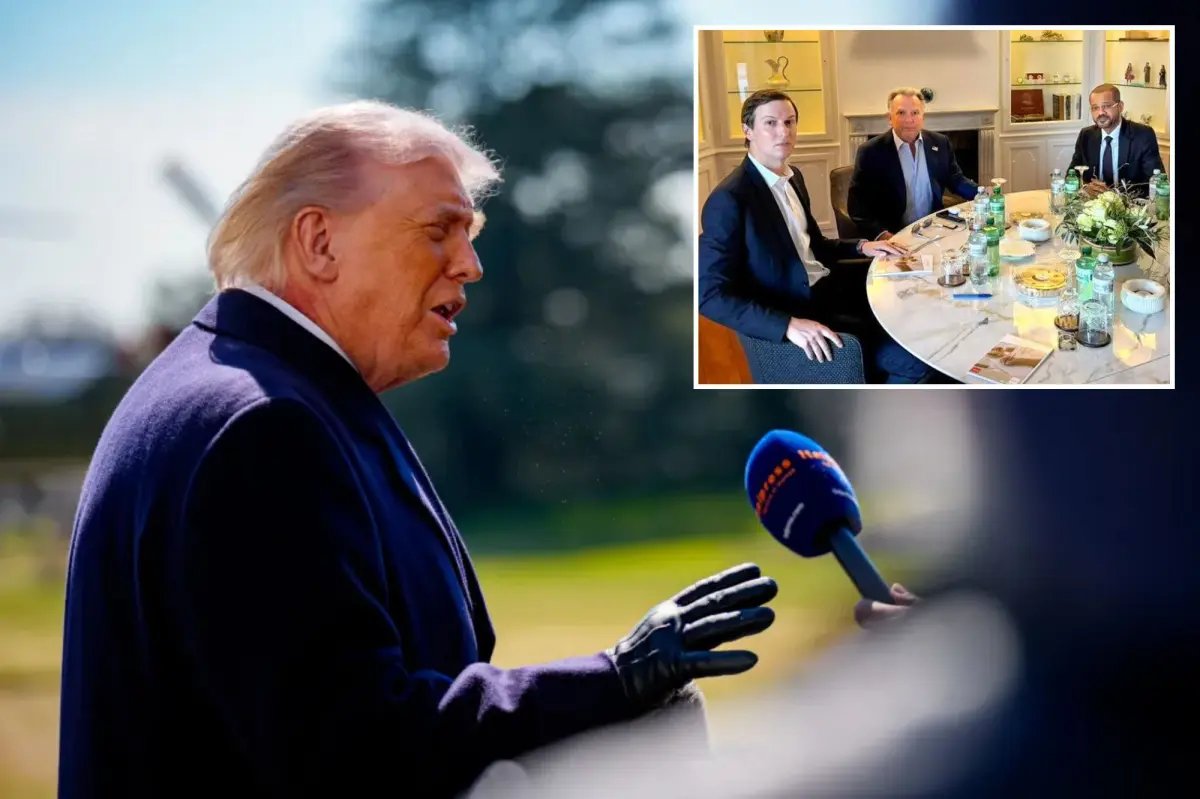
WASHINGTON — President Trump said Friday that he’s “not happy” about the progress of talks with Iran — while telling reporters that “there’s always a risk” that US airstrikes could result in another drawn-out war in the Middle East.
“I’m not happy with the fact that they’re not willing to give us what we have to have. I’m not thrilled with that. We’ll see what happens,” Trump said — one day after Iranian diplomats rebuffed his demands to give up their nuclear program during talks in Geneva.
“We are talking later. We’ll have some additional talks today. But no, I’m not happy with the way they are going.”

Trump insisted that “we haven’t made a final decision” on whether to follow through with threatened strikes following a massive buildup of American naval and air assets within striking distance of Iran.
“We’re not exactly happy with the way they’re negotiating. They cannot have nuclear weapons,” he reiterated.
A reporter then asked Trump if there was “a risk that strikes could turn into a long, drawn-out conflict in the Middle East.”
“I guess you could say there’s always a risk,” the president replied. “You know, when there’s war, there’s a risk in anything, both good and bad.”
Follow The Post’s live coverage of President Trump and national politics for the latest news and analysis
Trump’s special envoy Steve Witkoff and son-in-law Jared Kushner represented the president Thursday in Switzerland and are preparing for followup talks Monday in Vienna.
Meanwhile, Secretary of State Marco Rubio is scheduled to be in Israel Monday and Tuesday for meetings with Prime Minister Benjamin Netanyahu.
The Oman-mediated talks in Geneva got off to a bad start when Iran’s foreign minister, Abbas Araghchi, insisted his country had an inalienable right to enrich uranium — rejecting Trump’s central demand — but all sides left saying progress was made.
Omani foreign minister Sayyid Badr Al-busaidi met Friday with Vice President JD Vance in Washington to discuss the status of talks.
In his first term, Trump abandoned former President Barack Obama’s 2015 nuclear pact with Iran, called the Joint Comprehensive Plan of Action, arguing it lacked comprehensive safeguards to block atomic weapon development by the theocratic regime.

Trump’s use of gunboat diplomacy to back up his call for complete denuclearization follows his airstrikes in June 2025 on three Iranian nuclear facilities — Fordow, Natanz and Isfahan — in support of Israeli military action.
The president’s acknowledgement that further action could spark a major war is significant because of his own record of slamming his predecessors for destabilizing the Mideast with regime-change interventions, often singling out President George W. Bush’s 2003 decision to invade Iraq.
But Trump quickly followed his remark Friday with examples of one-off strikes that lost no American lives — including the Jan. 3 raid that captured longtime Venezuelan President Nicolas Maduro and brought him to New York to face federal drug and weapons charges.
“We’ve had tremendous luck with myself — Soleimani, al Baghdadi, everything worked out — and then we do the Midnight Hammer and so many others. Everything’s worked out, and we want to keep it that way,” Trump said.
“But we’re going to see. Look, it’d be wonderful if they negotiate really in good conscience, good faith and conscience, but they are not getting there.”