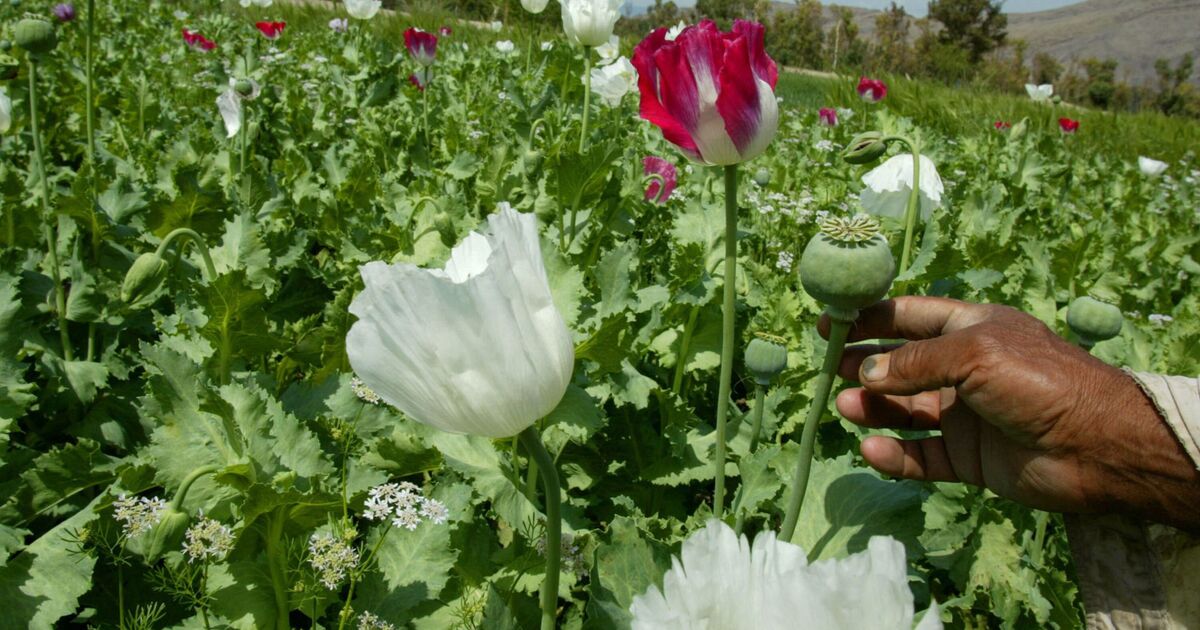

Afghan poppy farmers have been travelling over to Pakistan to farm the flower, whose seeds contain the key ingredient in heroin, after The Taliban imposed a ban on it in 2022. Now, according to satellite imagery, Pakistan is overtaking Afghanistan as the primary source of the world’s opium, and the shift could put millions of dollars in the hands of terrorist groups.
The images show a surge of large poppy fields in Balochistan, a province in South-west Pakistan and home to militant groups, including the Islamic State, and an expert says that the poppy crop in Pakistan could well exceed what is found in Afghanistan.
David Mansfield, an expert on Afghanistan’s opium trade who evaluated the US Government’s counter-narcotics programme, said that the size of the poppy farms, many of which are more than five hectares, and their locations near built-up areas suggest “unrestrained cultivation that has not ever been seen in Afghanistan even in its peak years of opium production”.
Afghan farmers are bringing technical expertise across the borders, such as using solar power to extract water from deep wells to grow poppies in the desert terrain, and according to analysts, the profits from the drugs business are likely to benefit the armed groups that control the major trade and human-smuggling routes that run through Balochistan.
Mr Mansfield told The Telegraph: “People talk about Balochistan as the new Afghanistan. It’s unruly. There’s a lot of different armed groups there.”
Around a staggering 8,100 hectares of poppy farms have been discovered in surveys of just two small areas of Balochistan. In contrast, over in Afghanistan, 8,000 hectares are found across two-thirds of its provinces.
Satellite imagery collected by geographic data company, Alcis, showed that up to 70% of agricultural land in Balochistan is given over to the crop.
The majority of Afghan farmers either rent land from Baloch locals or work as share-croppers for them, travelling across the border, which is constructed by a double-barbed wire fence.
Poppy farmers in the area say that they are required to pay “Pakistani militia” to export the crop, referring to local police forces like the Frontier Corps, who have long been accused of corruption.
One migrant Afghan farmer, who spoke on the condition of anonymity, said: “It’s very difficult to get land and grow poppies without a share for the local Baloch. They know the Pakistani militia in the area.”
The rise in farming can be followed on social media, which is flooded with videos of large fields of the flower and the next stages of production.
Despite the drugs business, Pakistani officials still maintain the status of “poppy-free” since it first declared it in 2001.
Provincial representatives in the Balochistan Assembly held a debate on the surge in poppy production last month, with members condemning the rise in drug production.
Zabid Reki, a member of the opposition, said: “The unchecked expansions of this crop is poisoning our youth and must be addressed urgently.”
A local MP from the ruling Government coalition responded that “poppy cultivation will not be tolerated” and called on the Opposition to help identify farms.
