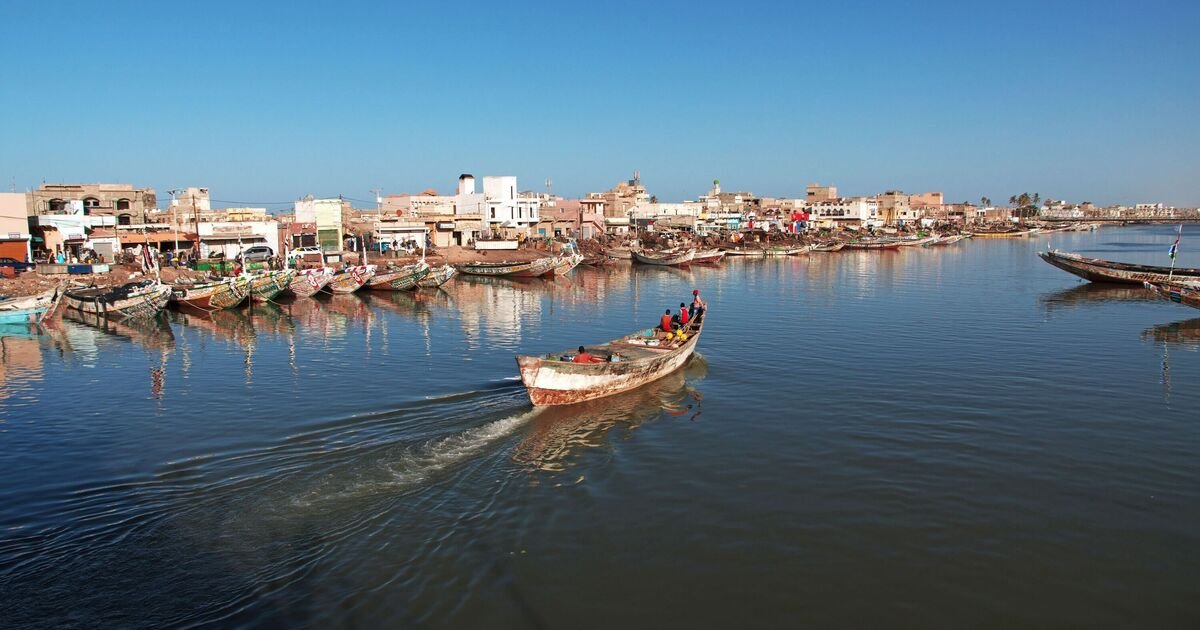

A town has been dubbed the ‘Venice of Africa’ because it’s slowly disappearing into the sea. Saint Louis, Senegal’s former capital, has a vulnerable topography with the Atlantic to the west and the Senegal River to the east.
Due to climate change, the fragile coastline is being eroded and its houses devoured by the sea. Today, high tides reach as far as the war memorial, several hundred metres inland. A failed initiative in 2003 to reduce flooding by digging a canal only exacerbated the problem, flooding an entire neighbourhood. And a decade later, a government report predicted that by 2080, 80% of the city will be at risk of flooding.
“Saint Louis is a water city,” says Cheikh Badiane, a retired fisherman. “If we are not careful, it will disappear.”
The impact of this phenomenon is already forcing many residents of Saint Louis to leave their homes. More than 3,000 residents have been relocated from coastal areas due to the threat of flooding. Cheikh Badiane and others are resigned to moving. “Everyone must go,” he sighs.
This is not just a local concern; the rapid growth of West Africa’s coastal cities could make Saint Louis a harbinger of the future. Lagos, Nigeria’s largest city, and Mauritania’s capital, Nouakchott, face a similar situation. Nouakchott lies below sea level and is protected only by a thin strip of dunes.
The World Bank estimates that 42%f West Africa’s GDP is generated in coastal areas, home to 33% of its population. Despite this, coastal cities will cease to be population magnets by 2050 due to increasing devastation from flooding and erosion.
The World Bank suggests nature-based solutions, such as mangroves and coral reefs, but these are also threatened by climate change.
Saint Louis illustrates the difficulties of containing the ocean’s advance. While there are attempts at sustainable solutions, the scale of the problem and the limited resources in poorer countries pose enormous challenges.
This means that many coastal communities will inevitably face relocation to higher ground. This trend will transform population dynamics and could turn cities themselves into sources of climate migration.
The reality in Saint Louis reflects an issue common to many West African coastal cities, highlighting the urgent need for global and sustainable solutions to mitigate the effects of climate change in the world’s most vulnerable regions.
