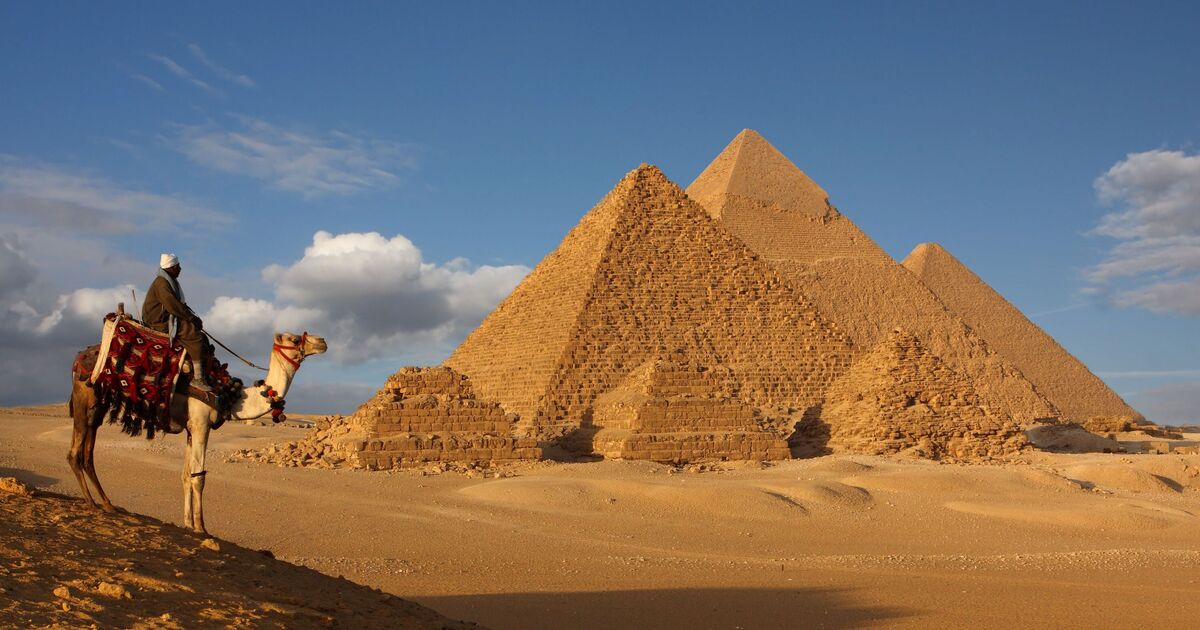

The Pyramid of Menkaure is a marvel of engineering despite being the smallest of the three renowned pyramids in the Giza Necropolis.
Located on the west bank of the Nile River, this iconic monument was built around 2530 BC for Pharaoh Menkaure, who ruled during the Fourth Dynasty of Egypt’s Old Kingdom.
Originally, the Pyramid was encased in gleaming white limestone, a feature that stone robbers have since stripped away over centuries.
Today, only remnants of these casing stones remain, giving the structure a rugged appearance that contrasts with its original splendour.
At 65 meters in height, the Pyramid may seem diminutive alongside the Great Pyramid of Khufu and the Pyramid of Khafre. Still, it’s intricate construction and historical significance make it a centrepiece of Egypt’s cultural heritage.
Pharaoh Menkaure, grandson of the Great Pyramid’s builder Khufu and son of Khafre, commissioned this Pyramid as his eternal resting place.
Menkaure’s reign, lasting around 20 years, is remembered for his contributions to monumental architecture and the enduring symbols of Egyptian power.
The Pyramid of Menkaure bears a scar of a different kind, a visible gash on its northern face, a relic of an ambitious but failed demolition attempt in AD 1196.
Al-Aziz Uthman, Sultan of Egypt and son of Saladin ordered the destruction of the pyramids, beginning with Menkaure’s. The goal was to repurpose their stones for other projects, but the operation proved almost as costly as the original construction.
For eight months, workers employed various methods, including levers, ropes, and wedges, to dislodge the massive stones.
Each fallen block often buried itself deep in the sand, requiring laborious efforts to recover and move it.
Despite their toil, the team removed only a few stones daily.
The slow progress and extraordinary expense ultimately led to the project’s abandonment, leaving the Pyramid intact but with its distinctive scar as a reminder of the attempt.
Today, the Pyramid of Menkaure continues to draw visitors worldwide, captivated by its history and the enduring mystery of its construction.
For those planning a trip, early morning visits are recommended to avoid crowds and enjoy the site in the cooler part of the day.
The Pyramid of Menkaure may be the smallest of the Giza pyramids, but its historical significance and the stories it holds are immense.
From its resilient architecture to surviving an attempted demolition, it is a tribute to the skill and determination of ancient Egyptian builders and the enduring allure of Egypt’s cultural legacy.
