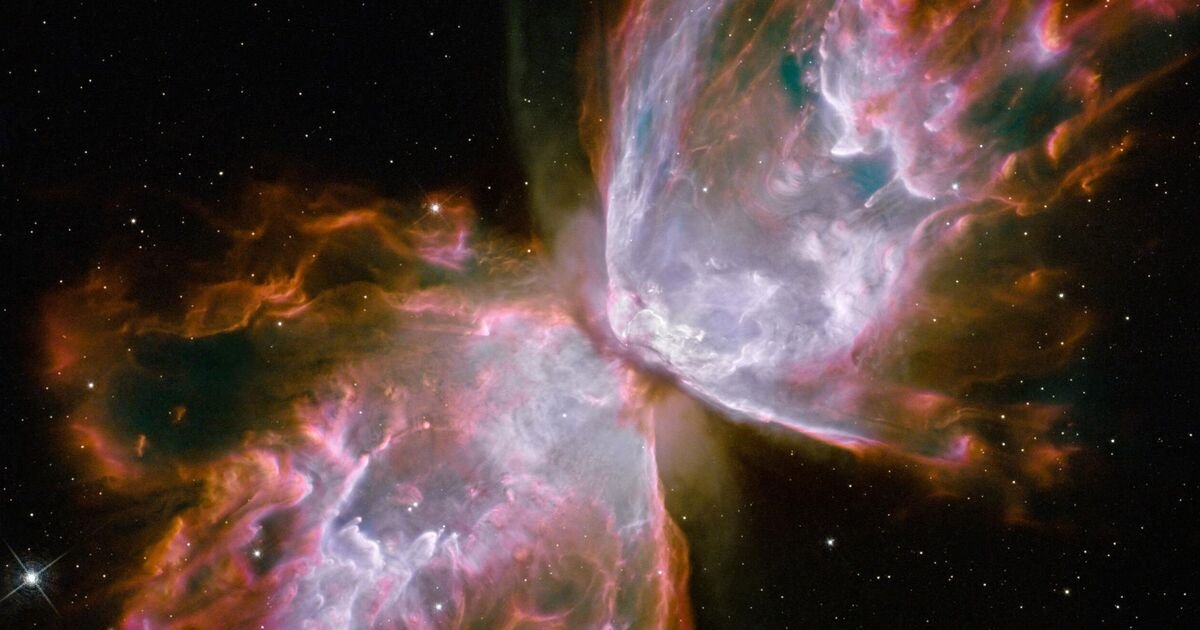

UK astronomers have revealed stunning images and secrets from the mysterious heart of the Butterfly Nebula – one of our galaxy’s most striking cosmic phenomena. Nebulae are large celestials clouds of interstellar gas, dust and plasma in space that can serve as ‘nurseries’ where new stars are born or the remnants of old stars die.
Located around 3,400 light-years away in the constellation Scorpius, the Butterfly Nebula boasts rare ‘wings’ of glowing gas previously captured in by the Hubble Space Telescope. But now new breathtaking images have been released from the powerful James Webb Space Telescope which have uncovered hidden structures and finally pinpoint the nebula’s elusive central star.
And at 220,000 Celsius they have found not only is its central star one of the hottest ever found, but the nebula contains carbon-based molecules known as polycyclic aromatic hydrocarbons – found on Earth in smoke and on burnt toast!
The new findings, helped by a team from The University of Manchester, have been published this week in Monthly Notices of the Royal Astronomical Society.
The Butterfly Nebula is what astronomers call a ‘bipolar nebula’ – having two lobes of gas that spread in opposite directions to form the ‘wings’ – but at the nebula’s central core is a dense band of dusty gas called the torus.
This structure energises the nebula and may be responsible for its insect-like shape by preventing gas from flowing evenly in all directions.
Using James Webb’s Mid-Infrared Instrument (MIRI), scientists have now been able to see through this dusty torus for the first time, providing an unprecedented view of its complex structure.
Combining images at many different wavelengths with data from the Atacama Large Millimetre/submillimetre Array in Chile, researchers including University of Manchester experts have discovered the butterfly’s central star is one of the hottest ever found in our galaxy – with a scorching surface temperature of around 220,000 Celsius.
Although this intense heat powers the nebula’s colourful glow, earlier telescopes lacked the sensitivity and resolution needed to see through the thick layer of dust, making the star impossible to detect at visible wavelengths.
Professor Albert Zijlstra, a co-author of the new paper on the nebula from The University of Manchester, said: “This is an extraordinary discovery.
“We’re looking at one of the hottest stars ever found – an object so elusive that even Hubble couldn’t detect it for decades. Thanks to JWST, we’ve finally uncovered it, concealed within its own dense shroud of dust.
“Surrounding the star is a massive dark torus, the heaviest ever observed around such an object, containing more material than our own Sun.
“Even Webb can’t fully pierce through it. Inside, the environment is sheer chaos; powerful radiation and stellar winds tearing into the surrounding cloud. It’s unlike anything I’ve ever seen.
“Most planetary nebulae appear graceful and symmetric, but this one is still at the beginning of its transformation – it’s more like a butterfly struggling out of its cocoon than the elegant shapes we’re used to seeing.”
The Webb data revealed that the torus is composed of crystals similar to quartz as well as unusually large grains of dust, suggesting they have been growing for a long time.
Outside the torus, the team observed jets of iron and nickel blasting away from the star in opposite directions, along with a multilayered structure made up of different atoms and molecules.
Perhaps most intriguing was the discovery of carbon-based molecules known as polycyclic aromatic hydrocarbons, or PAHs.
On Earth, these molecules are found in smoke from fires or even burnt toast – but they have never before been seen in an oxygen-rich planetary nebula.
The team believes the PAHs may form when a bubble of stellar wind bursts into the surrounding gas. The finding provides an important glimpse into the details of how these molecules form.
