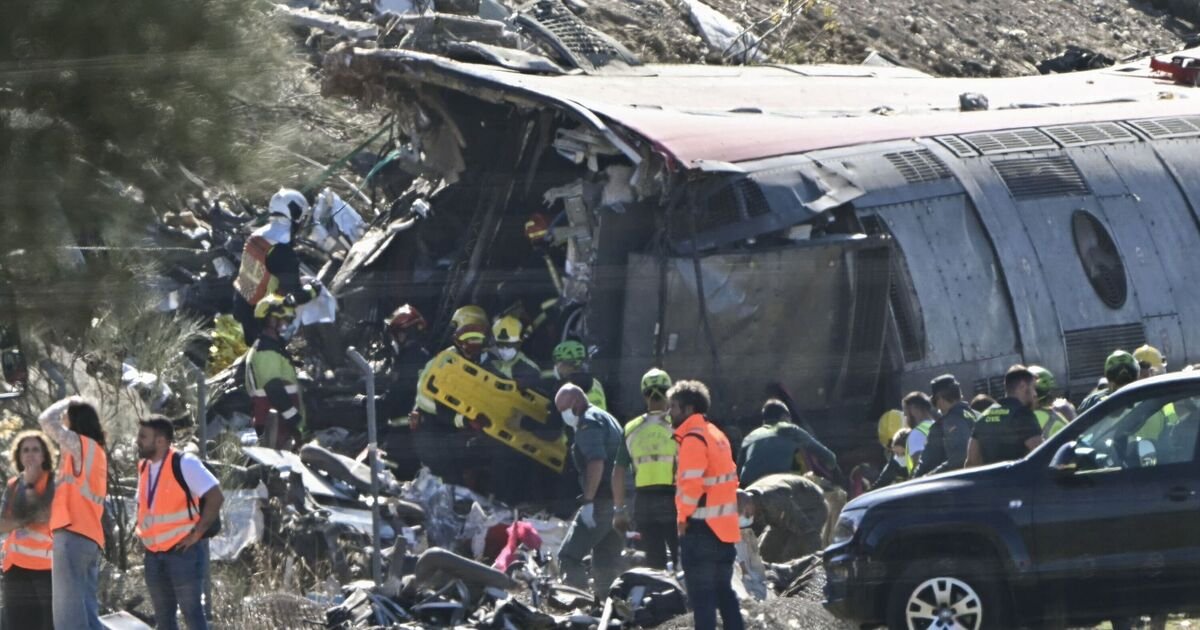

A Spanish engineer has sounded the alarm over the safety of the country’s railway network, urging the public to avoid travelling by train. Last month Spain was rocked by its second fatal rail disaster of the year, following a high-speed train collision in Madrid that claimed at least 69 lives and left dozens more injured. It is one of the worst rail disasters in Europe’s modern history and the country was already reeling from a high-speed rail disaster near Córdoba in January that killed 46 people.
Mechanical Engineer, Francisco Badea Romero, told The Express that railway incident’s of this magnitude in the 21st century is “bordering absurdity”.
The Professor at Nebrija University believes travelling by train is “clearly a risk” and has urged people to consider their safety and to avoid the Spanish railway network.
Mr Romero told The Express: “I would not take the train in Spain right now and would urge people not to, it is not safe.
“We have had two extremely grave incidents in a year, it is clearly a risk. The issue is across Spain, not just in Andalusia.
“We will almost certainly see a decrease in railway passengers, maybe things will begin to change after the election.”
Asked who might be responsible for the crash, Mr Romero pointed to failures in infrastructure management, arguing that proper maintenance of the track could have prevented the tragedy and spared 69 families from losing their loved ones.
He said: “Spain’s railway issues need to be addressed, the safety systems obviously failed. It is bordering absurdity that it was just a computer failure, it is extremely extremely unlikely, other systems surely would have failed.
“The likelihood of a crash like this is almost zero, this incident is something that could have happened 100 years ago but it is happening now despite all the safety regulations in place.
“This crash could have been prevented and 69 broken families could have been spared. There is obviously bad maintenance on the line and things haven’t improved since the fatal crash in Cordoba earlier this year.
“100s of kilometres of track needs to be addressed and checked. Perhaps Spain needs to go and visit other railways across Europe to see how they are working and where we are going wrong.”
Former Transport minister Óscar Puente, who resigned on Wednesday, said a computer failure at around 8.30am on the morning of October 28 led to the initial halt of six moving trains, including the two trains that subsequently collided.
“In the event of a system failure, the control centre takes over,” he said, adding it was the control centre that decided to allow the trains to move again, without any speed restrictions.
That decision, Puente said, was made “under inexplicable circumstances”. It resulted in the Renfe train crashing into the Iryo train, which was stationary on the tracks some distance ahead.
Spain’s high-speed rail network was considered one of the country’s crowning achievements. It is the world’s second-largest, after China’s. Until this year, it had not experienced a deadly crash since coming into service over three decades ago.
The crash in the Spanish capital is worst the country has seen since 2013, when 80 people died on the outskirts of Santiago de Compostela.
Railway unions in Spain have announced plans to strike on November 17 over railway safety.
