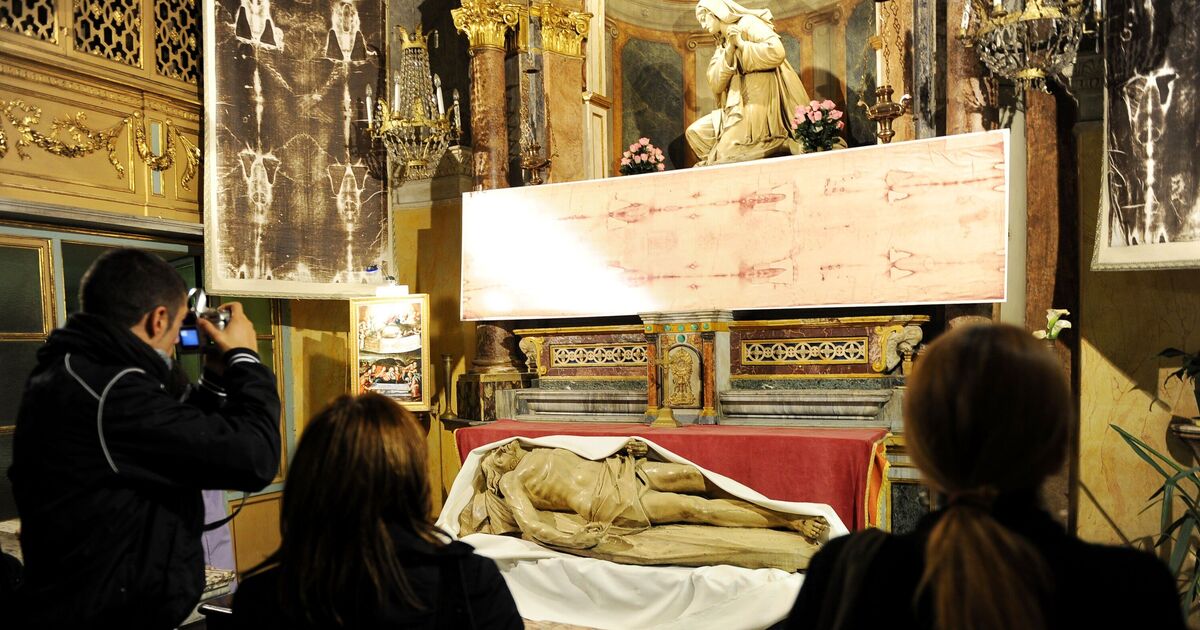

The Shroud of Turin, believed to be Jesus’ burial cloth, could not have been formed on a human body, according to bombshell new research. The image is far more likely to be an impression from a low-relief sculpture, a graphics expert has concluded. Brazilian 3D digital designer Cicero Moraes, who specialises in historical facial reconstructions, used modelling software to examine how fabric drapes over a human body compared to how it falls over a low-relief sculpture.
He told Live Science: “The image on the Shroud of Turin is more consistent with a low-relief matrix. Such a matrix could have been made of wood, stone or metal and pigmented (or even heated) only in the areas of contact, producing the observed pattern.” The shroud was first documented in the late 14th century, with debate over its authenticity as a genuine relic from Christ’s crucifixion beginning immediately.
Carbon dating analysis conducted in 1989 dated the shroud to between AD 1260 and 1390
During this period in European mediaeval history, low-relief representations of religious figures – including carved tombstones – were commonly used.
To examine how the Shroud of Turin might have been created, Moraes developed and studied two digital models. He used 3D simulation tools to virtually drape fabric onto two different body models: a 3D human body and a low-relief representation.
Comparing the virtual fabric to photographs of the shroud taken in 1931, he found that the fabric from the low-relief model almost exactly matched the photographs.
In contrast, the fabric deformed around the volume of the 3D body, resulting in a swollen and distorted image.
This is sometimes referred to as the “Agamemnon Mask effect”, named after the unnaturally wide gold death mask found in a tomb at Mycenae in Greece.
Moraes demonstrated this effect in a video by painting his face and pressing a paper towel to it, which resulted in distortion caused by imprinting a 3D object onto a 2D piece of fabric.
However, a low-relief sculpture wouldn’t cause the image to deform and would look more like a photocopy, similar to the Shroud of Turin. This occurs because it shows only the regions of potential direct contact, without any real volume or depth.
Moraes wrote: “[There’s a] remote possibility that it is an imprint of a 3D human body. It is plausible to consider that artists or sculptors with sufficient knowledge could have created such a piece, either through painting or low relief.”
