


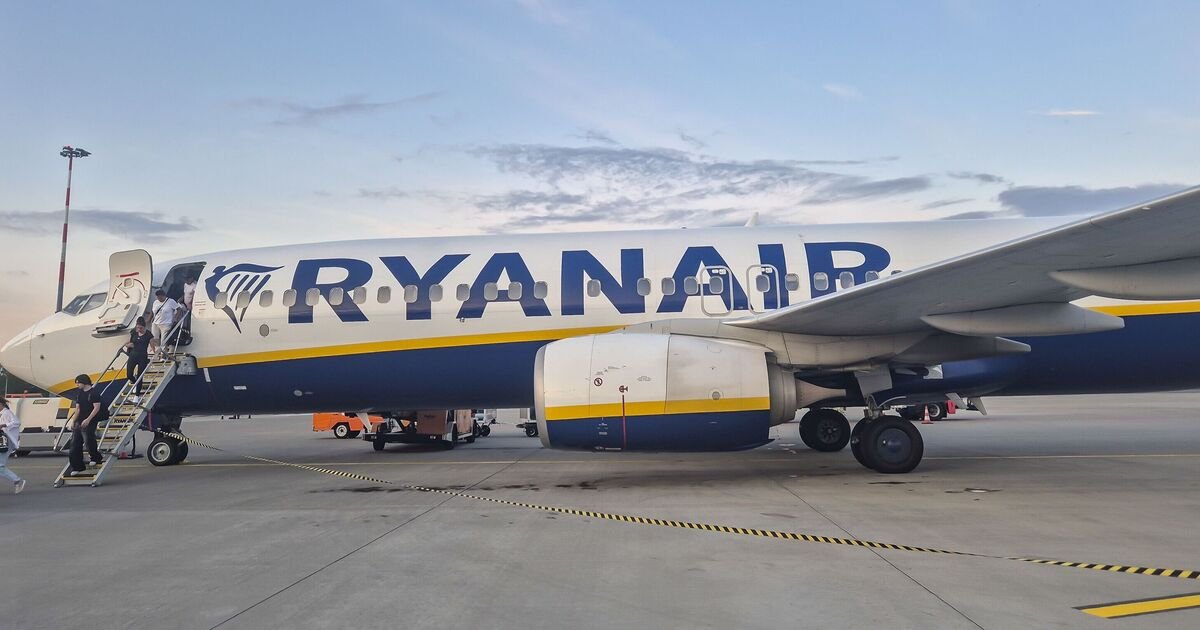
Holiday gloom is looming for thousands of Ryanair passengers as the airline begins cancelling flights to major Spanish destinations ahead of a prolonged baggage handler strike set to cripple operations through to the end of the year. Flights to and from Alicante, Ibiza, Palma de Mallorca, and Tenerife South are among those already being pulled from schedules, with more disruption expected across the airline’s entire Spanish network – despite the company suggesting disruption will be minimal.
The industrial action, organised by Spain’s UGT union, will involve staff from Azul Handling – Ryanair’s own ground services subsidiary – who work across 12 of the airline’s Spanish bases. The strike begins on August 15 and will continue every Wednesday, Friday, Saturday, and Sunday until December 31. Walkouts will occur during three peak windows: 5am to 9am, noon to 3pm, and 9pm to midnight.
These repeated stoppages will affect operations at Madrid, Barcelona, Valencia, Alicante, Malaga, Seville, Ibiza, Palma de Mallorca, Girona, Tenerife South, Lanzarote, and Santiago de Compostela – a network which covers virtually all of Ryanair’s major Spanish traffic hubs.
The union says the strikes are being held in protest against what it describes as exploitative working conditions.
Grievances include sanctions imposed on workers, excessive and mandatory overtime, restrictions on taking medical leave, and the persistent failure to consolidate part-time contracts into stable jobs.
According to UGT, Azul Handling has repeatedly ignored union demands and violated the basic rights of more than 3,000 employees.
Jose Manuel Perez Grande, federal secretary of the FeSMC-UGT Air Union, the branch of the union which represents airport workers, accused the company of maintaining “a strategy of precariousness and pressure on the workforce that violates basic labour rights and systematically ignores union demands”.
By law, minimum service must be maintained during industrial action in Spain, but the details of what that means in practice have yet to be defined.
Meanwhile, the union has requested formal mediation through Spain’s Interconfederal Mediation and Arbitration Service (SIMA), but with no agreement in sight, the strikes are expected to drag on for months.
A Ryanair spokesman said: “Ryanair does not expect any disruption to our operation as a result of these third-party handling strikes in Spain.”
Nevertheless, passengers have begun receiving notifications of changes to their itineraries, and the airline has advised affected customers of options including refunds, vouchers, or alternative flights.
In past disputes, Ryanair has temporarily banned hold luggage on affected routes, forcing passengers to travel with cabin bags only to avoid bottlenecks caused by unstaffed baggage belts.
The timing is potentially particularly painful for holidaymakers.
August is peak travel season to the Balearic and Canary Islands, and the impact is expected to stretch into the autumn half-term and the Christmas getaway.
This latest strike follows similar unrest at Spanish airports last year, and comes as Ryanair continues to warn about other systemic issues affecting European travel.
In June, the airline accused EU governments of failing to address chronic staff shortages in air traffic control centres, with CEO Michael O’Leary warning of “record ATC delays” if nothing is done before the end of summer.
With both ground operations and air traffic systems under strain, passengers flying to or from Spain with Ryanair in the coming months should prepare for potential chaos — and watch their inboxes.