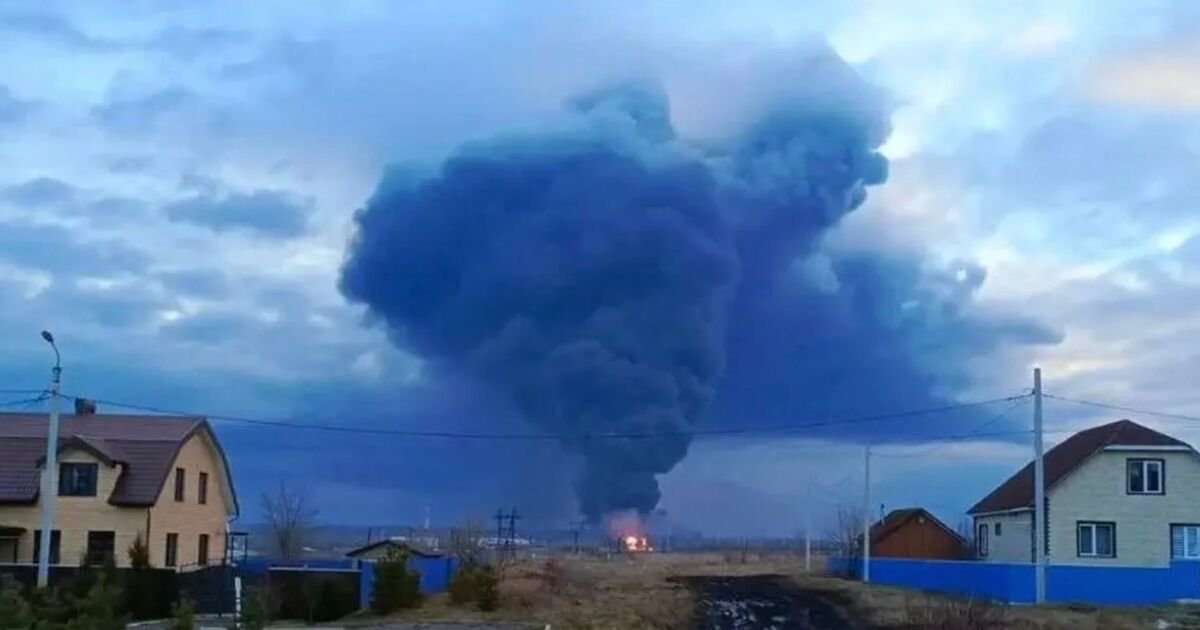

Vladimir Putin’s war machine suffered another major blow overnight after Ukrainian forces launched a coordinated wave of long-range attacks, setting two key Russian oil facilities ablaze and slamming a military airfield. The General Staff of the Armed Forces of Ukraine confirmed on Thursday (November 26) that its forces struck a Transneft oil transportation and storage hub in the Republic of Bashkortostan, an oil refinery in Slavyansk-on-Kuban in the Krasnodar Territory and the Marinovka airbase in the Volgograd region. Dramatic footage shared on Telegram by open-source intelligence channels showed thick plumes of black smoke billowing into the sky near the Transneft industrial site in Bashkortostan. Ukrainian commanders confirmed a direct hit on a storage tank sparked a major blaze at the Subkhankulovo linear production and dispatching station – a critical artery pumping crude from Western Siberia.
“Each such hit means less oil for refining and fewer oil rubles for which Russia is waging war,” the General Staff declared. Local Russian media outlet Bashinform confirmed an air raid alert had been triggered in the area, with Tuymazinsky district administration chief Bulat Musin claiming falling drone debris sparked the fire inside the industrial zone.
Meanwhile, Ukraine’s military intelligence agency (HUR) confirmed its long-range drones also battered the Slavyansk-ECO refinery while crews were still repairing damage from a previous raid. Key production units, a tank farm and transport pipelines were hit, igniting another fierce fire.
The facility processes up to 5.2 million tons of oil annually, churning out petrol, diesel and fuel oil vital to keeping Russian tanks and trucks rolling on the front line. “Now the Russian military machine will have to lose time and pace in its criminal plans,” HUR said in a statement, reported The Kyiv Independent.
In a third blow, Kyiv unleashed its homegrown Neptune cruise missiles on the Marinovka airfield in Volgograd Oblast – a key base housing Russia’s feared Su-34 fighter-bombers. Russian forces rely heavily on the Su-34 fleet to rain devastating guided aerial bombs down on Ukrainian cities and frontline troops.
While the General Staff said battle damage at the airfield is still being assessed, crippling the jets deals a heavy setback to Moscow, which has roughly 140 of the aircraft in service and faces steep costs and delays to replace them. The Neptune missile – famous for sinking Russia’s Black Sea flagship Moskva in 2022 – has since been upgraded by Ukrainian engineers to strike targets up to 620 miles (1,000km) away.
Separately, Ukrainian monitoring channels reported a fresh blaze erupting on Thursday morning at the Rosneft-owned Kuibyshev refinery in Samara Oblast, just hours after Kyiv targeted two refineries in the region.
The overnight blitz marks the latest escalation in Ukraine’s relentless campaign to choke off Putin’s oil revenues and fuel supplies. Earlier this month, Kyiv also crippled the Kaleykino pumping station in Tatarstan, which feeds the crucial Druzhba pipeline, as well as the Samara dispatch station responsible for blending up to half of Russia’s Urals export crude.
Kyiv’s deep-strike campaign against Russian refineries and pumping stations is aimed at crippling the Kremlin’s primary source of war funding while starving Moscow’s frontline troops of diesel and jet fuel. As Western sanctions make specialist refining equipment difficult and expensive for Moscow to replace, knocking out processing units forces Russia into domestic fuel shortages, slashes export revenues and serves as direct retaliation for Russia’s brutal winter blitz against Ukraine’s own power grid.
See more of the stories you love from Daily Express and find us easily in Google by making us a Preferred Source. Free and easy-to-do, just click here to activate or add us as Preferred Source in your Google search settings.
