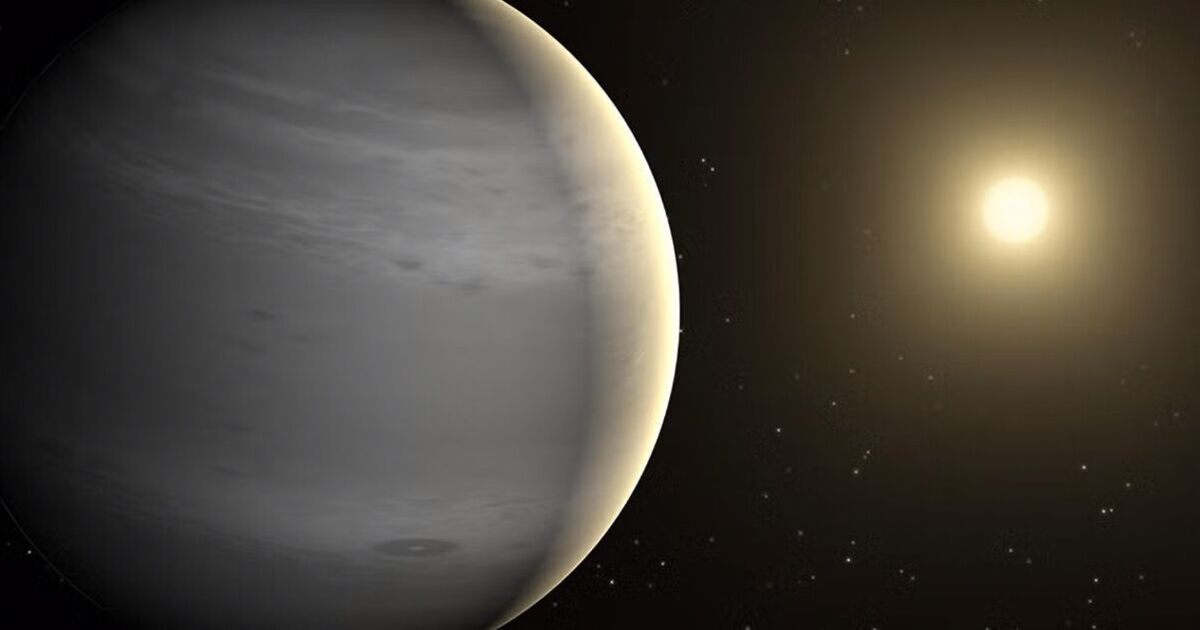

A new planet has been discovered around 400 light-years from Earth. Named TOI-4465 b, the giant, gaseous celestial body is similar to Jupiter.
The discovery was made thanks to NASA’s Transiting Exoplanet Survey Satellite (TESS) mission and Unistellar’s network of citizen scientists. Franck Marchis is a Senior Astronomer at the SETI Institute and Chief Scientific Officer at Unistellar.
He told the Express: “This planet is scientifically significant because it helps bridge a gap in our understanding of planetary systems.
“So far, we mostly detect hot Jupiters orbiting very close to their stars, unlike the cold gas giants in our own solar system.
“TOI-4465 b falls somewhere in between – a ‘temperate’ Jupiter, offering a valuable case study of gas giants that bridge the gap between the most prolific gas giants and those in our solar neighbourhood.”
TOI-4465 b is a rare example of a large, dense planet which orbits its star every 102 days. As a long-period exoplanet, it was notoriously difficult to confirm its existence because the chances of catching another transit were slim. A long-period giant is a big planet, like Jupiter, which takes a long time to orbit its star.
Team leader and University of Mexico researcher Zahra Essack said: “This discovery is important because long-period exoplanets, defined as having orbital periods longer than 100 days, are difficult to detect and confirm due to limited observational opportunities and resources.
“As a result, they are underrepresented in our current catalogue of exoplanets. Studying these long-period planets gives us insights into how planetary systems form and evolve under more moderate conditions.”
Data was collected from 24 observers from the UK, US, Japan, New Zealand, Germany, France, Italy, Switzerland, the Netherlands and Austria. Twenty-one of the total were amateur astronomers.
The planet’s transit signature was found only once in TESS data. Transit signature is a term used to describe the tiny dip in a star’s brightness which happens when a planet passes in front of it. It is a clue a planet might be orbiting that star.
TOI-4465 b’s planet signature prompted the study’s lead author to gather radial velocity data on the target. This is how fast a star moves towards or away from our own planet, usually due to a planet’s gravity pulling on it.
With this data, they predicted the next transit event and tipped off SETI Institute astronomers.
Under the expert direction of SETI scientists, Unistellar’s citizen astronomers then captured what has been described as a “long and challenging” event.
Even though the transit lasted about 12 hours, the global nature of the network meant observations could be coordinated to cover the whole event.
Because experts weren’t sure about the exact time the planet would pass in front of its star, astronomers observed over three days.
Mr Marchis said: “TOI-4465 b is the most massive, long-period giant to transit a sub-solar metallicity star.” This is a star with less elements which are neither hydrogen nor helium compared to our sun.
He added: “It’s a great candidate for follow-up observations of its atmosphere, so there’s a good chance JWST (James Webb Space Telescope) will be looking at this planet at some point in the future.”
Mr Marchis said people equipped with a digital smart telescope can now observe and confirm exoplanets from their back gardens, helping NASA map nearby planetary systems detected by the TESS mission.
He added: “The likelihood of TESS observing another transit of a planet like TOI-4465 b, which happens only every 102 days, is low. So the SETI-Unistellar network is essential for these discoveries.”
