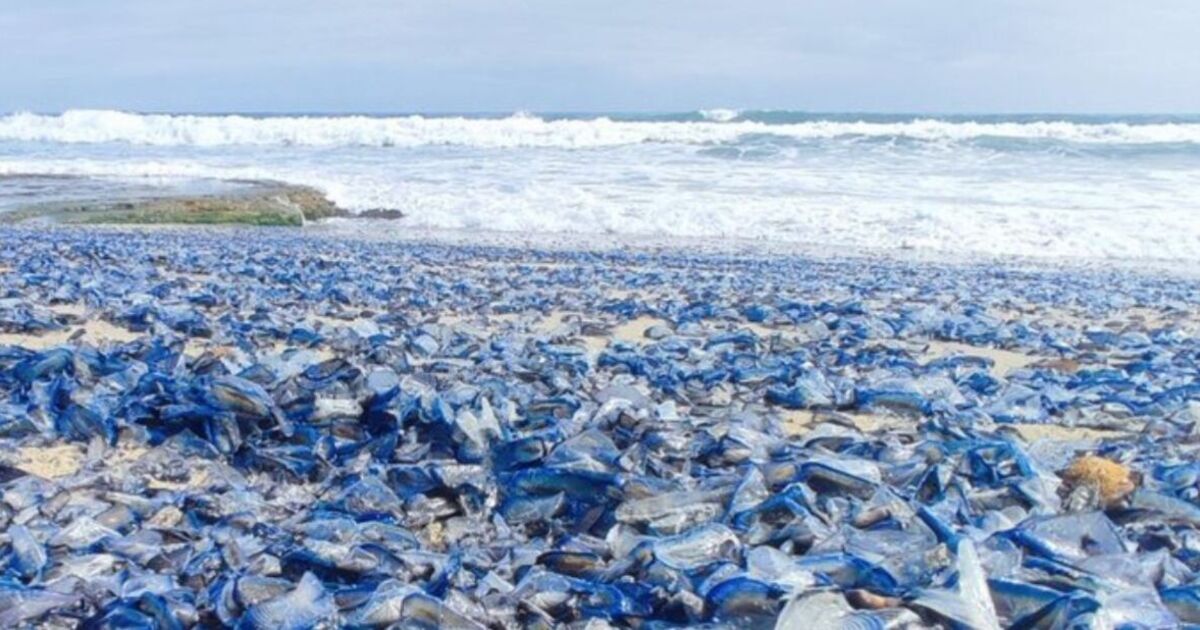

One of Majorca’s most popular and most beautiful beaches has been invaded by thousands of jellyfish. Locals and residents were shocked to find that Cala Millor’s Blue Flag beach was full of ‘velella velella’ jellyfish on Friday, March 7.
Cala Millor’s beach was covered in an intense blue colour due to the massive arrival of the animals, producing spectacular images. The unexpected appearance of the velella velella on the east coast of Majorca is largely due to wind and sea currents, with thousands of them washing ashore when conditions are right. Known in Spain as “barquetes de Sant Pere” (Saint Peter’s small boats), these tiny organisms have a distinctive sail that allows them to catch the wind and float on the sea’s surface.
Images shared on social media show the astonishing sight of thousands of these blue creatures scattered across the sand, their tiny sails glistening in the sun.
Despite their resemblance to the dangerous Portuguese man o’ war, these creatures are relatively harmless, though they can cause mild skin irritation if touched. These creatures do not sting because they are much smaller than other animals of this kind.
While the invasion of these creatures is not uncommon, especially in the spring, it can still be quite a shock to beachgoers.
Their presence is common in spring along the entire coastal area of Spain as there is plenty of plankton and numbers of the jellyfish grow exponentially.
They often form large clusters that produce a huge blob effect in the middle of the sea. Their intense blue colour indicates that they are in good health, as when they have problems, they start to lose their characteristic colour.
In April last year, the beach at Cala Mandia in Manacor was covered by jellyfish, prompting a warning from authorities.
In addition, similar events have occurred at other beaches in the Balearics, including Camp de Mar in 2022 and Cala Molins in Cala Sant Vicenç in 2021.
In the Mediterranean there are more than 17,000 marine species living under the sea with spring being the time of year when marine life is most active.
