



Graduation podiums have become political soapboxes — and New York University has a terrible solution.
For the class of 2026’s big day, the school is having students pre-record their commencement addresses to prevent anyone from using the commencement podium as a platform for controversial political beliefs — a common occurrence at colleges around the country in recent years.
Speakers will sit quietly on the stage as their pre-taped remarks play on a screen.
It’s a sad reflection of how divisive campuses have become — and an ever sadder moment for free speech.
Washington Square News, NYU’s student newspaper, reported that a senior set to deliver an address this year was reportedly told by a dean that her speech would be “professionally recorded” in an attempt to curate a “respectful experience.”
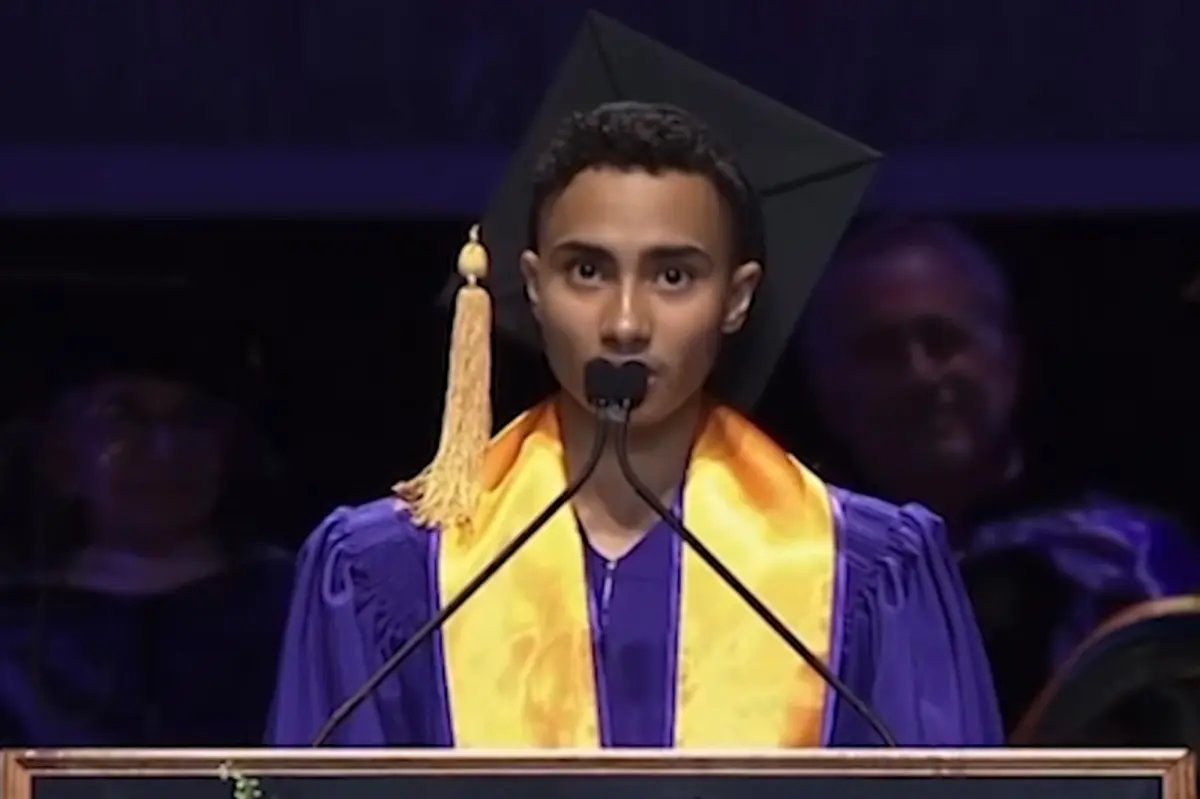
Last May, NYU student Logan Rozos used his graduation speech as a completely inappropriate platform to condemn “atrocities currently happening in Palestine” and accused the United States of “complicity in this genocide.”
Similar stunts have occurred at George Washington University, Harvard University, and MIT in recent years.
In the end, NYU withheld Rozos’s diploma and issued a statement saying he had “misused his role” to express “personal and one-sided political views.”
Understandably, they want to pre-empt a repeat performance this year. But does anyone really feel more respected because an administrator screened students’ speeches for offensive content?
“It’s really not engaging for the families that paid thousands of dollars to see a staged, fake video,” Maddy van der Linden, the student who was asked to prerecord her speech, told the student paper. “We all know it’s because of the political stuff.”
A spokesperson for NYU emphasized that the university-wide commencement will still feature a live speaker and that the new policy pertains to graduations held for individual schools within the university such as Tisch and Stern. They also told The Post that multiple Jewish advocacy groups have expressed support for the policy.
“Graduation is a special rite of passage,” the spokesperson said. “The speakers we invite to ceremonies are there to speak for everyone, not only themselves. At points in the past, students and families have felt robbed of their moment, and we owe them better.”
The whole debacle is a consequence of the state of our universities. Young people are activists more than they are students, and they seem increasingly unable to coexist with other students with differing backgrounds and opinions.
Nobody is saying you can’t support Palestine, but it’s worth considering whether graduation at a school with a considerable Jewish population is really the appropriate setting to make that known. It’s their graduation, too.
The whole point of delivering a graduation speech is to speak for your fellow students as a representative of the collective. But censoring Rozos and all other future speakers will only make things worse for NYU.
The more schools attempt to surveil students’ views, the more emboldened student agitators will become. What better proof that you’re speaking truth to power than administrators coming down on your head?
NYU is stuck between a rock and a hard place, attempting to hold the peace among thousands of young people with strong opinions and an activist streak. But scrapping the tradition of live commencement speeches is allowing the squeakiest wheels to set the rules.
The school should revert to its existing policy: students must apply with the speech they plan to deliver. There’s no removing the risk one kid might deviate, but colleges need to trust their students, even if there are a few bad eggs.
The larger solution is for schools to work much, much harder to foster an environment of respectful discourse, not unhinged expression without thought for the venue and audience. Colleges have failed for decades to foster an environment where different opinions can be expressed in civilly.
Because intellectual dialogue is so degraded, those opinions are spilling out into inappropriate places, like commencement ceremonies. Higher education must emphasize civility as much as, if not more so, than activism.
Instead, schools have been responding to student activism in ways that harm everyone’s educational experience.
At Columbia, for instance, students and faculty spent years swiping their ID and proving their identity to enter what used to be an open campus quad that had been taken over by an encampment of pro-Palestinian student protesters. The school only recently began to gradually open campus back up in December after more than two years.
Just a couple kids were allowed to make the iconic campus feel like a prison on lockdown — and all students were worse off for it.
It’s all a consequence of the fact that schools are failing to create students who are intellectually humble.
NYU is making a big mistake. Scrapping traditions in response to student activists is capitulation. Proactively censoring students is only going to make their cause feel more urgent.