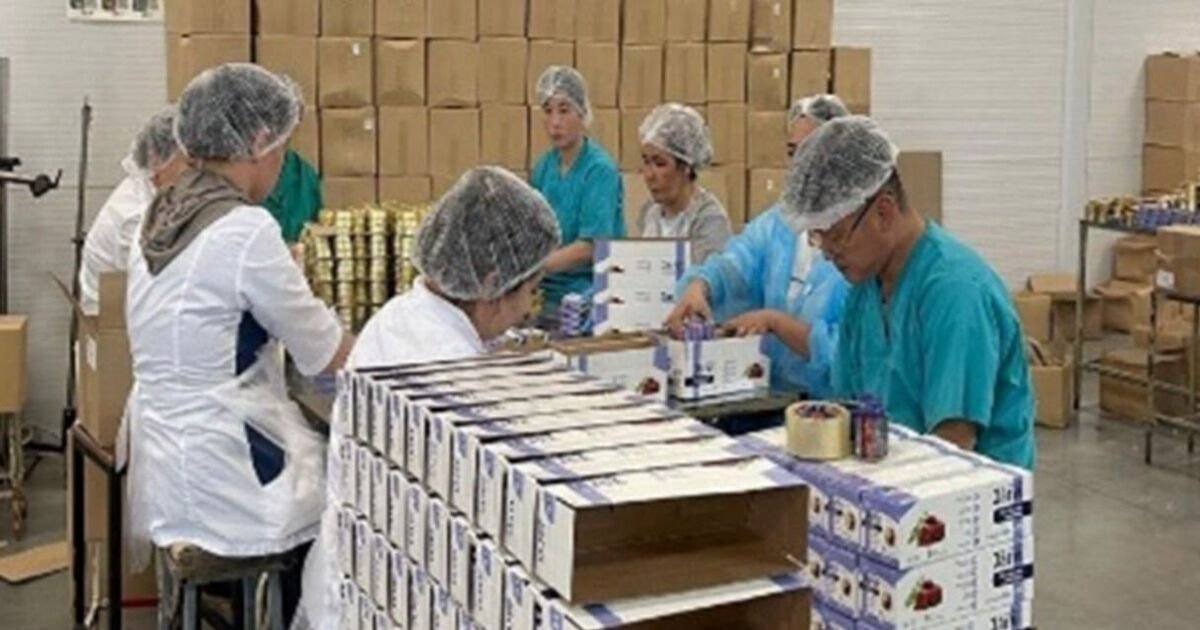


Workers packing food products at a factory in Russia (Image: Global Rights Compliance)
North Korea is selling workers to Russian businesses through a state-sponsored forced labour scheme that helps fund its ballistic missile programme and supports Moscow’s war economy, an investigation has found. The nine-month investigation by international law foundation Global Rights Compliance uncovered a network allegedly marketing North Korean workers online as commodities, with Russian employers able to place orders for large groups of labourers.
The report centres on Moscow businessman Vladimir Sokolov, who operates an online labour-brokering platform called KNDR.su. The website advertises North Korean workers for sale and charges a commission of between 100,000 and 150,000 roubles – approximately £900 to £1,350 – per worker, with a minimum order of 50 workers.

North Korean workers at sewing machines in a large garment factory in Russia (Image: Global Rights Compliance)
Investigators posing as a prospective employer secured direct contact with Ruslan Zhukov, the network’s operations director. Mr Zhukov confirmed that orders were accepted for at least 50 workers and said North Koreans had been working in Russia since 2025.
The report alleges that workers are fictitiously enrolled at Russian colleges and placed in practical training at host companies. The arrangement allows them to enter Russia on student visas and avoids formal labour contracts prohibited under UN sanctions, leaving them exposed to exploitation and abusive living conditions.
Russia issued 36,413 visas to North Korean nationals in 2025, approximately four times the number issued in 2024. More than 98% of those visas were student visas.
South Korean intelligence estimates that more than 50,000 North Korean labourers are present in Russia, many of whom reportedly receive little or no information before leaving their home country.
The investigation found evidence of coercive measures used to control workers, including the retention of their documents, restrictions on their movements and threats of “serious consequences in their country” if they breach their contracts.

North Korean embassy officials inspect a Russian food production facility (Image: Global Rights Compliance)
The investigation found evidence of coercive measures used to control workers, including the retention of their documents, restrictions on their movements and threats of serious consequences back home if they breached their contracts.
One advertisement on KNDR.su reassured prospective employers that the workers “won’t run away”.
The report alleges that North Koreans can be required to work for up to 18 hours a day, six or seven days a week, while surrendering 90% of their earnings to the North Korean government.
Global Rights Compliance said the arrangement was formally authorised by the North Korean regime, with officials from its embassy in Moscow involved in inspecting Russian companies seeking to employ workers through the network.
Using facial recognition technology, investigators identified North Korean embassy advisers visiting factory sites across Russia, including General Adviser Kim Huyk.
Nine sites in Russia were identified as being associated with the network, including two linked to the country’s war economy.
North Korean officials, including Mr Kim, were documented visiting KPP Ruskon in Moscow Oblast, one of Russia’s largest producers of military rations, canned food and preserved food products.
Our community members are treated to special offers, promotions, and adverts from us and our partners. You can check out at any time. Read our Privacy Policy
One advertisement on KNDR.su reassured prospective employers that workers “won’t run away”.
The report found that North Koreans can be required to work for up to 18 hours a day, six or seven days a week, while forfeiting 90% of their income to the North Korean government.
Global Rights Compliance said the North Korean regime formally authorises the supply of workers to Russian businesses through Mr Sokolov’s network. Russian companies seeking to use the service must undergo an inspection visit from the North Korean embassy as part of the certification process.
Using facial recognition technology, investigators identified North Korean embassy advisers touring factory sites across Russia, including General Adviser Kim Huyk.
The report identifies nine sites in Russia associated with the network, including two connected to the country’s war economy.
North Korean officials, including Mr Kim, were documented visiting KPP Ruskon in Moscow Oblast, one of Russia’s largest producers of military rations, canned food and preserved food products.
Footage showed 30 North Korean workers at the site, although investigators believe the true number is likely to be higher given the network’s minimum order of 50 workers.
Officials were also documented visiting Agrisovgaz in Kaluga Oblast, a US-sanctioned metalworking plant whose clients include sanctioned defence, aerospace and naval enterprises. The report raises concerns about the possible use of forced labour within Russia’s defence supply chain.
Lara Strangways, head of business and human rights at Global Rights Compliance, said: “Our findings have shown that labour is helping to deepen the ties between North Korea and Russia. North Korean workers are being sent to Russian factories through a network that serves both states’ at once: their labour props up Russian industry, including sites linked to the war in Ukraine, while the revenue they generate helps fund North Korea’s military programme.
“What we are seeing is a clear exploitation of these workers as part of a cross-border system. If governments are serious about responding to this deepening alliance, they need to understand the role that forced labour is playing in sustaining it.”
Dylan Carter, lead investigator at Global Rights Compliance, said: “In Russia, slave labour is not only commodified, it is available to customers in just a few clicks. Large brigades of North Korean workers, operating under the thin veil of educational exchanges, are openly advertised online and marketed as commodities.
“‘They won’t run away’, their recruiters boldly claim, while gruelling shifts are presented as something North Koreans particularly enjoy. These workers do not come cheap, yet little, if any, of the money paid for their labour reaches them. Instead, it lines the pockets of the DPRK state.”
The report estimates that overseas forced labour generates between £338million and £600million ($450million and $800million) for the Hermit State, with the revenue channelled into the military-industrial complex that sustains its ballistic missile programme.
Since the investigation began, all material relied upon in the report has been removed from Mr Sokolov’s website, although it was preserved in archived captures.
Sokolov was sanctioned by the European Union on October 12, 2026, and had his assets frozen over his promotion of industrial cooperation projects with North Korea.
