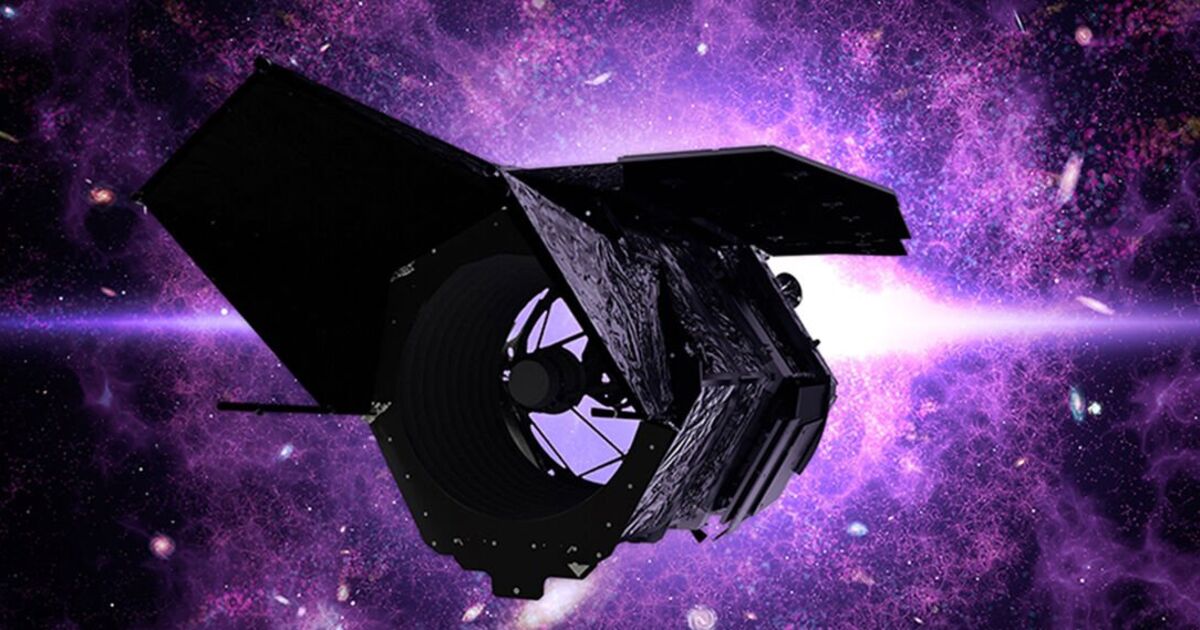

The hunt for alien life is about to get a massive boost with the launch of a state-of-the-art space telescope designed to identify exoplanets that could harbour the right conditions for habitability.
NASA’s Nancy Grace Roman Space Telescope, which has a current launch window of October 2026-May 2027, will also focus on the mysteries of dark energy and dark matter in unprecedented detail.
Named after NASA’s first chief astronomer, it boasts a Wide-Field Instrument, providing a field of view 100 times greater than the Hubble Telescope. This allows it to scan enormous sections of space for potential habitable planets.
The telescope, estimated to cost £2.6 billion ($3.2 billion), will use microlensing, a sophisticated technique that uses the gravitational field of stars to magnify and detect planets that might otherwise remain hidden. This will effectively double the number of known exoplanets.
Scientists hope to identify new planetary systems that might support life and deepen our understanding of planetary diversity.
It will build a statistical profile of exoplanet types across the galaxy, studying their sizes, compositions, and potential atmospheres.
Besides exoplanets, the Roman Telescope is set to tackle some of the biggest questions in cosmology.
Examining the distribution of galaxies across time and space will map the influence of dark energy, the mysterious force accelerating the universe’s expansion.
Additionally, the telescope’s ability to image in infrared allows it to peer through cosmic dust and unveil early galaxy formations, giving scientists insights into the evolution of the cosmos.
The telescope is equipped with a sophisticated Coronagraph Instrument, designed to directly image planets orbiting distant stars by blocking out their starlight.
This pioneering technology will enable it to capture images of Jupiter-sized exoplanets in unprecedented clarity and test methods that may one day be used to search for smaller, Earth-like planets around nearby stars.
The Nancy Grace Roman Space Telescope’s mission marks a new era of space observation and discovery.
By providing vast data on exoplanets, dark matter, and galaxy structures, it holds the potential to not only reveal where alien life might exist but also reshape humanity’s understanding of the universe.
