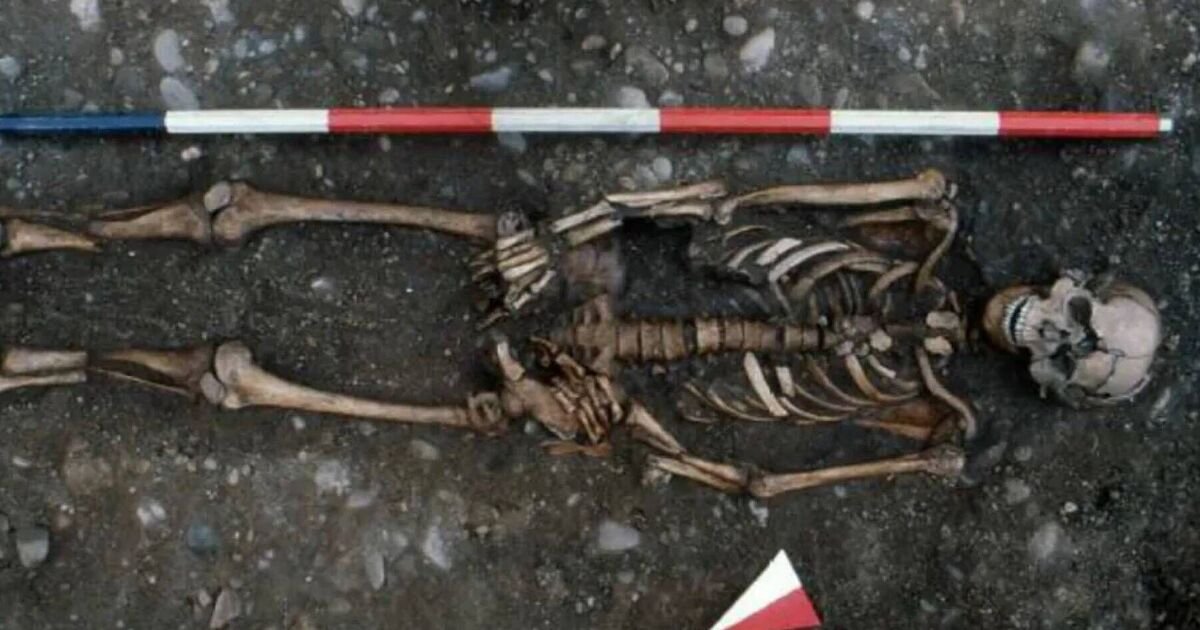


The young man had every limb broken (Image: Soprintendenza ABAP Milano)
There are countless gruesome ways to meet your end – but a botched beheading followed by the shattering of nearly every bone in your body could well rank amongst the most dreadful.
The remains of a man who appeared to have endured the notoriously agonising torture method have been unearthed. As if this weren’t sufficient, he also survived having his head severed.
The man, believed to have been aged between just 17 and 20, was discovered by archaeologists from the University of Milan, as documented in the Journal of Archaeological Science.
Forensic examination of his skeleton uncovered unusual linear fractures at the cranial base of his skull. This was most probably, the researchers conclude, the consequence of sharp force trauma inflicted by a heavy weapon during a “clumsy decapitation.”
It is thought the man perished in Medieval times, at some point during the 13th century, and was interred near a cathedral in Milan, northern Italy, reports the Daily Star.
It emerged that his wounds were almost identical on both sides of his body. He had symmetrical injuries across both his arms and legs – leading scientists to conclude the damage was intentional.
Disturbingly, examining his injuries alongside historical records, researchers established that the man had been subjected to torture using the wheel, also known as the Catherine wheel, or the breaking wheel. This terrifying instrument of torture was deployed to both entertain and horrify onlookers.
The wheel was widespread across Europe throughout the Middle Ages, functioning to brutally crush and snap victims’ limbs. The ordeal began with a heavy wooden wheel being dropped onto the victim’s limbs, commencing with the shin bones before progressing upwards.
Once the body had been thoroughly battered, the shattered limbs would be threaded through the wheel’s spokes or bound tightly to it with rope.
As if this were not sufficient, blunt instruments, fire, whips, or scorching hot pincers were employed to inflict further agony, before the wheel was hoisted aloft like a banner. The barely living victim would remain suspended for days or even weeks, until they ultimately perished or were put to death.
This brutal method of torture was most commonly deployed against those convicted of particularly serious crimes, yet in northern Italy, where this body was unearthed, such punishment was typically reserved for people suspected of spreading the plague.
“The victim of the wheel could have been considered as different by his contemporaries, and possibly this discrimination may have been the cause of his final conviction, as he could have been sacrificed, being a “freak”, by an angry crowd, as a plague spreader,” the researchers write.
This remarkable find may represent the very first genuine archaeological proof of a human being subjected to torture by the wheel.
