


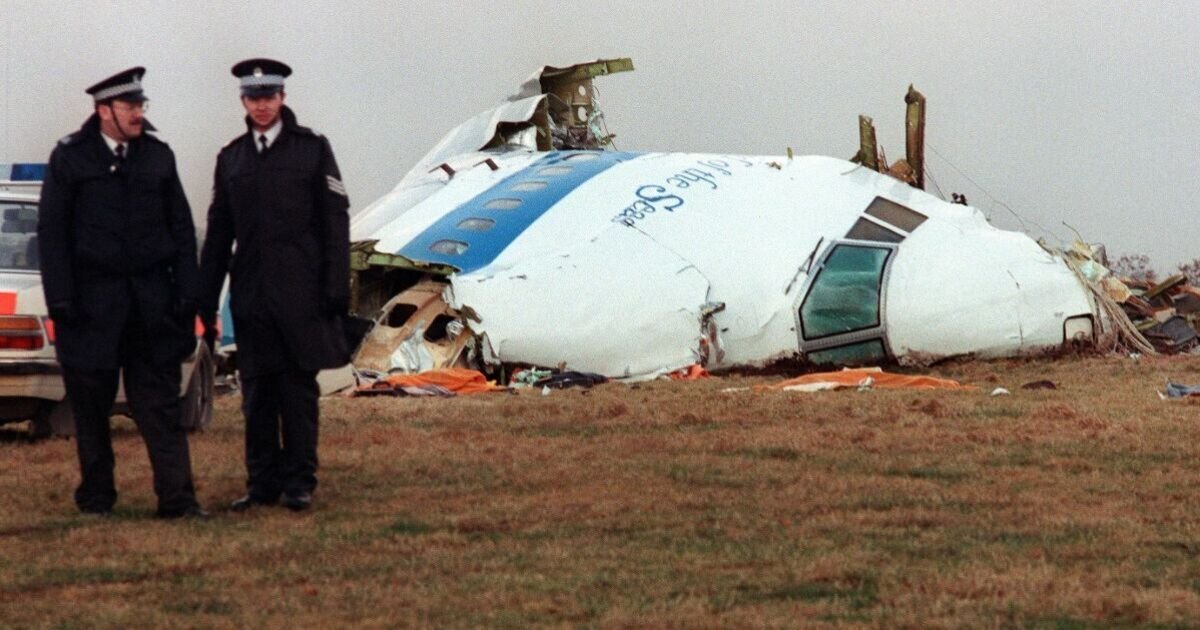
Forensic experts have made a major breakthrough, extracting DNA for the first time from the suitcase that contained the Lockerbie bomb. The explosion on board Pan Am flight 103 and the crash killed 270 people in Britain’s most deadly terrorist atrocity.
Now, new technology has allowed Scottish scientists to recover vital forensic clues from inside the luggage lining and an umbrella packed into the suitcase before the device detonated. The mid-air explosion of flight 103 over the Dumfries and Galloway town of Lockerbie on December 21, 1988, murdered all 259 passengers and crew on board and killed 11 people on the ground who were hit by falling wreckage.
The new DNA evidence obtained 37 years after the heinous attack could be used to match swabs taken from Libyan explosives chief, and alleged bomb-maker, Abu Agila Masud, 74, who is expected to face trial in Washington DC in April next year.
In papers for the US district court for the District of Columbia, Masud is alleged to have named two accomplices in the bombing plot, Libyans Abdelbasset Al Megrahi and Al Amin Khalifah Fhimah.
Megrahi was convicted by a Scottish court sitting in the Netherlands in 2001 for murdering the 270 victims of the attack. He later died at home in Tripoli, Libya, aged 60, after being controversially released from custody in 2009 by the Scottish Government on compassionate grounds as he was dying from terminal cancer.
Megrahi’s co-accused, Al Amin Khalifa Fhimah, 69, was found not guilty at the same trial and was allowed to return home, but a US warrant for his arrest still remains active.
According to The Sunday Times, documents relating to Masud’s upcoming case list expert witnesses for the prosecution, among them Dr Nighean Stevenson, who is described as a leading authority in DNA analysis for the Scottish Police Authority (SPA).
Outlining Dr Stevenson’s expertise, US court papers state: “Dr Stevenson examined items relating to an umbrella and an item relating to the lining of a suitcase. These items were examined using specialised lighting, and DNA samples were taken from each. The DNA profiles obtained from these items were of varying quality and were generally commensurate with the expectations of these items.”
DNA evidence could be a vital cornerstone of the prosecution’s case if a sample can be matched to Masud.
The document adds: “Analysis of a DNA reference sample relating to the accused nominal [Masud] has yet to be carried out. When a DNA profile relating to this individual has been generated, it will thereafter be compared to any suitable DNA profiles which have already been obtained.”
Masud’s name had been mentioned in the original investigation by the FBI and Scottish police, but initially, investigators had been unable to trace him. He was first publicly named as a suspect in 2015 after the collapse of Colonel Gaddafi’s regime in Libya and was charged by then-US Attorney General William Barr with the destruction of an aircraft resulting in death. Masud was taken into US custody in 2022 after allegedly confessing to building the Lockerbie bomb and transporting the suitcase from the Libyan capital to Malta.
Masud has denied the allegations made against him, and his defence team is expected to argue that the confession, which was made in a Libyan jail, was taken under duress.
Dick Marquise, the FBI special agent who led the US end of the original investigation, told The Sunday Times he was not aware of any other DNA samples being collected in the immediate aftermath of the 1988 bombing as it was “much too new a science”.
He added: “If you’ve got his DNA [in the suitcase] … it would knock down the building blocks of his potential defence.”
The Express has contacted the Scottish Police Authority for comment.