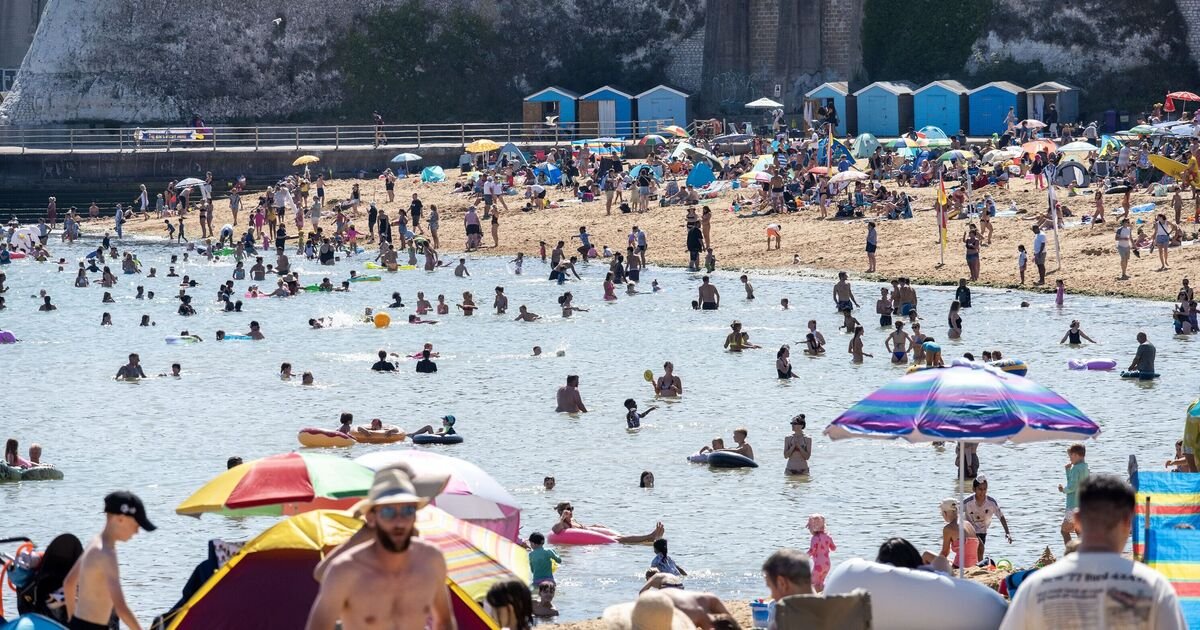

As summer begins to draw to a close millions of us will start thinking about the upcoming winter season. However, Brits won’t have to dust off their winter coats and jackets just yet as September looks set to be a scorcher.
Long range WXCHARTS weather maps have turned red and orange indicating that a heatwave is on its way to blast the UK. Large swathes of southern England and Wales look set to be blasted by a scorching Iberian jet stream that will bring 25C heat on September 8 as a September summer heatwave takes hold of the country. Those in the north will not experience the same boiling weather.
Weather maps show a red wall of heat will make its way over the UK at 12pm on September 8. The south west, south east and the entirety of Wales will see the warmest weather as temperatures will likely to hover between 22C-25C.
Elsewhere, the West Midlands is also likely to see the mercury reach the low 20s. Those in northern England and Scotland will not see heatwave conditions, with temperatures only predicted at 14C.
The tip of Scotland will even see temperatures reach single digits of around 8C.
As we approach Wednesday, September 10, Kent, London, and Surrey will bask in 25C. Hampshire, Dorset, and Sussex will not be far behind, with the mercury forecast to reach 24C.
Norfolk, Suffolk and Essex will not miss out on the warm weather with 23C temperatures likely. The mercury will hover between 22C-24C for key cities in the south west including Bristol and Bath.
Parts of Yorkshire and the Humber will hit 20C as will large parts of the north West.
Seperately, in the Met Office’s weather outlook the forecaster predicts that “low pressure patterns are expected to dominate at the start of this period, bringing changeable weather conditions with showers or some longer spells of rain.”
It adds: “Conditions may begin to turn more settled and drier later in the period, particularly in the south. Temperatures are likely to be close to or slightly above average”.
