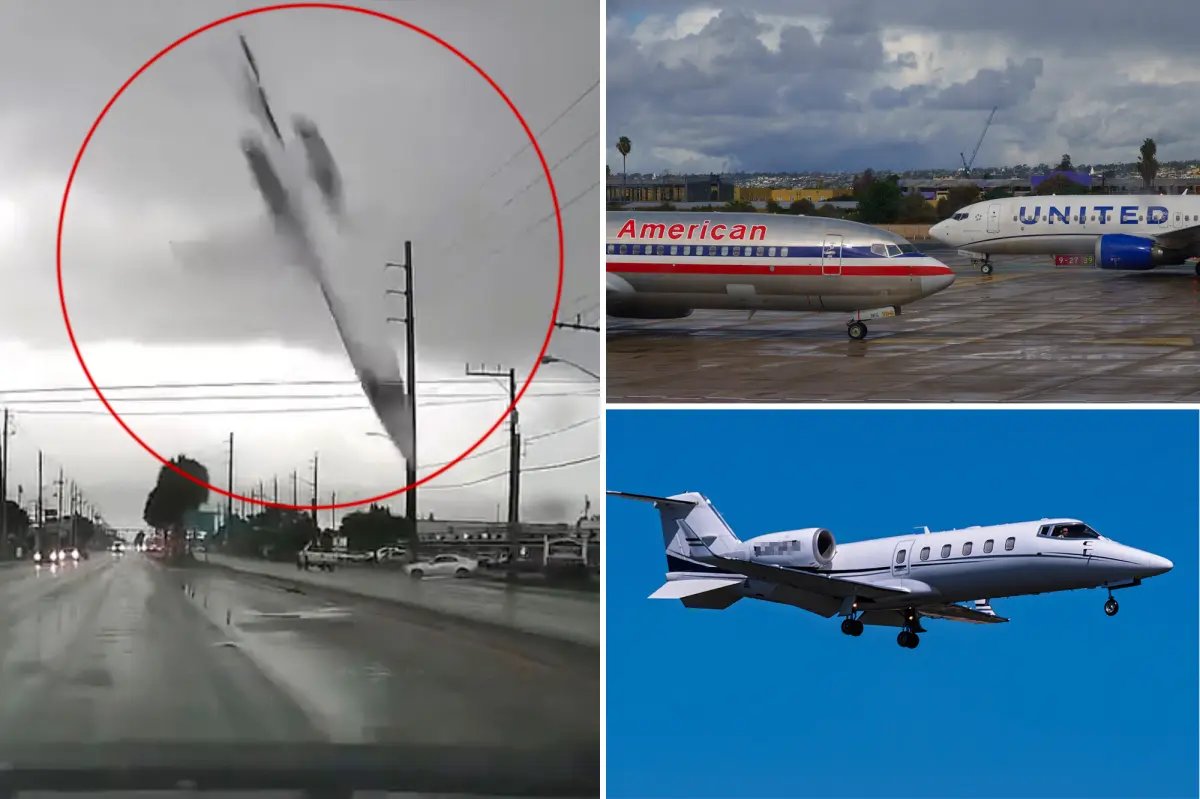


Suddenly, that middle seat on a packed commercial flight might not look so bad.
The Learjet crash that resulted in the deaths of nine people over the weekend has renewed concerns over the dangers of flying private — and federal statistics show it is about 80 times more deadly than traveling on a traditional airliner.
Scheduled US air carriers notably saw zero deaths in 2024, the latest available data from the National Transportation Safety Board (NTSB) — while private charter flights saw 16 deaths that year
Deaths 2026 are expected to be higher, given at least two high profile chartered plane crashes — one in January in Bangor, Maine, that killed six people and the crash in Florida on Sunday.
When you compare the deaths on private flight to the statistically zero deaths across millions of passengers on commercial airlines, the difference begins to feel larger.
Over the last decade, chartered flights were 80 times more deadly per 100,00 flight hours, the metric that federal aviation officials use to count the time planes are in the air.
Flying with your family in your own small plane is even more dangerous. So-called “general aviation” crashes killed 300 people in 2024.
That’s 500 times more deaths on a per-flight-mile basis.
Chartered helicopters, meanwhile, saw 13 fatalities, according to the NTSB.
Experts have said the disparity in fatalities and accidents lies in how safety varies widely among private charter operators as opposed to the uniform regulations imposed on commercial airlines.
In the private industry, pilots aren’t required to have as much experience compared to airlines where pilots are typically required to complete at least 1,500 hours in the air.
For private charters, pilots are generally only required to have at least 500 hours under their belt, with co-pilots only needing half that time.
There is also no age ceiling for chartered flight pilots as opposed to commercial airlines, where the Federal Aviation Administration has a mandatory retirement age of 65.
Private flights also can leave their pilots to evaluate weather and flight conditions alone, whereas airlines can rely on dispatchers to evaluate whether a route is safe or not.
The chartered flight pilots also tend to be at the whim of their clients and the pressure may cause them to make a bad call.
One expert told The Post that the Learjet crash in Florida may have been doomed by “get-there-itis” — the push for private pilots to push through to get clients to their destinations quickly, even if it meant flying through a powerful storm system.
Commercial airlines, on the other hand, have strict rules and air-traffic controllers to conduct their movements.
While non-commercial flights are statistically more dangerous than their highly regulated counterparts, flying is still the safest mode of transportation in the US. Commercial flights are about 700 times safer than car travel, according to one study.
In 2024 alone, there were nearly 40,000 deaths on America’s roads, with car travel resulting in 99% of all transportation injuries in the US in 2023, according to the US Department of Transportation’s latest report.
