


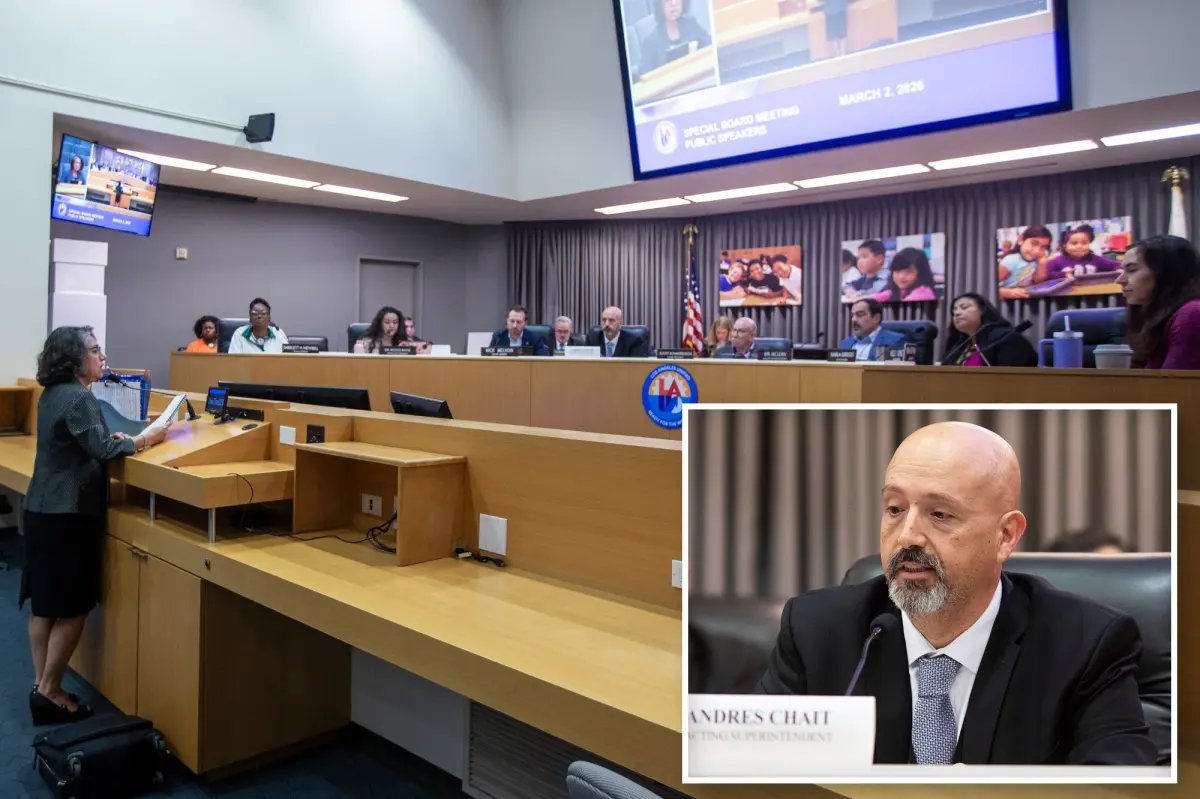

The Los Angeles United School District’s leadership meltdown spilled into public view Monday as the school board huddled in a closed-door special meeting — but not before the district’s new chief delivered a message of calm amid the chaos.
Acting Superintendent Andres Chait, installed just last week after Superintendent Alberto Carvalho was shoved aside following an FBI raid on his home, opened the meeting with carefully measured remarks aimed at steadying nerves across the nation’s second-largest school district.
“As acting superintendent, my top priority is to keep Los Angeles Unified steady and focused on our core mission,” Chait said. He stressed safety, continuity and uninterrupted learning.
Chait assured families that schools would remain “places of safety, consistency and opportunity,” adding that teaching and learning would continue without disruption. “I know transitions can create uncertainty, but our district is strong.”
Chait’s name sat on a plain cardboard place card, not the district’s usual permanent nameplate.
Monday marked Chait’s first time presiding over the board as acting chief, a role he assumed immediately after the board voted unanimously Friday to place Carvalho on paid administrative leave pending investigation.
Board President Scott Schmerelson framed the move as necessary to keep classrooms focused on learning “without distraction,” calling Chait a respected veteran capable of stepping in seamlessly during the crisis.
The agenda itself listed the closed session under “Personnel — Public Employment — Superintendent’s Evaluation — General Superintendent of Schools,” along with a sweeping labor negotiation item covering virtually every major union in the district.
Parent safety advocate Maria Palma stepped to the microphone and zeroed in on the ambiguity.
“You’re going to talk about superintendent evaluation — but which superintendent?” she asked, noting that the district effectively has two leaders: Carvalho on leave and Chait acting in his place.
Executive Officer of the Board of Education Michael McLean noted before closed session the evaluation would concern Chait, not Carvalho — a statement that only deepened confusion over the agenda’s wording and the meaning of “evaluation” for someone just installed in the job.
Public testimony was brief but tense, with parents voicing fears about safety, accountability and transparency as the district faces one of the most serious crises in its history.
“Are you going to empower him to do his job?” one speaker asked the board, pressing members to move beyond rhetoric. “Which one of you is going to take responsibility?”
Then the doors shut.
More clarity may come when the board reconvenes to address Chait’s evaluation and contract, decisions that could determine whether his role remains temporary or becomes something far more permanent.