


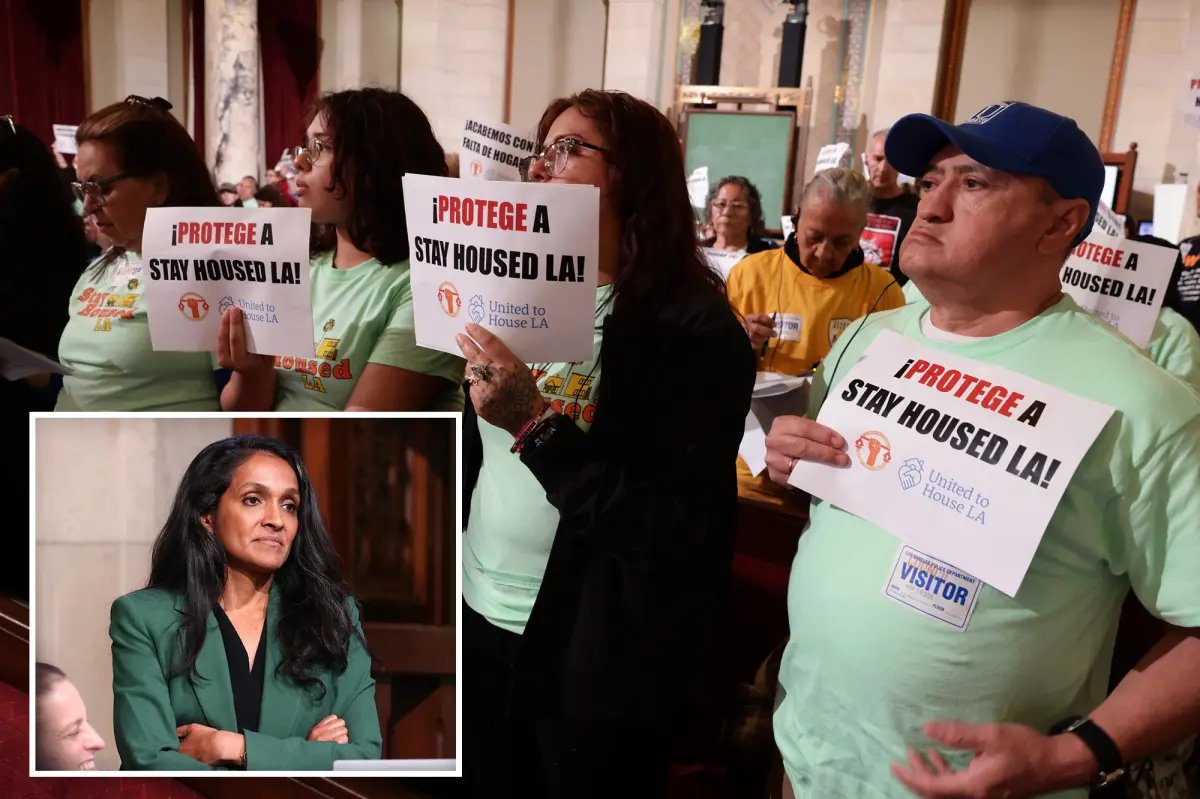

The Los Angeles City Council will pay out $177 million in contracts to tenant-rights attorneys who routinely sue the city and groups who rally against the LAPD.
The 12–1 vote came after more than 90 minutes behind closed doors with the City Attorney Tuesday. Councilmember John Lee, the only Independent on council, cast the lone dissenting vote.
Council members said they were briefed on troubling issues tied to former contracts with the same groups, including allegations some failed to submit receipts or basic reports showing how taxpayer money was spent or what the programs actually delivered.
Tenant-rights activists packed the council chambers and hallways prior to the vote, many holding signs and chanting as the vote approached.
Driving the push was Nithya Raman, the left-leaning councilmember and mayoral hopeful who chairs the council’s Housing and Homelessness Committee and has championed expanding the city’s eviction-defense network.
In late February, Raman’s committee advanced the plan, setting the stage for one of the largest recent funding packages for eviction-defense legal services in Los Angeles and directing the money to a tight network of politically influential nonprofits.
Those organizations include the Legal Aid Foundation of Los Angeles, Strategic Actions for a Just Economy (SAJE), the Liberty Hill Foundation and the Southern California Housing Rights Center, groups that form the backbone of the city’s Stay Housed L.A. eviction-defense coalition.
The package total of $177 million, is more than the annual budgets of several Los Angeles city departments combined, including Animal Services, the Department on Disability and the administrative offices of Board of Public Works.
The Legal Aid Foundation of Los Angeles, or LAFLA, is expected to receive the largest share of the funding, more than $106 million under the proposed contracts. The organization has played a central role in litigation against the city. LAFLA currently has 12 pending suits sitting in State and Federal courts.
One of its attorneys, Shayla Myers, recently secured a court ruling preventing Los Angeles from towing and dismantling inoperable RVs used by homeless residents, a decision that frustrated some city officials who argued it limited the city’s ability to address encampments.
Los Angeles City Councilwoman Traci Park, who represents the city’s coastal neighborhoods, criticized the decision in comments to the Los Angeles Times, calling it “another example of activist lawsuits impeding our ability to address urgent public health and safety concerns while moving people indoors.”
Another organization tied to the contracts, Strategic Actions for a Just Economy.
The group has a long history of headline-grabbing activism. It has publicly pushed to defund and abolish the LAPD, urged boycotts of city hotels, opposed the LA28 Olympics and championed sweeping rent and mortgage freezes during the pandemic. In 2023, it even sued the City of Los Angeles over a hotel development, while continuing to receive city funding.
The eviction defense effort began in April 2020 as a $7.1 million emergency contract with LAFLA during the COVID-19 eviction crisis. Through a series of amendments approved by City Hall with little to do transparancy, the agreement expanded to $76 million over three years before the City Attorney’s Office raised concerns that the contracts should be subject to competitive bidding requirements under the City Charter.
While a bidding process was being developed, the council approved additional amendments that pushed the contract total to $90.8 million and extended the agreement through March 31, 2026.
Funding for the contracts are largely through Measure ULA, the voter-approved “mansion tax” intended to address housing instability and homelessness. But the funding source became another point of contention ahead of the vote, as officials warned that a measure expected on the November ballot could repeal ULA altogether. If that happens, the city could be required to reimburse money already spent, potentially leaving Los Angeles on the hook for millions and creating a significant hole in the city’s finances.
On Tuesday, Councilwoman Monica Rodriguez addressed concerns about the level of oversight applied to the contracts, noting that even basic city contractors are required to provide detailed documentation to receive payment.
“Graffiti contractors are required to provide more documentation just to get paid. So I don’t understand why the hell we’re lamenting this and not simply writing contracts the way they should be written when you’re dealing with millions and millions of dollars. If you don’t provide the receipts, we’re not going to pay you,” Rodriquez said.
Rodriguez introduced one of seven amendments to the motion before the final vote. Her proposal added language requiring contractors to clearly separate administrative costs from direct program services and directed the Housing Department to report annually to the City Council on all expenditures tied to the contracts.
Councilmembers Eunisses Hernandez and Nithya Raman were among the four members who voted against the amendment. Despite that opposition, the amendment passed, along with the broader motion approving the funding.