


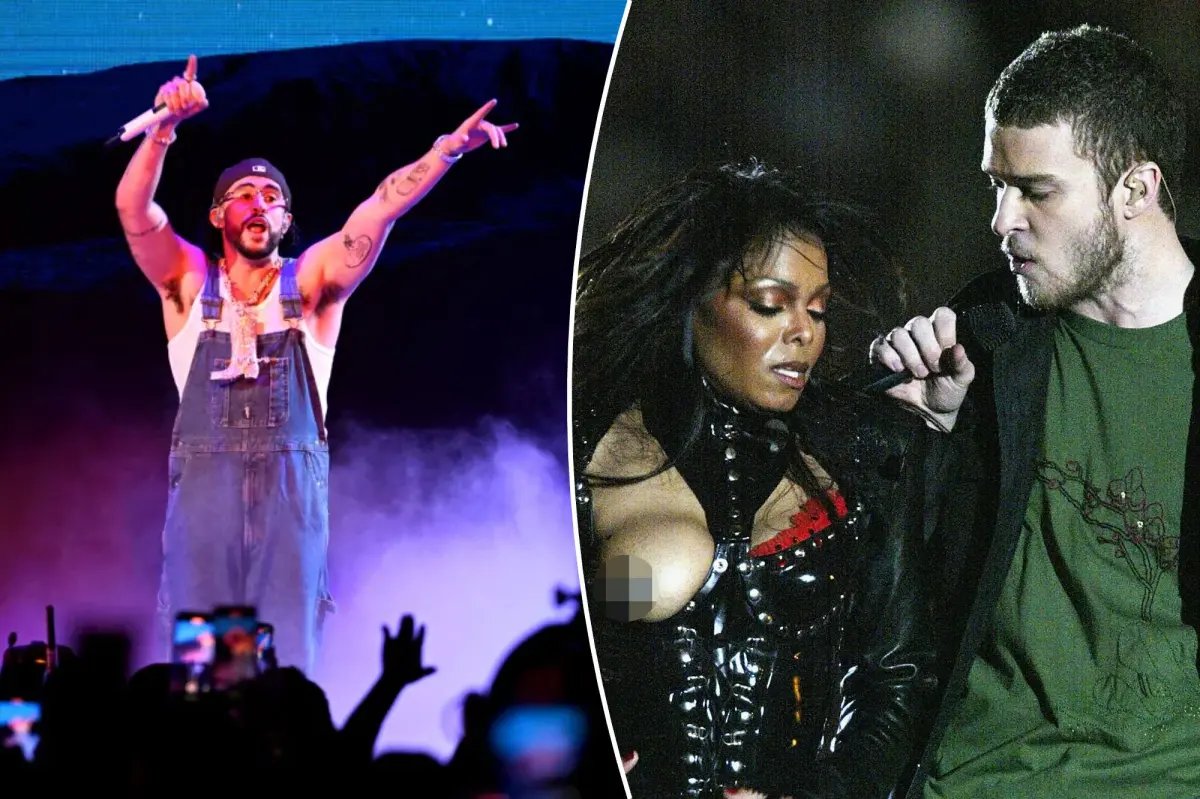

When Bad Bunny takes to the stage for the halftime show at Sunday’s Super Bowl LX at Levi’s Stadium in Santa Clara, Calif., the Puerto Rican superstar’s performance will be the culmination of a year’s planning.
Though the spectacle lasts barely a quarter of an hour, the show is a jaw-dropping logistical circus that reportedly costs $1 million per minute and requires military-grade precision and thousands of people to execute.
“You’re producing a global entertainment moment on live television, within an immovable time window, on a playing field that has to be ready for football again minutes later,” Jon Barker, NFL SVP, Global Event Operations & Production, told The Post. “It’s remarkably complex.”
One misstep could turn the National Football League’s crown jewel into a televised nightmare.
“Executing a live performance of this size and scale, in the middle of the single biggest day in sports, requires extraordinary coordination,” Barker said. “There’s a very precise moment we refer to as ‘go/no-go’ — a fraction of a second when everything must be perfectly aligned and on track. Once that call is made, the stages begin rolling onto the field, and there’s no turning back. But that point-of-no-return is thrilling.”
In total, there can be anywhere from 2,000 to 3,000 people working on the show, including the hundreds in the on-field “audience” who supplement the artist with choreographed dance routines or group backing vocals.
Six-time Emmy Award winner Patrick Baltzell has been the lead sound engineer on nineteen Super Bowls and notes there’s a lot that can go wrong when you’re dealing with the show’s crowded wireless frequencies, temporary concert-grade audio systems that need to be installed and connected in just minutes and, of course, a sports stadium that simply isn’t designed for music performances.
“It’s the biggest, most complicated show there is,” he said.
Typically, the set-up teams have just seven minutes to erect the modular stage, the sound system and the lighting, as well as get everybody in place for the performance itself — all without damaging the field for the second half of the game.
For the most part, it is only the artist who sings live, with the musicians playing along to a pre-recorded backing track. A few performers have insisted on playing live — like the Rolling Stones in Detroit in 2006 and, famously, Prince in torrential rain at Miami Gardens the following year — but if producers can remove any risk, they will.
Each stadium presents its own challenges.
In 2004 for Super Bowl XXXVIII, Baltzell struggled with the then-new Reliant Stadium in Houston and its “ridiculous reverb.” The sound bounced off the venue’s retractable glass roof and the two giant video scoreboards, but organizers insisted he crank up the volume regardless.
Baltzell thought the performance — which featured Janet Jackson, accompanied by P. Diddy, Kid Rock, Nelly and Justin Timberlake — sounded “atrocious” and was despondent.
“It was the worst show I had done in 35 years of doing TV specials,” he said.
He skipped the afterparties and went back to his hotel to wallow, convinced he had blown it.
“I probably drank a bottle of wine because I was so despondent,” he said. “It was just f—–g awful.”
The following day, Baltzell returned to Los Angeles expecting a flurry of complaints, but got none.
“All anyone was talking about was Justin Timberlake revealing Janet Jackson’s nipple,” he laughed. “I hadn’t even seen it on the night, as I was so busy — and I’d avoided any coverage because I knew it would be atrocious … It was a miracle — Nipplegate saved my career!”
It wasn’t always such a spectacle. When the halftime show first took place in 1967, it featured collegiate marching bands — not the biggest pop stars of the moment.
That all changed in 1993 when Michael Jackson took the stage at the Pasadena Rose Bowl. The King of Pop dramatically shot up from below to his performance perch with pyrotechnics, then stood as still as a mannequin for an excruciating 90 seconds before launching into an array of his hits, including “Billie Jean,” “Black Or White” and “Heal The World.” A cast of thousands of children accompanied him, and the modern halftime show was born.
“That was the true inflection point, when it became clear that halftime wasn’t just a break in the game, but a moment that could either lose or engage a massive audience,” Barker said. “It was the moment we fully crossed the threshold and halftime became an event in its own right.”
Baltzell said a key acid test is whether the artist is happy.
“If I don’t get called to their dressing room or their trailer, then I’m doing fine,” he noted. “People always ask, ‘What’s Beyoncé like?’ and I say I don’t know — because I never got called in to explain myself.
“And that’s a good thing.”
But Bey’s 2013 performance at Super Bowl XLVII at New Orleans’ Mercedes-Benz Superdome was almost a disaster.
Baltzell struggled with power outages in the lead-up to the day, forcing organizers to use two additional generators just to keep the lights on.
Beyoncé’s show went off without a hitch, but just after it the stadium was plunged into darkness, delaying the start of the third quarter by 30 minutes. Spectators in private boxes using microwaves and hotplates had caused a massive power outage that, just a few minutes earlier, would have ruined Queen B’s performance.
“I can’t imagine what might have happened if it had occurred during her show,” Baltzell said.
Once the performance is over, the football field must be returned to game-ready conditions as quickly as possible.
With scores of carts carrying heavy audio and visual equipment onto the playing surface — some requiring a dozen people to move — the risk of ruining the turf and pitch markings is extremely high. For safety, not even a single screw can be left behind.
Afterwards, the pitch is inspected for damage and paint marks are touched up, returning the field to pristine condition.
“After all,” Baltzell said, “there is still a football game that needs playing.”