



It’s not your average trip to the doctor.
Patients at a brand new Northwell Health medical facility are being given the greenlight to get frat house high on magic mushrooms, MDMA and cannabis, while watching sports and chowing down on chips — all in the name of medical research.
“We’re studying full doses that produce anywhere from a four to a six-hour trip,” Nehal Vadhan, director of the Manhasset-based Feinstein Family human neuropsychopharmacology lab, told The Post in an effort to treat things like schizophrenia and social anxiety.
“With cannabis, we’re asking them to consume it all at once, rather than puff on it throughout the day. So they’re getting a massive hit of it right up front. We can really obtain very robust effects.”
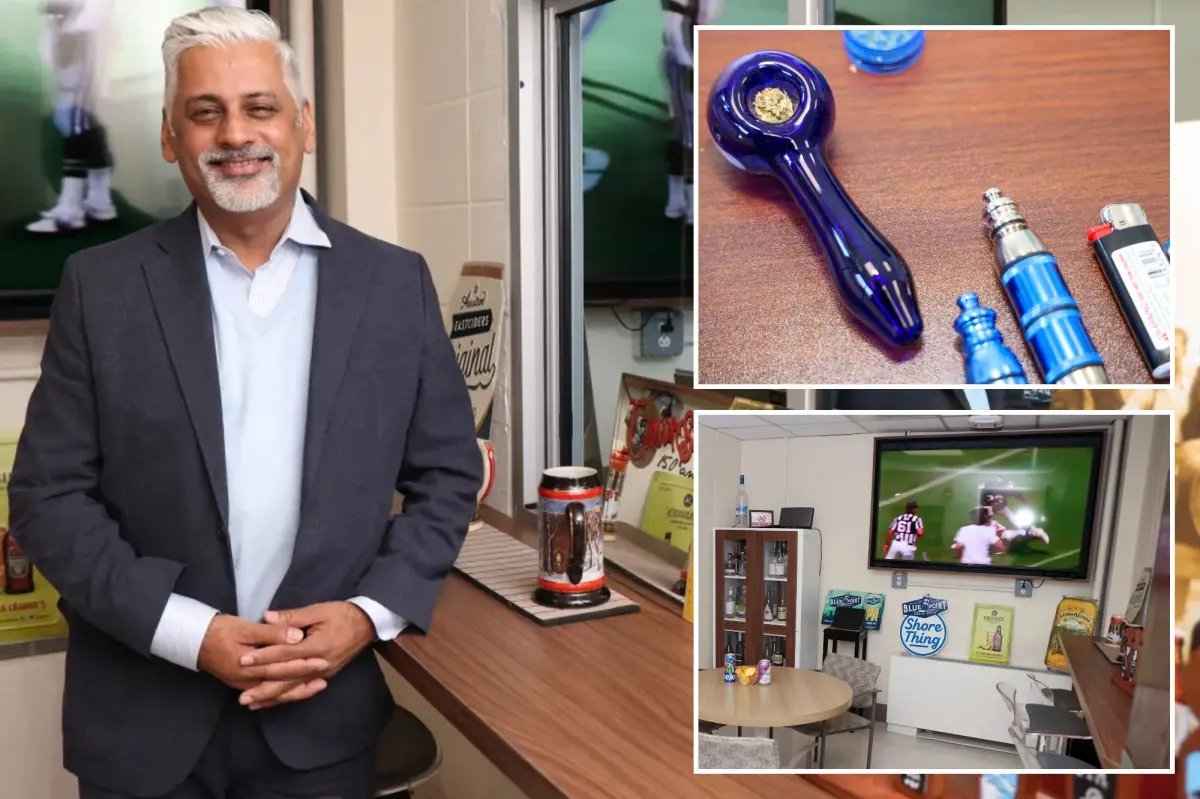
Northwell’s venture focuses on “naturalistic” environments that embody either the comfort of one’s living room, where patients can get stoned, or a live bar setting for getting drunk — complete with high-def TVs showing sports highlights, snacks, and refills on demand.
“They’ll have to answer questions, they’ll have to report on their mood state,” he said of what’s expected to be a four-day-per-week commitment with a day off in between sessions.
“But there is downtime where people can enjoy themselves,” added Vadhan.
No wasted time
Vadhan plans to run a host of exams — mostly on psychiatric patients already at the hospital or another Northwell center — to see the behavioral effects of alcohol and how drugs may be medicinally beneficial.
“We have one study where we’re testing the effects of a full dose of psilocybin — the main component of magic mushrooms — on treating social anxiety disorder,” he said.
“We have another study where we’re looking at the safety and tolerability of MDMA to eventually treat negative symptoms of schizophrenia.”
Clinical ketamine research is also in the works at the newly opened Center for Psychedelics Research and Treatment at nearby Zucker Hillside Hospital along the Nassau-Queens border, which is where the new Feinstein program is being rolled out — in more ways than one.
The center has dedicated two rooms to monitor different drug uses that are tailored to make users of substances feel especially cozy.
One room has blueish mood lighting for someone tripping on the psychedelics, while another room is lit in green for cannabis.
Both have comfy seating, classical music, and relaxing images displayed on a TV screen, plus virtual reality headsets that show soothing environments.
A pair of therapists will typically join patients in the rooms for “guidance” purposes as well.
“They’re there to provide a comforting presence and to help guide people back towards the focus of the session,” said Vadhan, who added that “the goal is not to make it completely comfortable the whole time.”
“Without some discomfort, there’s probably not much ability to change. You have to confront certain things that comprise your disorder.”
Even bad trips may elicit a mild response.
“It’s really more just people might fall asleep, they might get really giggly, or they might start slurring their words,” he said.
“Very rarely do we see any kind of aggression, any kind of anger.”
Patients’ highs and lows will be observed anonymously by medical professionals through one-way glass and a series of cameras in a space similar to the back end of a police interrogation room.
The bar, located in the Hillside facility basement, is equipped with a one-way sliding window that allows the psych team to easily provide refills of beer, wine or hard liquor.
Those doing the alcohol experiments will be consuming around three to five drinks daily.
“Mainly, what we’re looking to assess in a natural environment are people’s craving for alcohol and the actual effects of alcohol,” he said.
“So after people have had some drinks, we might ask them to remember a string of numbers, do addition, or make choices out of a series of choices that are available to them on the computer screen.”
Northwell’s pour house also has dimmable lights, barstools, and an array of pub signage that Vadhan had donated by a local watering hole.
It sits next to a driving simulator that will be used to test patients’ abilities driving through work zones or bumper-to-bumper traffic while under the influence — like getting behind the wheel in “Grand Theft Auto.”
“We can look at things like acceleration, braking, because sometimes, especially people who are experienced with alcohol and marijuana, have learned how to compensate,” he said.
However, test subjects are not allowed to drive to or from their sessions.
“So even if they’re feeling a little bit buzzed when they leave here,” Vadhan explained, “there’s no danger.”