


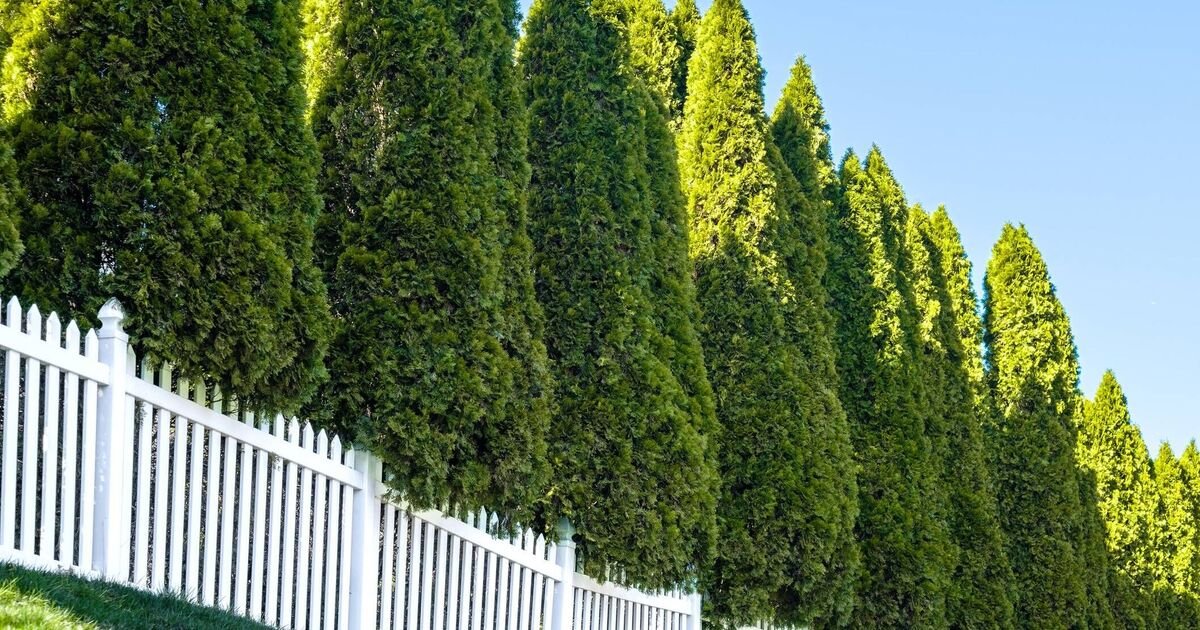

Row of cypress trees lines fence for privacy hedge (Image: Getty)
As we bid farewell to a glorious summer, our gardens are bursting with life, showcasing plants, trees, and shrubs in their full splendour. However, this seasonal peak also brings challenges, particularly when the flourishing greenery begins to encroach on personal spaces and affects your garden.
Take for instance the majestic conifer next door; it’s a sight to behold until it’s casting a shadow over your property, transforming your sun-drenched haven into a gloomy, damp space. This prompted me to seek guidance from legal and property experts regarding the encroachment of a neighbour’s tree on my natural light.
I sought advice from experts in law and property about what could be done if a neighbour’s tree started to interfere with my natural light. They all agreed on one point. I had previously asked if I could cut a neighbour’s tree if it’s hanging over my garden — you can read what all the experts agreed on here.
Manjinder Kaur Atwal, a housing director at Duncan Lewis Solicitors, said: “Unfortunately, the law doesn’t give you an automatic right to natural light just because a neighbour’s tree blocks it. You can usually only trim back branches that overhang your property, and only as far as your boundary — never beyond it and without damaging the tree.”
Joanne Ellis, a dispute resolution specialist at Stephensons solicitors, told WalesOnline: “Under current UK law, there’s no general ‘right to light’ when it comes to trees affecting your garden or outdoor areas. So, if your patio is in permanent shade because of a neighbour’s tree, unfortunately, the law doesn’t offer much recourse.”

A garden with large trees on both sides (Image: Getty)
Joanne noted an exception for indoor spaces: “However, the situation changes when interior spaces are affected. If natural light has entered a window uninterrupted for at least 20 years, and the obstruction significantly interferes with the use of that room, you may have acquired a legal ‘right to light’ under the Prescription Act 1832. In such cases, remedies like an injunction or damages could be available-but these claims are complex and typically require expert legal and technical assessment.”
She also mentioned the importance of property deeds: “There may be specific rights or obligations attached to properties and deeds should be checked. It is possible to have a specific right to light, or not, in your deeds. Other express rights or obligations in your deeds may assist in any event.”
She also highlighted a potential remedy for issues with hedges: “If the problem stems from a hedge rather than a single tree, and it consists of two or more evergreen or semi-evergreen trees or shrubs over two metres tall, you may be able to take action under the High Hedges provisions of the Anti-Social Behaviour Act 2003. In these cases, your local council can investigate and, if appropriate, issue a remedial notice requiring the hedge to be reduced in height.”

You cannot cross a boundary to begin cutting a neighbour’s tree (Image: Getty)
What you can do
Experts at First4LandlordAdvice dished out some guidance on the things you can do: “Here’s what you can do: you are allowed to trim any branches or roots that cross into your side, but only back to the boundary and from your own land. You should offer the cuttings back to your neighbour rather than simply disposing of them over the fence.”
“If an evergreen or semi-evergreen hedge is over two metres and blocks reasonable enjoyment of your property, you can make a formal complaint to the council under the Anti-social Behaviour Act 2003.
“If your windows have had uninterrupted daylight for more than 20 years, you may have a civil ‘right to light’, though this is usually resolved by negotiation or legal remedy rather than cutting trees yourself.”

Two men argue in neighbour dispute taking place in a garden (Image: Getty)
What you cannot do
However, there are clear boundaries on what you cannot do. The specialists at First4LandlordAdvice set the record straight: “Here’s what you can’t do: you cannot cross the boundary or cut beyond it without permission – no stepping into your neighbour’s land or shaping the tree from their side.
“You cannot cut or damage a tree that is protected by a Tree Preservation Order or located in a conservation area without consent, as this can be a criminal offence. You cannot assume a general ‘right to light’ gives you the power to remove trees; this only applies in very specific circumstances. You cannot dump prunings back into your neighbour’s garden or keep fruit from overhanging branches without their agreement.”
Our community members are treated to special offers, promotions, and adverts from us and our partners. You can check out at any time. Read our Privacy Policy
Chris Taylor, the head of Chris Taylor Gardening, has shared some essential advice for those dealing with overhanging trees from a neighbour’s garden. He clarified: “If a tree sits entirely on your neighbour’s land but its branches overhang and block light into your property, you have the right to trim those branches back only to the boundary line – no further.”
He also warned against trespassing or excessive trimming, stating: “You cannot cut from within your neighbour’s garden or remove parts of the tree that don’t extend over your side. Because the tree legally belongs to your neighbour, any cut branches should be offered back to them. If they don’t want them, you can dispose of them yourself.”
On the topic of when it becomes a neighbour’s duty to intervene, Dave Sayce, co-founder and managing director of Compare My Move, weighed in: “Your neighbour does not have to trim their tree if it crosses your boundary or looks bad. Your neighbour only has a responsibility to trim their tree if it becomes dangerous or is considered a nuisance, legally.”

Even if you cut down parts of a neighbour’s tree or plant that has grown into your garden, you should actually offer them back (Image: Getty)
What you should do before taking action
Before taking any action, it’s crucial to consider the relationship with your neighbour. Manjinder Kaur Atwal, director of housing at Duncan Lewis Solicitors, advised: “Before taking action, it’s best to speak with your neighbour first to avoid souring relations. If the tree is protected by a Tree Preservation Order (TPO), you’ll need permission from the council before pruning. Legal disputes over loss of light are complex, so try to resolve the issue amicably where possible.”
Joanne Ellis, a partner and specialist in dispute resolution at Stephensons solicitors, advised: “Before taking any formal steps, I always recommend starting with a friendly conversation. Many disputes can be resolved amicably, and maintaining good neighbourly relations is invaluable. If the issue persists — or if protected trees are involved, such as those under a Tree Preservation Order or within a conservation area — professional legal advice is essential.”
Chris Taylor, who operates the professional garden firm Chris Taylor Gardening, suggested: “To avoid disputes, it’s always best to speak with your neighbour beforehand and explain that the branches are affecting light into your property.”