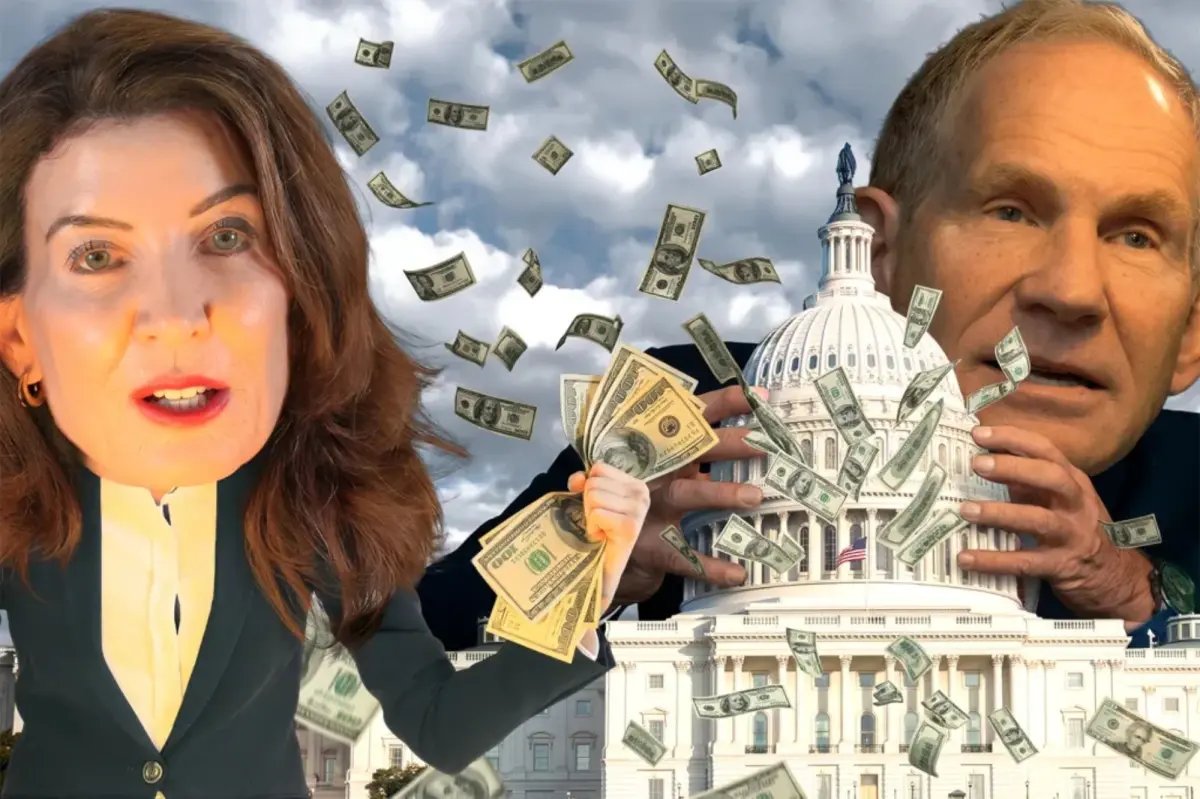


They’re itching to railroad the next Congress.
Gov. Kathy Hochul and her transit boss are licking their chops at the chance to squeeze more taxpayer dough out of Washington for the money-hungry MTA once Democrats take over Congress next year.
Metropolitan Transportation Authority Chairman Janno Lieber has been celebrating since Democrats’ blue wave midterm romp, even as his perpetually cash-strapped agency keeps hiking fares and fees — and stares down a projected $900 million budget hole by 2030.
Now he wants Uncle Sam to cover more MTA spending.
“It’s time to deal with the fact that New York historically has been radically shortchanged in money from Washington for transit,” Lieber said on NY1 Tuesday. “We’re 43% of all the nation’s mass transit riders in the country, we get 17% of the money. Time to fix that.”
Hochul and Lieber are hopeful more liberal leadership from New Yorkers Sen. Chuck Schumer and Rep. Hakeem Jeffries — likely to be the next Senate majority leader and House speaker, respectively — will redistribute the nation’s public transit money.
“This is a rare moment for transit when we have two leaders, both in the House and the Senate, who grew up riding the subway, who understand transit,” Lieber said.
He even dangled a sweetener, suggesting federal cash could replace some of the billions the state and city pour into the flailing transit system.
“Now we have the opportunity to replace some of all that effort that’s coming from the state and the city with federal money, which is overdue to New York, and that is a rare opportunity. We must take advantage of it,” he said.
An MTA spokesperson did not address an inquiry from The Post about which state and city contributions could be replaced, or by how much.
Though replacing state and city contributions does not necessarily put money back in New Yorkers’ pockets, cautioned Ana Champeny, vice president for research at the Citizens Budget Commission.
“Those funds would go back not to the taxpayers, but to the city and the state, who would then probably use them for something else,” she said.
Lieber’s desperation comes after Albany approved funding last year for the MTA’s $68.4 billion 2025-2029 capital plan, which already includes $14 billion in anticipated federal aid.
The agency’s operating budget this year topped a whopping $21.3 billion.
Hochul also wants to ride the blue wave to Washington’s wallet. She wants more federal funding for the Second Avenue Subway and the planned Interborough Express connecting Brooklyn and Queens, she said after an unrelated press conference Tuesday.
She also wants to keep New York’s pocketbook closed when it comes to Penn Station’s redevelopment.
“President Trump has already said he’ll pay for it. And sometimes I hear whispers looking to New York. I would keep looking at the federal government,” she said.
Hochul also pointed to New York’s expected clout in the incoming Congress, though the leadership positions aren’t locked in yet.
Jeffries faces a Democratic nominating vote next week and a full House vote for speaker in January, while Schumer’s leadership election is expected in December.
“We have a lot of influence for New York state with … the leaders we have returning to their positions,” she said at an unrelated press conference. “But it’s up to their members to make those decisions.”
Democratic control of Congress does improve the MTA’s prospects — but the agency still needs more than congressional allies to deliver, Champeny said.
“Ultimately it does depend on the House, the Senate, and the White House,” Champeny said. “There are challenges with the federal-MTA relationship.”
The MTA has clashed with the Trump administration over congestion pricing and Penn Station.
Meanwhile, the MTA has already laid out its Washington wish list in a policy brief titled “The MTA’s Emerging Federal Priorities.”
They want a bigger share of federal transit aid, which is distributed through a mix of formulas set by Congress — that weigh factors such as population, system mileage and passengers — and grants awarded for individual projects.
Champeny said the formulas are the easiest way for the MTA to secure more federal money since grants can be competitive.
The MTA also wants lawmakers to boost transit security grants and reject a Trump budget proposal to halve that program.
The agency is also seeking tariff exemptions for its train and bus purchases, warning the levies could add an estimated $1 billion to its fleet replacement costs.
