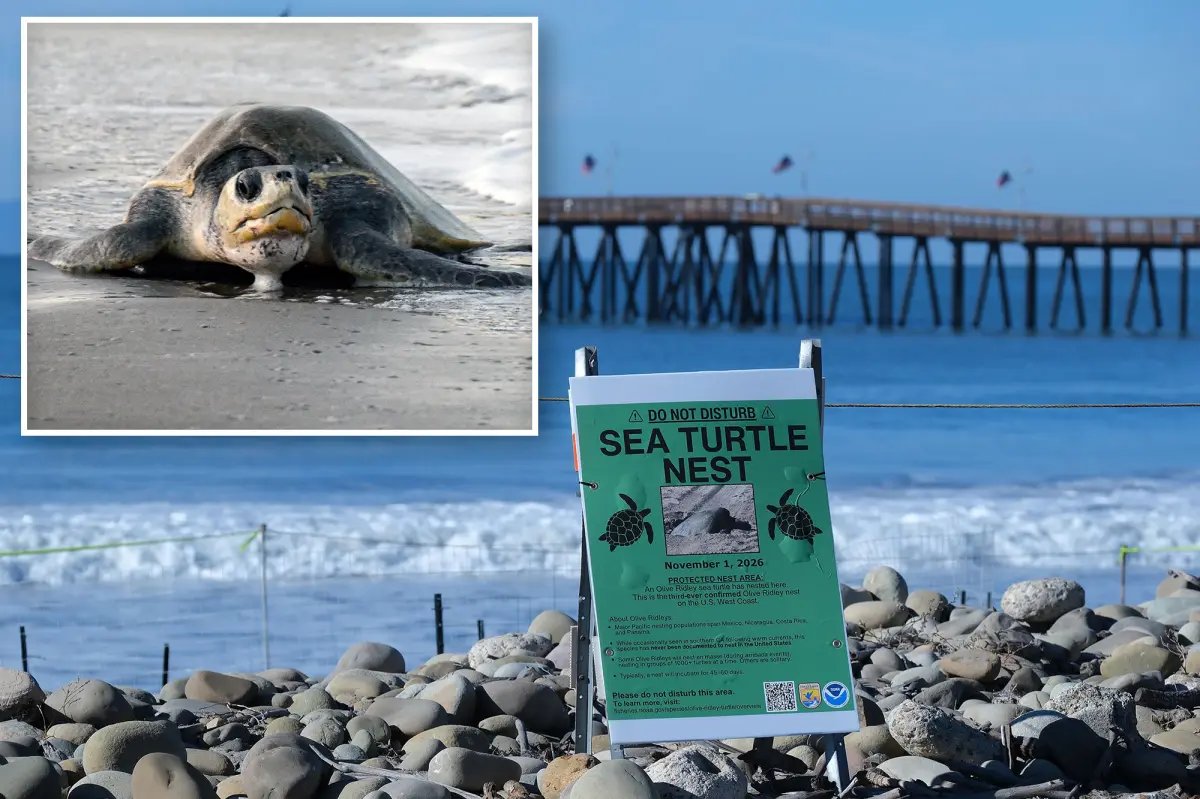


The future population of a rare sea turtle that laid eggs on a Southern California beach has taken a hit after storms destroyed dozens of eggs.
High swells and powerful tides decimated an olive ridley sea turtle nest at San Buenaventura State Beach in Ventura on Friday, a U.S. Fish and Wildlife Service spokesperson told The Post.
The wildlife service, along with California State Parks officials, transported 33 eggs to the Santa Barbara Zoo for examination.
However, the zoo’s Conservation & Science team determined that none of the eggs were viable, nor did they show “evidence of development,” the spokesperson told The Post.
Each of the 33 eggs was weighed, measured and “candled” — a process which involves shining a light through the eggshell to inspect its contents.
The team also used ultrasound technology on two of the eggs and performed necropsies on two other eggs, which is the animal equivalent of a human autopsy. The shell, yolk and albumen from the two necropsied eggs were preserved for future analysis, and the remaining eggs will be transferred to a designated repository for scientific evaluation.
Officials had warned the eggs were unlikely to hatch because Ventura’s sand was too cold for normal embryo development, with olive ridley sea turtles typically nesting much farther south along Mexico’s coast.
Temperatures around the nest ranged from 64.4 to 72.5 degrees Fahrenheit — significantly colder than the typical 77- to 95-degree range these turtles are accustomed to, according to the Ventura County Star.
While the U.S. Fish and Wildlife Service said it usually prefers limited interference with wildlife, which the spokesperson said is consistent with sea turtle conservation efforts across the United States, it made an exception in September when Hurricane Polo swells threatened the eggs.
Those eggs were relocated and successfully hatched at the Aquarium of the Pacific in Long Beach; however, officials say the circumstances in Ventura were different.
While the circumstances in Orange County allowed for relocation, “this was not the case for the Ventura nest because ocean temperatures are not expected to be warm enough for survival if hatching occurred in late December or January,” the spokesperson said.
The spokesperson described the situation in Orange County as “atypical,” and said the U.S. Fish and Wildlife Service will continue to individually assess each instance of sea turtle nesting in California going forward.
